

Wednesday, November 11, 2026
Science
No Result
View All Result
  • Login
  • HOME
  • SCIENCE NEWS
  • CONTACT US
  • HOME
  • SCIENCE NEWS
  • CONTACT US
No Result
View All Result
Scienmag
No Result
View All Result
Home Science News Agriculture

Drying Method Shapes Phenolic Retention in Cactus Cladodes

November 5, 2026
in Agriculture, Medicine
Alan Morgan
By Alan Morgan Scienmag Editorial Profile - Precision Agriculture
Reading Time: 2 mins read
0
Drying Method Shapes Phenolic Retention in Cactus Cladodes

Drying Method Shapes Phenolic Retention in Cactus Cladodes

65
SHARES
587
VIEWS
Share on FacebookShare on Twitter
ADVERTISEMENT

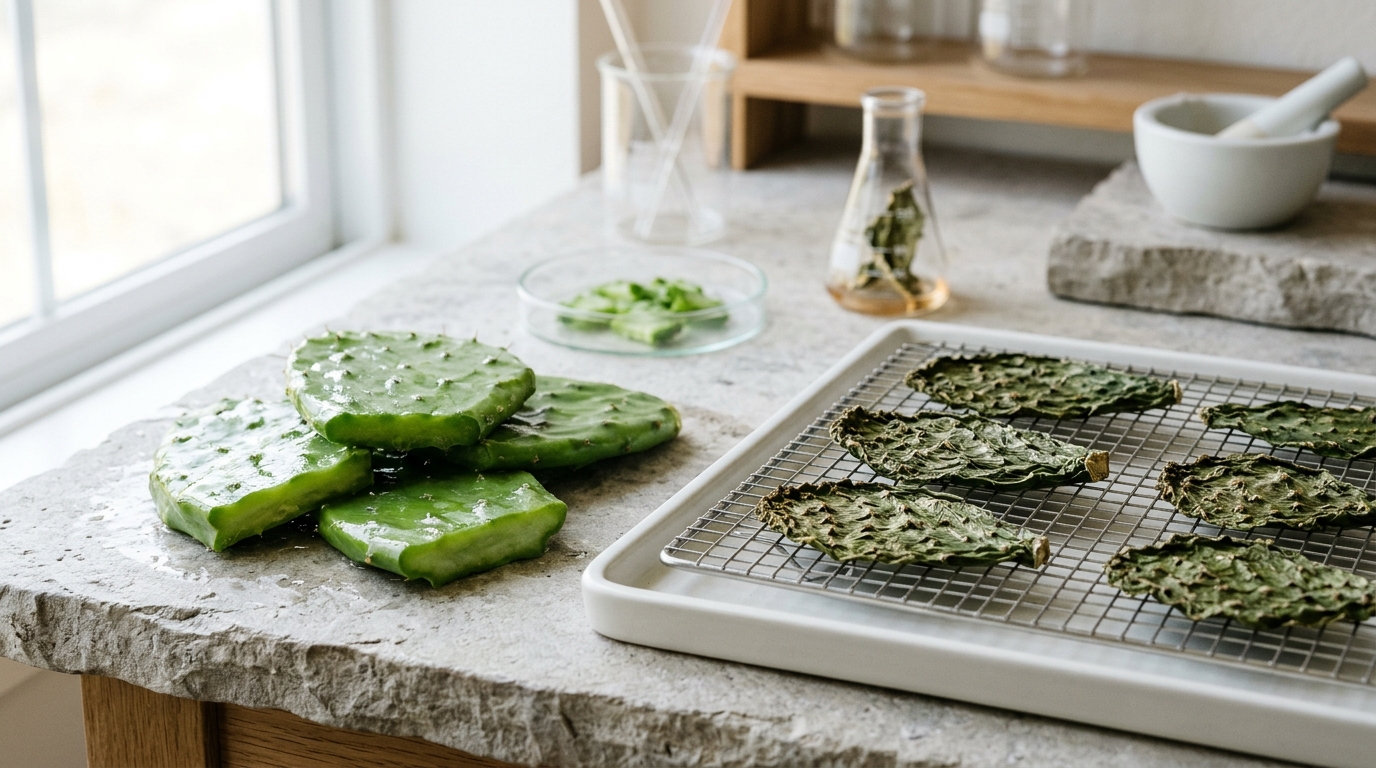
The research team collected wild cactus cladodes from a single field in Antalya, Turkey, in May, choosing medium-mature pads measuring 18 to 22 centimeters. After washing, cleaning, and removing spines, the cladodes were sliced to a uniform 5-millimeter thickness.

Convectional drying was carried out in a tray-type oven with forced-air circulation at an average airflow velocity of 0.83 meters per second, using temperatures of 50, 60, 70, and 80 degrees Celsius.

Color analysis using the CIE L*, a*, b* system revealed that total color difference from the fresh sample was highest in the ultrasound-pretreated vacuum-dried sample at 80 degrees, reaching a ΔE of 23.62. The lowest color changes appeared in microwave drying at 720 watts and convectional drying at 70 degrees.

Total phenolic content, measured by the Folin–Ciocalteu assay and expressed as milligrams of gallic acid equivalents per gram of dry matter, fell significantly after all drying processes. Fresh cladodes contained 8.85 mg GAE/g DM, while dried samples ranged from 2.16 to 5.30 mg GAE/g DM. Notably, ultrasound-pretreated vacuum drying at 60 and 70 degrees preserved more phenolics than convectional drying at the same temperatures, yielding 4.97 and 5.30 mg GAE/g DM respectively, compared with 2.75 and 3.11 mg GAE/g DM for convectional drying.

Microwave drying also outperformed convectional drying in phenolic retention, with samples dried at 720 watts reaching 4.41 mg GAE/g DM.

High-performance liquid chromatography identified nine phenolic components across the samples: eight phenolic acids—gallic, protocatechuic, syringic, ellagic, m-coumaric, caffeic, p-coumaric, and ferulic acids—and one flavonoid, chrysin. Ellagic acid dominated the fresh sample at 3.988 mg/g DM but dropped dramatically after drying, ranging from 0.150 to 0.595 mg/g DM, indicating its susceptibility to thermal and oxidative degradation.

Antioxidant capacity, measured by both DPPH and TEAC assays, decreased with drying regardless of technique, with fresh samples showing 17.42 and 54.26 μmol TE/g DM respectively. Dried samples ranged from 5.27 to 7.51 μmol TE/g DM by DPPH and 8.74 to 18.51 μmol TE/g DM by TEAC, but no significant differences emerged between drying methods or conditions.

Subject of Research: Effects of different drying methods on antioxidant compounds and physicochemical characteristics of cactus cladodes

Article Title: Valorization of Cactus Cladodes (Opuntia ficus indica): The Effects of Different Drying Methods on Antioxidant Compounds and Physicochemical Characteristics

Article References: Bağirsakci, Ş. G., Karacabey, E., & Karasu, S. (2026). Valorization of Cactus Cladodes ( Opuntia ficus indica ): The Effects of Different Drying Methods on Antioxidant Compounds and Physicochemical Characteristics. Food Science & Nutrition, 14(11), Article e72461. https://doi.org/10.1002/fsn3.72461

Image Credits: AI Generated

DOI: 10.1002/fsn3.72461

Keywords: cactus cladodes, Opuntia ficus indica, drying methods, antioxidant capacity, total phenolic content, ultrasound pretreatment, microwave drying, convectional drying, ascorbic acid, phenolic profile, food preservation, scanning electron microscopy

Cite Scienmag News

Alan Morgan. (November 5, 2026). Drying Method Shapes Phenolic Retention in Cactus Cladodes. Scienmag. https://scienmag.com/drying-method-shapes-phenolic-retention-in-cactus-cladodes/

Alan Morgan. "Drying Method Shapes Phenolic Retention in Cactus Cladodes." Scienmag, 5 November 2026, https://scienmag.com/drying-method-shapes-phenolic-retention-in-cactus-cladodes/. Accessed 11 November 2026.

Alan Morgan. "Drying Method Shapes Phenolic Retention in Cactus Cladodes." Scienmag. November 5, 2026. https://scienmag.com/drying-method-shapes-phenolic-retention-in-cactus-cladodes/

Tags: antioxidant capacityascorbic acidcactus cladodesconvectional dryingdrying methodsfood preservationmicrowave dryingOpuntia ficus-indicaphenolic profilescanning electron microscopytotal phenolic contentultrasound pretreatment
Share26Tweet16
Previous Post

Reinforcement learning tunes PID controllers to keep irrigation canals stable in drought

Next Post

Optimal Path Constraints Minimize Noise in Seismic Generalized Inversion Analysis

Related Posts

Chitosan and Carnauba Wax Coating Extends Cold-Stored Guava Shelf Life
Agriculture

Chitosan and Carnauba Wax Coating Extends Cold-Stored Guava Shelf Life

November 11, 2026
Intrabiliary Gelatin Sponge Slurry Controlled Acute Hemobilia in Preliminary Retrospective Study
Medicine

Intrabiliary Gelatin Sponge Slurry Controlled Acute Hemobilia in Preliminary Retrospective Study

November 11, 2026
CMR pulmonary artery peak velocity marks severe pulmonary hypertension in fibrotic ILD
Medicine

CMR pulmonary artery peak velocity marks severe pulmonary hypertension in fibrotic ILD

November 11, 2026
Childhood Trauma and Violence Linked to Higher Endometriosis Occurrence in Meta-Analysis
Medicine

Childhood Trauma and Violence Linked to Higher Endometriosis Occurrence in Meta-Analysis

November 11, 2026
Drought Intensifies Nutrient Imbalances in Major European Forest Trees
Agriculture

Drought Intensifies Nutrient Imbalances in Major European Forest Trees

November 11, 2026
Disaster Victim Identification Exposes Forensic Workers to Substantial Occupational Trauma Burden
Medicine

Disaster Victim Identification Exposes Forensic Workers to Substantial Occupational Trauma Burden

November 11, 2026
Next Post
Optimal Path Constraints Minimize Noise in Seismic Generalized Inversion Analysis

Optimal Path Constraints Minimize Noise in Seismic Generalized Inversion Analysis

  • Mothers who receive childcare support from maternal grandparents show more optimized

    Mothers who receive childcare support from maternal grandparents show more parental warmth, finds NTU Singapore study

    27656 shares
    Share 11059 Tweet 6912
  • University of Seville Breaks 120-Year-Old Mystery, Revises a Key Einstein Concept

    1061 shares
    Share 424 Tweet 265
  • Bee body mass, pathogens and local climate influence heat tolerance

    682 shares
    Share 273 Tweet 171
  • Researchers record first-ever images and data of a shark experiencing a boat strike

    546 shares
    Share 218 Tweet 137
  • Groundbreaking Clinical Trial Reveals Lubiprostone Enhances Kidney Function

    531 shares
    Share 212 Tweet 133
Science

Embark on a thrilling journey of discovery with Scienmag.com—your ultimate source for cutting-edge breakthroughs. Immerse yourself in a world where curiosity knows no limits and tomorrow’s possibilities become today’s reality!

RECENT NEWS

  • Chitosan and Carnauba Wax Coating Extends Cold-Stored Guava Shelf Life
  • Rock Dust and Organic Amendments Alter Early Soil Chemistry in Field Trial
  • Intrabiliary Gelatin Sponge Slurry Controlled Acute Hemobilia in Preliminary Retrospective Study
  • Eatwell Guidance Classifies 95 Percent of Processed UK Foods as Unhealthy

Categories

  • Agriculture
  • Anthropology
  • Archaeology
  • Athmospheric
  • Biology
  • Biotechnology
  • Blog
  • Bussines
  • Cancer
  • Chemistry
  • Climate
  • Earth Science
  • Editorial Policy
  • Marine
  • Mathematics
  • Medicine
  • Pediatry
  • Policy
  • Psychology & Psychiatry
  • Science Education
  • Science News
  • Social Science
  • Space
  • Technology and Engineering

Subscribe to Blog via Email

Enter your email address to subscribe to this blog and receive notifications of new posts by email.

Join 5,150 other subscribers

© 2026 Scienmag - Science Magazine

Welcome Back!

Login to your account below

Forgotten Password?

Retrieve your password

Please enter your username or email address to reset your password.

Log In
No Result
View All Result
  • HOME
  • SCIENCE NEWS
  • CONTACT US

© 2026 Scienmag - Science Magazine

Discover more from Science

Subscribe now to keep reading and get access to the full archive.

Continue reading

