


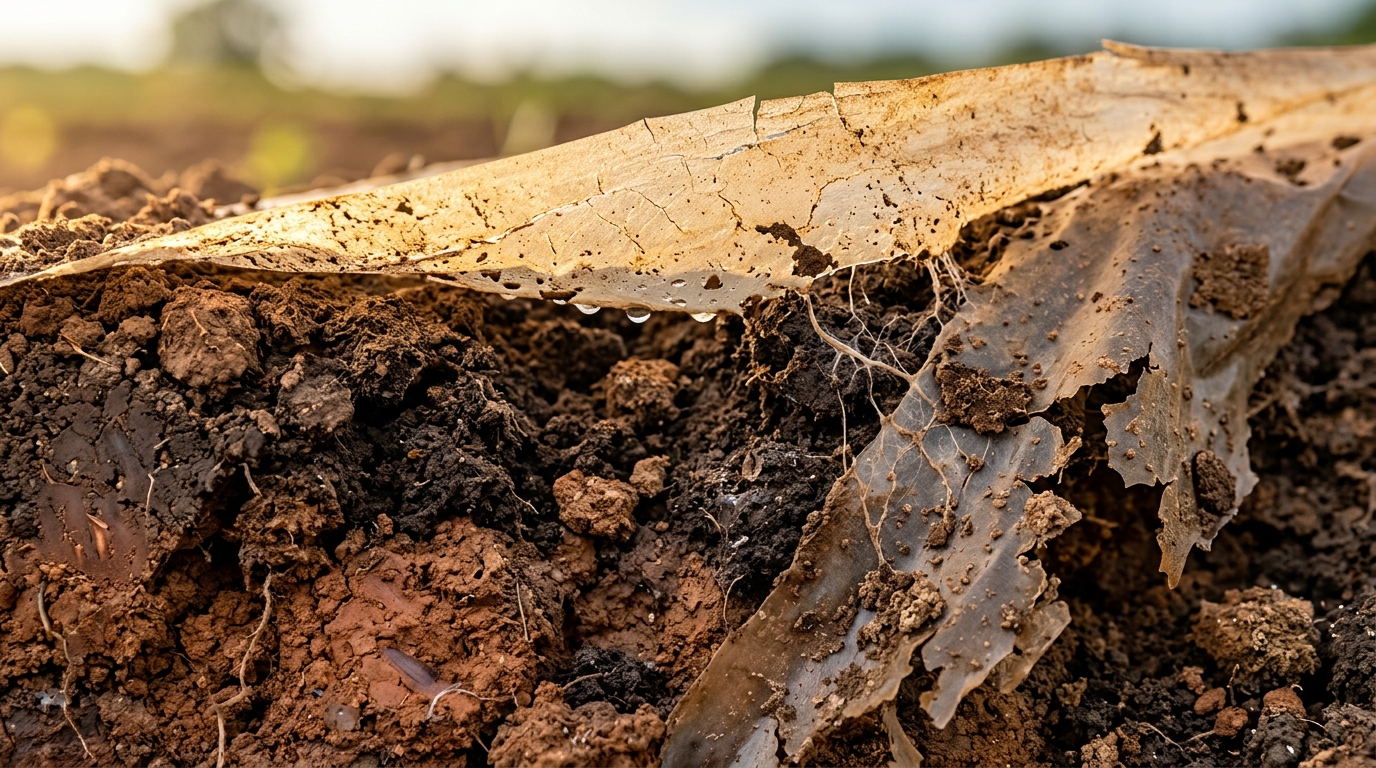
Biodegradable plastic mulch films have become a popular alternative to conventional plastic in agriculture because they retain soil moisture, suppress weeds and improve crop productivity. Yet whether these materials truly break down safely once they enter the soil has remained uncertain. A new study published in the journal New Contaminants shows that the answer depends heavily on the surrounding environment: naturally occurring clay minerals, ultraviolet radiation and burial depth interact to determine how quickly and how completely these plastics degrade.
The research, led by scientists at Shenyang Agricultural University, focused on two of the most widely used biodegradable polymers in agricultural films: poly(butylene adipate-co-terephthalate), known as PBAT, and polylactic acid, or PLA. The team examined how different clay minerals and soil environments affected the physical and chemical transformations of these polymers, aiming to understand the environmental fate of mulch films after use.
“Biodegradable plastics are often considered a sustainable solution to agricultural plastic pollution, but their environmental behavior is far more complex than simply disappearing into the soil,” said Wei Liu, the corresponding author of the study. “Our findings highlight how natural soil components can actively influence plastic degradation and why understanding these interactions is essential for evaluating environmental safety.”
To investigate these processes, the researchers exposed PBAT and PLA films to controlled ultraviolet radiation in the presence of two common clay minerals, kaolinite and montmorillonite. They also compared degradation at the soil surface with degradation at a burial depth of 10 centimeters over a period of 60 days. This experimental design allowed the team to separate the effects of light, mineral contact and soil position on polymer aging.
The results revealed three key findings. First, PBAT degraded more readily than PLA under the experimental conditions. Its comprehensive aging index reached 24.02, nearly twice the value recorded for PLA, which was 12.98. This indicates that the two biodegradable materials respond very differently to environmental stress, meaning that a single label of “biodegradable” does not describe uniform behavior across polymer types.
Second, kaolinite accelerated UV-induced degradation more effectively than montmorillonite. Under UV exposure, PBAT films in the kaolinite treatment lost approximately 10.69 percent of their weight, compared with 4.84 percent under UV exposure without clay minerals. Kaolinite also promoted greater degradation of PLA. The reason lies in the mineral’s optical and electronic properties: kaolinite absorbed light more effectively and facilitated electron transfer, generating higher levels of reactive oxygen species. These highly reactive molecules, particularly hydroxyl radicals, attacked the polymer chains and accelerated their breakdown.
Third, and perhaps most surprising, plastic films buried 10 centimeters below the soil surface showed more pronounced degradation than films placed on the surface. Although UV radiation could barely penetrate to that depth, soil moisture and interactions with minerals promoted chemical reactions that contributed to polymer aging. This finding challenges the assumption that buried plastics are protected from degradation simply because they are shielded from sunlight.
Advanced chemical analysis showed that degradation involved the breaking of ester bonds and oxidation reactions, producing smaller molecules such as organic acids, alcohols and polymer fragments. However, faster degradation does not necessarily mean complete environmental safety. The researchers also identified the release of chemical additives, including antioxidants, stabilizers and plasticizers, and some transformation products showed potential ecological toxicity in computational assessments, underscoring the need for further investigation.
“Understanding how biodegradable plastics interact with soil minerals can help us better predict their environmental fate and guide the development of safer agricultural materials,” Liu added. The study provides valuable insights for designing environmentally responsible agricultural materials and for improving assessments of biodegradable plastics in farmland settings.
The researchers emphasize that further field studies are needed to examine long-term degradation, chemical migration and ecological risks under natural agricultural conditions. Ultimately, the findings demonstrate that the environmental performance of biodegradable plastics depends not only on the materials themselves but also on the complex soil environments in which they are used.
Subject of Research: How clay minerals, UV radiation and soil burial depth influence the degradation of biodegradable plastic mulch films in agricultural soil
Article Title: Hidden forces in soil: Scientists reveal what really drives biodegradable plastic mulch breakdown
Article References: Hidden forces in soil: Scientists reveal what really drives biodegradable plastic mulch breakdown. Original publication (Bibliographic details unavailable.)
Image Credits: AI Generated
DOI: Not provided
Keywords: biodegradable plastics, mulch films, PBAT, PLA, clay minerals, kaolinite, montmorillonite, UV radiation, soil degradation, reactive oxygen species, agriculture, New Contaminants
Cite Scienmag News
Alan Morgan. (November 4, 2026). Clay minerals, UV light and burial depth drive breakdown of biodegradable mulch films. Scienmag. https://scienmag.com/clay-minerals-uv-light-and-burial-depth-drive-breakdown-of-biodegradable-mulch-films/
Alan Morgan. "Clay minerals, UV light and burial depth drive breakdown of biodegradable mulch films." Scienmag, 4 November 2026, https://scienmag.com/clay-minerals-uv-light-and-burial-depth-drive-breakdown-of-biodegradable-mulch-films/. Accessed 23 November 2026.
Alan Morgan. "Clay minerals, UV light and burial depth drive breakdown of biodegradable mulch films." Scienmag. November 4, 2026. https://scienmag.com/clay-minerals-uv-light-and-burial-depth-drive-breakdown-of-biodegradable-mulch-films/




