


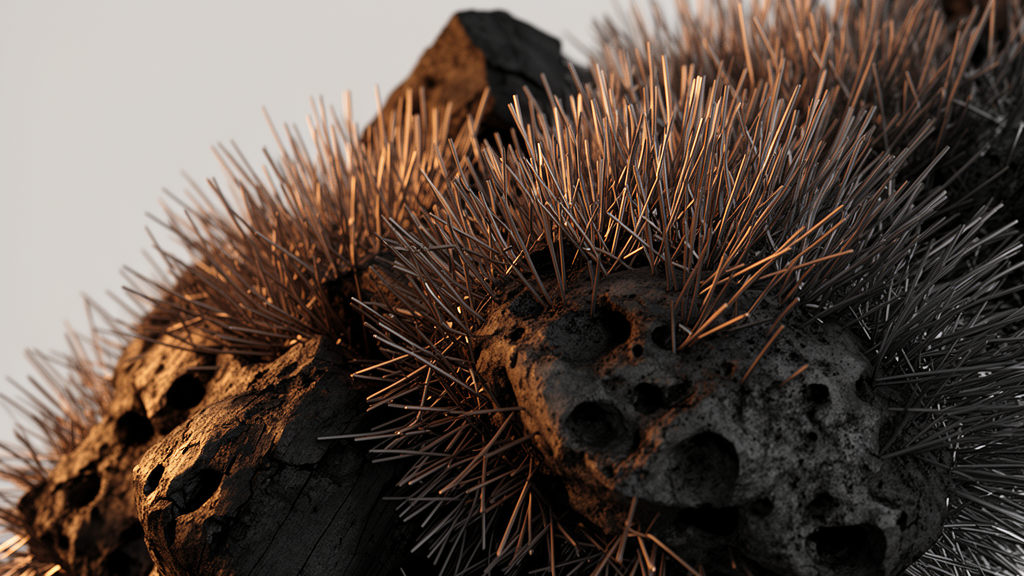
Researchers have combined one-dimensional α-MnO2 nanoneedles with a porous, defect-enriched biochar scaffold to create a supercapacitor electrode composite that markedly outperforms either component on its own. The nanocomposite, described in the Journal of Materials Science, was synthesized through a hydrothermal strategy followed by thermal treatment, embedding crystalline α-MnO2 uniformly on a conductive carbon framework derived from biomass.
The motivation lies in a well-known limitation of transition-metal-oxide electrodes: although metal oxides such as MnO2 offer high pseudocapacitive charge storage through fast surface redox reactions, their poor electrical conductivity and weak rate performance restrict practical use. Pairing the redox-active oxide with a conductive biomass-derived carbon is presented in the study as an effective route around this bottleneck.
Structural and spectroscopic analyses confirmed that crystalline α-MnO2 was successfully anchored on the porous biochar framework, which contains abundant defect sites and hierarchical mesoporosity. The composite achieved a high specific surface area of approximately 800 square meters per gram, a feature the authors link to enhanced electrolyte accessibility and rapid ion-transport pathways through the electrode.
Electrochemical measurements showed substantially improved charge-storage behavior relative to pristine α-MnO2 and pristine biochar electrodes. Compared with the individual components, the nanocomposite displayed an enlarged cyclic voltammetry response, longer galvanostatic discharge duration, reduced interfacial resistance, and favorable rate capability, indicating that electrons and ions can move through the hybrid structure more efficiently than through either material alone.
Kinetic analysis added quantitative detail to this picture. The composite exhibited mixed charge-storage behavior dominated by surface-controlled pseudocapacitance, with a b-value of roughly 0.80, a signature indicating that capacitive processes contribute substantially to the current response. Dunn’s model further indicated that the capacitive contribution to charge storage rose from about 58 percent to about 85 percent as the scan rate increased, meaning that at faster charging rates the storage remains dominated by fast, surface-level processes rather than slower diffusion-limited insertion.
The authors attribute the enhanced response to a synergistic interaction between the redox-active α-MnO2 nanoneedles and the conductive, defect-rich biochar scaffold. According to the study, this combination accelerates electron transport, shortens ion diffusion pathways, and improves the accessibility of electroactive sites, allowing the two materials to compensate for one another’s weaknesses.
Because the carbon component is derived from biomass, the approach also carries a sustainability dimension, aligning electrode design with abundant, renewable carbon precursors. The findings highlight the potential of sustainable carbon–metal oxide hybrid architectures for next-generation high-performance supercapacitor systems, though the reported results come from laboratory electrochemical measurements on synthesized electrode materials, and the abstract does not report device-level cycling stability or full-cell performance data.
Subject of Research: A biochar-supported α-MnO2 nanoneedle nanocomposite for high-performance supercapacitor electrodes
Article Title: One-dimensional α-MnO2-decorated porous defect-enriched biochar nanocomposite for sustainable supercapacitor applications
Article References: Dubey, M., & Kuchhal, P. (2026). One-dimensional α-MnO2-decorated porous defect-enriched biochar nanocomposite for sustainable supercapacitor applications. Journal of Materials Science. https://doi.org/10.1007/s10853-026-13959-3
Image Credits: AI Generated
DOI: 10.1007/s10853-026-13959-3
Keywords: supercapacitors, α-MnO2, biochar, nanocomposite, pseudocapacitance, energy storage, hydrothermal synthesis, electrodes, biomass-derived carbon, Dunn's model, One-dimensional, MnO2-decorated
Cite Scienmag News
Denise Maddox. (October 30, 2026). MnO2 Nanoneedles on Defect-Rich Biochar Boost Supercapacitor Performance. Scienmag. https://scienmag.com/mno2-nanoneedles-on-defect-rich-biochar-boost-supercapacitor-performance/
Denise Maddox. "MnO2 Nanoneedles on Defect-Rich Biochar Boost Supercapacitor Performance." Scienmag, 30 October 2026, https://scienmag.com/mno2-nanoneedles-on-defect-rich-biochar-boost-supercapacitor-performance/. Accessed 30 October 2026.
Denise Maddox. "MnO2 Nanoneedles on Defect-Rich Biochar Boost Supercapacitor Performance." Scienmag. October 30, 2026. https://scienmag.com/mno2-nanoneedles-on-defect-rich-biochar-boost-supercapacitor-performance/









