


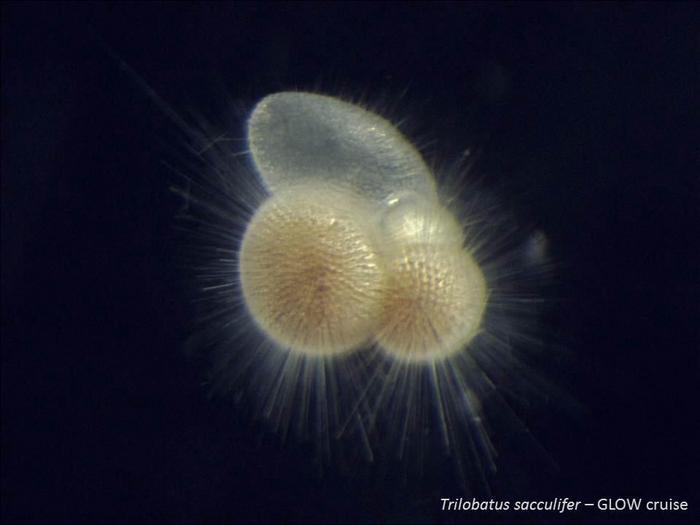
Marine communities migrated to Antarctica during the Earth’s warmest period in 66 million years long before a mass-extinction event.

Credit: Tracy Aze
Marine communities migrated to Antarctica during the Earth’s warmest period in 66 million years long before a mass-extinction event.
All but the most specialist sea plankton moved to higher latitudes during the Early Eocene Climatic Optimum, an interval of sustained high global temperatures equivalent to worst case global warming scenarios.
When the team, comprised of researchers from the University of Bristol, Harvard University, University of Texas Institute for Geophysics and the University of Victoria, compared biodiversity and global community structure, they found that the community often responds to climate change millions of years before losses of biodiversity.
The study, published today in Nature, suggests that plankton migrated to cooler regions to escape the tropical heat and that only the most highly specialised species were able to remain.
These findings imply that changes on the community scale will be evident long before extinctions in the modern world and that more effort must be placed on monitoring the structure of marine communities to potentially predict future marine extinctions.
Dr Adam Woodhouse from the University of Bristol’s School of Earth Sciences, explained: “Considering three billion people live in the tropics, this is not great news.
“We knew that biodiversity amongst marine plankton groups has changed throughout the last 66 million years, but no one had ever explored it on a global, spatial, scale through the lens of a single database.
“We used the Triton dataset, that I created during my PhD, which offered new insights into how biodiversity responds spatially to global changes in climate, especially during intervals of global warmth which are relevant to future warming projections.”
Dr Woodhouse teamed up with Dr Anshuman Swain, an ecologist and specialist in the application of networks to biological data. They applied networks to micropalaeontology for the first time ever to document the global spatial changes in community structure as climate has evolved over the Cenozoic, building on previous research on cooling restructured global marine plankton communities.
Dr Woodhouse continued: “The fossil record of marine plankton is the most complete and extensive archive of ancient biological changes available to science. By applying advanced computational analyses to this archive we were able to detail global community structure of the oceans since the death of the dinosaurs, revealing that community change often precedes the extinction of organisms.
“This exciting result suggests that monitoring of ocean community structure may represent an ‘early warning system’ which precedes the extinction of oceanic life.”
Now the team plan to apply similar methods to other marine plankton groups. This study has only worked on the planktonic foraminifera, however there are many other microfossil groups which have important roles in marine food webs which need to be studied. They also need to use the patterns they’ve observed in the past and present to model future community structure using new climate models.
Paper:
‘Biogeographic responses in marine plankton functional groups to Cenozoic climatic and environmental changes’ by Anshuman Swain, Adam Woodhouse, William F. Fagan, Andrew J. Fraass, and Christopher M. Lowery in Nature.
Journal
Nature
Method of Research
Computational simulation/modeling
Subject of Research
Animals
Article Title
Biogeographic responses in marine plankton functional groups to Cenozoic climatic and environmental changes’
Article Publication Date
17-Apr-2024
Cite Scienmag News
Violet Maxwell. (April 17, 2024). Marine plankton behaviour could predict future marine extinctions, study finds. Scienmag. https://scienmag.com/marine-plankton-behaviour-could-predict-future-marine-extinctions-study-finds/
Violet Maxwell. "Marine plankton behaviour could predict future marine extinctions, study finds." Scienmag, 17 April 2024, https://scienmag.com/marine-plankton-behaviour-could-predict-future-marine-extinctions-study-finds/. Accessed 4 September 2026.
Violet Maxwell. "Marine plankton behaviour could predict future marine extinctions, study finds." Scienmag. April 17, 2024. https://scienmag.com/marine-plankton-behaviour-could-predict-future-marine-extinctions-study-finds/

