


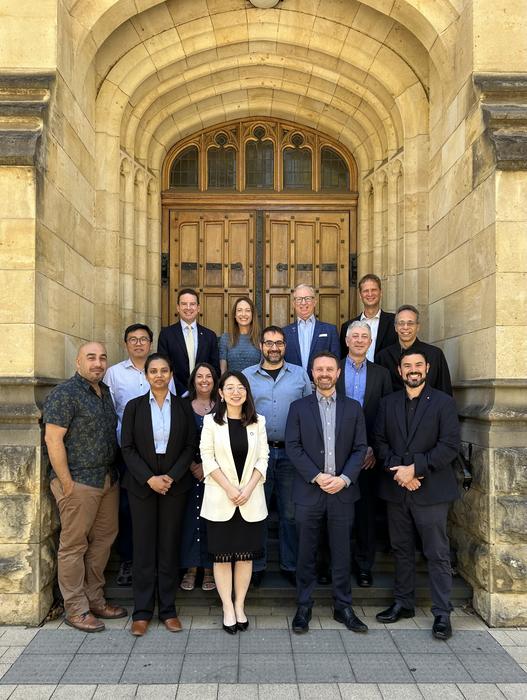
In an era where the convergence of technology and scientific inquiry is accelerating at an unprecedented pace, universities are pioneering collaborative efforts to harness artificial intelligence (AI) for transformative breakthroughs. The University of Adelaide in Australia and the University of Surrey in the United Kingdom have embarked on an ambitious partnership designed to propel innovative research across multiple scientific domains, including AI, sustainability, space exploration, and cybersecurity. This international alliance has unveiled a new phase characterized by a joint seed-fund supporting eight cutting-edge projects, each co-led by researchers from both institutions. This strategic initiative not only fortifies transcontinental academic ties but also establishes a fertile ground for groundbreaking innovations that resonate throughout the global scientific community.
AI’s impact on environmental sciences emerges as a prominent theme within this pioneering partnership. Researchers focus on developing AI-powered methodologies aimed at monitoring and reversing damage to marine ecosystems. The intricate dynamics of marine biology, characterized by complex interactions among species and environmental variables, traditionally present challenges for conventional monitoring techniques. Through advanced machine learning algorithms and high-resolution sensing technologies, the collaborative teams are designing systems capable of real-time environmental analysis and adaptive restoration strategies. These approaches leverage large-scale data integration, encompassing satellite imagery, sensor networks, and oceanographic models to build comprehensive and predictive frameworks for marine conservation.
Simultaneously, the interdisciplinary research endeavors are pushing frontiers in healthcare, particularly women’s health. One of the focal points is the application of AI to improve the diagnosis and management of gynecological conditions such as endometriosis — a chronic disorder affecting millions worldwide. Endometriosis diagnosis has traditionally been hindered by its heterogeneity and symptom overlap with other disorders. Machine learning models, trained on diverse biomedical datasets incorporating genomics, imaging, and clinical parameters, can identify nuanced patterns invisible to human observers. This AI-driven precision medicine approach aspires to enable earlier detection, tailored treatment pathways, and ultimately improved patient outcomes, illustrating the profound societal implications AI holds beyond pure technological applications.
The partnership leverages distinct institutional strengths. The University of Surrey stands at the vanguard of people-centered AI development through its Surrey Institute for People-Centred AI, where ethical and human-centric paradigms are embedded into algorithmic design. Concurrently, Surrey’s Institute for Sustainability and its renowned Space Centre provide expertise in environmental stewardship and space technology. Cybersecurity forms another pillar, with the Surrey Centre for Cyber Security advancing research on safeguarding digital infrastructures. Complementing these capabilities, the University of Adelaide brings to the table its Australian Institute for Machine Learning — a global leader in autonomous systems and computational intelligence — alongside its Environment Institute and the Institute for Sustainability, Energy and Resources. These combined proficiencies allow for a holistic approach where AI intertwines with pressing challenges in sustainability, space sciences, and secure digital landscapes.
A notable research thread concerns the ethical and academic dimensions of AI proliferation. As cutting-edge AI models become increasingly accessible, questions of academic integrity and authentic authorship arise. The collaborative teams are investigating frameworks and tools that uphold originality and trustworthiness in scholarly output. This includes developing AI-detection techniques, provenance tracking mechanisms, and policies to navigate the evolving terrain of AI-assisted research and publishing. In doing so, the partnership not only addresses technological innovation but also the societal and ethical matrices surrounding AI’s integration into the fabric of knowledge creation.
Complementing terrestrial AI applications, the alliance delves into advanced telecommunications, particularly space-based systems. Researchers are exploring terahertz (THz) technology, which operates at extremely high frequencies beyond conventional microwave and radio bands, to push the envelope of satellite communications. THz waves offer substantial bandwidth advantages, enabling faster data transmission and lower latency—critical for the coming era of ubiquitous connectivity and space-based internet infrastructure. This research involves intricate engineering challenges, such as atmospheric attenuation, antenna design, and power efficiency, demanding collaborative efforts that span materials science, signal processing, and space engineering to realize operational next-generation satellite networks.
The partnership’s inception in 2022 has since blossomed through continuous intellectual exchange and shared strategic vision. In March 2025, a delegation from the University of Surrey conducted an extensive visit to Adelaide, engaging with local experts, exchanging ideas, and deepening collaborative bonds. These interactions are part of a broader program encompassing interdisciplinary roundtables, student mobility initiatives, and the joint development of industry-aligned short courses in AI, cybersecurity, and space technologies. Such initiatives not only enhance academic synergies but also cultivate a pipeline of well-equipped professionals capable of driving future technological ecosystems.
Patrick Degg, Vice-President of Global at the University of Surrey, emphasizes the forward-looking nature of this alliance, highlighting how rapid global change necessitates proactive academic partnerships. He underscored the commitment to harness AI not merely for economic gain but to serve human and planetary well-being. This ethos encapsulates the philosophy behind the joint seed-fund: enabling visionary research that transcends conventional disciplinary boundaries and contributes to sustainable and equitable technological progress.
Professor Jessica Gallagher, University of Adelaide’s Deputy Vice-Chancellor for External Engagement, reflects on how this collaboration fosters unique opportunities for researchers around the globe. By bridging geographical and intellectual divides, the partnership engenders shared perspectives and co-created knowledge essential to tackling multifaceted global challenges. The commitment to interdisciplinary and cross-cultural collaboration ensures that innovations emerging from this alliance are responsive to diverse societal needs and sustainable futures.
Together, the universities are charting novel pathways where AI becomes integral to understanding and solving some of the most pressing issues of our time—from environmental restoration and healthcare innovation to ethical scholarship and next-gen communications infrastructure. Their joint projects epitomize the potential for academic partnerships to spur transformative science that is deeply attuned to people and the planet. As this partnership matures, the research outcomes are poised to catalyst profound scientific advancements, tangible societal benefits, and strategic leadership in the global knowledge economy.
In conclusion, the evolving University of Surrey–University of Adelaide collaboration exemplifies a model for international, interdisciplinary engagement in the 21st century. By strategically investing in research across AI, sustainability, space, and cybersecurity, these institutions are not only generating critical scientific insights but also advancing frameworks for ethical, responsible, and impactful innovation. This partnership highlights the indispensable role of universities in shaping technologies that benefit humanity and reinforce our stewardship of the Earth and beyond.
Cite Scienmag News
Hailey Crawford. (April 15, 2025). UK–Australia Research Alliance Poised to Fast-Track Advances in Space, AI, and Cybersecurity. Scienmag. https://scienmag.com/uk-australia-research-alliance-poised-to-fast-track-advances-in-space-ai-and-cybersecurity/
Hailey Crawford. "UK–Australia Research Alliance Poised to Fast-Track Advances in Space, AI, and Cybersecurity." Scienmag, 15 April 2025, https://scienmag.com/uk-australia-research-alliance-poised-to-fast-track-advances-in-space-ai-and-cybersecurity/. Accessed 4 September 2026.
Hailey Crawford. "UK–Australia Research Alliance Poised to Fast-Track Advances in Space, AI, and Cybersecurity." Scienmag. April 15, 2025. https://scienmag.com/uk-australia-research-alliance-poised-to-fast-track-advances-in-space-ai-and-cybersecurity/


