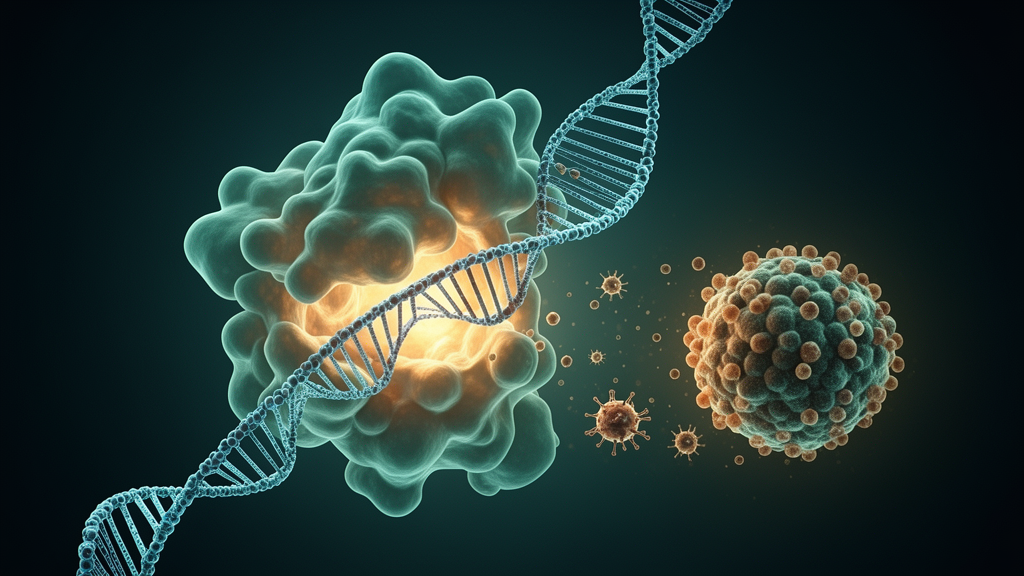
A single RNA chemical tag may help breast cancer cells grow, invade and slip past the immune system, according to a new laboratory study published in the journal Cell Division. Researchers report that an enzyme called NSUN2 installs a methyl mark known as 5-methylcytosine, or m5C, on the messenger RNA of a gene called PARP9, and that this mark, once recognized by a reader protein named YBX1, keeps the PARP9 transcript stable and its protein levels high. When the team silenced NSUN2 in breast cancer cells, PARP9 mRNA decayed faster, PARP9 protein dropped, and the cells became less proliferative, less invasive, less angiogenic, less stem-like and less able to evade immune attack. The work, led by Xin Li and Changjiao Yan of the First Affiliated Hospital of the Air Force Medical University in Xi’an, China, together with colleagues, was published on 19 July 2026 as an open-access research article.
The study set out to clarify how NSUN2, one of the best-studied writers of the m5C RNA modification, influences breast cancer progression. m5C is a ubiquitous RNA modification that participates in RNA metabolic regulation and has been implicated in the occurrence of various tumors. Methyltransferases such as NSUN2 catalyze the addition of m5C to target RNAs, while reader proteins such as YBX1 recognize the modified transcripts and influence their stability, translation and degradation. Prior work had established NSUN2/YBX1-mediated m5C regulation of transcripts such as HGH1 in breast cancer and SKIL in colorectal cancer, but the precise impact of NSUN2-mediated m5C modification on breast cancer, and any connection to PARP9, had not been reported.
To identify candidate downstream targets, the researchers first analyzed a public gene expression dataset, GSE95299, comparing YBX1-overexpressing MCF-7 breast cancer cells with vector controls. That analysis showed PARP9 was significantly upregulated when YBX1 was overexpressed, with a log2 fold change of 4.03 and an adjusted P value below 0.0001 under Benjamini-Hochberg correction. The team then examined PARP9 expression in breast cancer using the TCGA and GEPIA databases, both of which showed PARP9 significantly upregulated in tumor tissues compared with normal breast tissues. In a collected cohort of 35 patients with pathologically confirmed breast cancer who underwent surgery at Xijing Hospital between January 2019 and December 2021, PARP9 mRNA and protein levels were elevated in tumor tissues relative to adjacent non-tumor tissues. PARP9 protein was also higher in the BT-549, MDA-MB-231 and MCF-7 cancer cell lines than in the non-tumorigenic MCF-10A breast epithelial line.
Experimentally, the researchers transfected small interfering RNAs against PARP9 into MDA-MB-231 and MCF-7 cells and measured a battery of malignant behaviors. EdU assays showed that PARP9 knockdown repressed cell proliferation, while flow cytometry showed it promoted apoptosis. Transwell assays indicated that PARP9 deficiency markedly restrained invasion, and tube formation assays suggested that PARP9 silencing repressed angiogenesis, the process by which tumors coax new blood vessels. Sphere formation assays, which gauge stemness, showed that the sphere-forming ability of both cell lines was suppressed by PARP9 knockdown. The effects on proliferation, apoptosis, invasion and immune escape were restored when the researchers transfected a PARP9 overexpression vector back into the cells, supporting the specificity of the knockdown phenotype.
The immune findings drew on a co-culture system in which peripheral blood mononuclear cells from healthy donors, activated with a T-cell stimulant, were mixed with the transfected breast cancer cells. After PARP9 knockdown, the researchers measured increased concentrations of the inflammatory signaling proteins TNF-α and IFN-γ in the co-culture medium by ELISA, and flow cytometry showed that apoptosis of CD8-positive T cells was restrained. Because reduced TNF-α and IFN-γ and heightened CD8 T-cell death are markers of tumor immune evasion, the authors interpreted these results as evidence that PARP9 silencing reduced the immune escape of breast cancer cells in this in vitro setting.
The mechanistic core of the paper concerns how PARP9 itself is regulated. A database called RMDisease V2.0 indicated that PARP9 contains m5C modification sites, and TCGA data showed NSUN2 expression elevated in breast cancer. In the 35-patient tissue cohort, NSUN2 mRNA was higher in tumors than in normal tissues and was positively correlated with PARP9 mRNA, as assessed by Spearman’s correlation. When the team knocked down NSUN2 in MDA-MB-231 and MCF-7 cells, m5C enrichment decreased, PARP9 mRNA and protein levels fell, and methylated RNA immunoprecipitation assays showed reduced m5C modification of PARP9. An RNA pull-down assay verified the physical interaction between NSUN2 and PARP9 mRNA. After treatment with actinomycin D, a drug that blocks new transcription, NSUN2 knockdown weakened PARP9 mRNA stability, indicating that the methyltransferase helps keep the transcript intact.
YBX1 entered the picture as the reader of that mark. The RBPmap database predicted that YBX1 could bind PARP9, and silencing YBX1 decreased PARP9 mRNA and protein in both cell lines. Critically, RNA immunoprecipitation showed that NSUN2 knockdown reduced the enrichment of PARP9 RNA bound to YBX1, which the authors interpret to mean that NSUN2-mediated m5C modification on PARP9 mRNA is required for efficient recognition and binding by YBX1. An actinomycin D assay further showed that YBX1 knockdown reduced the stability of PARP9 mRNA. In the authors’ model, NSUN2 functions as an m5C writer that catalyzes the modification of PARP9 mRNA, while YBX1 acts as an m5C reader that recognizes the modified transcript and enhances its stability, thereby elevating PARP9 expression in breast cancer cells.
To test whether PARP9 lies downstream of NSUN2 functionally, the researchers overexpressed PARP9 in cells in which NSUN2 had been silenced. PARP9 overexpression restored the proliferation that NSUN2 knockdown had suppressed, reversed the apoptosis that NSUN2 loss had promoted, and abated the inhibitory effects of NSUN2 deficiency on invasion, angiogenesis and stemness in MDA-MB-231 and MCF-7 cells. In the immune co-culture, the increases in TNF-α and IFN-γ and the suppression of CD8 T-cell apoptosis seen after NSUN2 knockdown were weakened when PARP9 was overexpressed. Taken together, the authors concluded that NSUN2 silencing regulates PARP9 expression to influence breast cancer progression and immune escape in vitro.
The team also examined tumor growth in living animals. They transduced MCF-7 cells with lentiviral particles carrying a short hairpin RNA against NSUN2, a control hairpin, or NSUN2 knockdown plus PARP9 overexpression, and injected the stable cells subcutaneously into the right flank of female BALB/c nude mice, five animals per group. Tumor volume, monitored from the ninth day every five days, and tumor weight at day 29 were reduced in the sh-NSUN2 group, but these effects were ameliorated in the group that also carried the PARP9 overexpression vector. Western blotting confirmed NSUN2 was downregulated in the sh-NSUN2 tumors, and western blot and immunohistochemistry showed that PARP9 and the proliferation marker Ki-67 were reduced in sh-NSUN2 tumors but recovered when PARP9 was overexpressed. The authors concluded that NSUN2 mediated PARP9 expression to alter tumorigenesis in vivo.
The study has acknowledged limitations. The authors note that they did not conduct an experiment to verify the direct binding relationship between YBX1 and the predicted PARP9 m5C sites, and they propose ultraviolet cross-linking and immunoprecipitation or electrophoretic mobility shift analysis to confirm that interaction in future work. They also describe the in vivo rescue experiment as largely phenotypic, without deeper mechanistic validation or functional endpoints beyond tumor volume and weight. The cell-line findings rest on MDA-MB-231 and MCF-7 models, and the xenograft work used immunodeficient nude mice, which cannot fully recapitulate an intact human immune system. Even so, the authors state that this is, to their knowledge, the first study to link PARP9 expression with RNA m5C modification, and they present the NSUN2/YBX1/PARP9 axis as a newly described regulatory pathway that may offer a fresh perspective for breast cancer therapy research.
Subject of Research: The role of NSUN2-mediated m5C modification of PARP9 mRNA in breast cancer progression and immune escape
Article Title: NSUN2 regulates PARP9 progression through m5C modification to mediate breast cancer progression
Article References: Li, X., Yan, C., Yi, J., Yun, J., Cui, F., Xu, X., Li, Y., & Xu, X. (2026). NSUN2 regulates PARP9 progression through m5C modification to mediate breast cancer progression. Cell Division, 21(1), Article 20. https://doi.org/10.1186/s13008-026-00192-2
Image Credits: AI Generated
DOI: 10.1186/s13008-026-00192-2
Keywords: breast cancer, NSUN2, PARP9, YBX1, m5C RNA modification, RNA methyltransferase, mRNA stability, immune escape, xenograft model, RNA epigenetics, tumor progression, Cell Division journal
Cite Scienmag News
Nathaniel Bowman. (October 28, 2026). RNA methyltransferase NSUN2 stabilizes PARP9 transcript to drive breast cancer growth and immune escape, study finds. Scienmag. https://scienmag.com/rna-methyltransferase-nsun2-stabilizes-parp9-transcript-to-drive-breast-cancer-growth-and-immune-escape-study-finds/
Nathaniel Bowman. "RNA methyltransferase NSUN2 stabilizes PARP9 transcript to drive breast cancer growth and immune escape, study finds." Scienmag, 28 October 2026, https://scienmag.com/rna-methyltransferase-nsun2-stabilizes-parp9-transcript-to-drive-breast-cancer-growth-and-immune-escape-study-finds/. Accessed 28 October 2026.
Nathaniel Bowman. "RNA methyltransferase NSUN2 stabilizes PARP9 transcript to drive breast cancer growth and immune escape, study finds." Scienmag. October 28, 2026. https://scienmag.com/rna-methyltransferase-nsun2-stabilizes-parp9-transcript-to-drive-breast-cancer-growth-and-immune-escape-study-finds/