Nanovoids and grain morphologies introduced by laser powder bed fusion can substantially weaken an idealized nanocrystalline steel, according to a simulation and machine-learning study published in Discover Materials on 27 October 2026. Researchers led by Mahshad Fani, Oluwatimilehin Akinloye, Yingtao Liu, and Shuozhi Xu combined molecular statics simulations with a deep neural network surrogate model and a gradient-boosting comparison model to probe the ultimate hydrostatic tensile strength (UHTS) of a body-centered-cubic Fe80Cr16Ni4 ternary solid solution, an idealized chemistry inspired by the Fe–Cr–Ni matrix of 17-4 PH stainless steel.
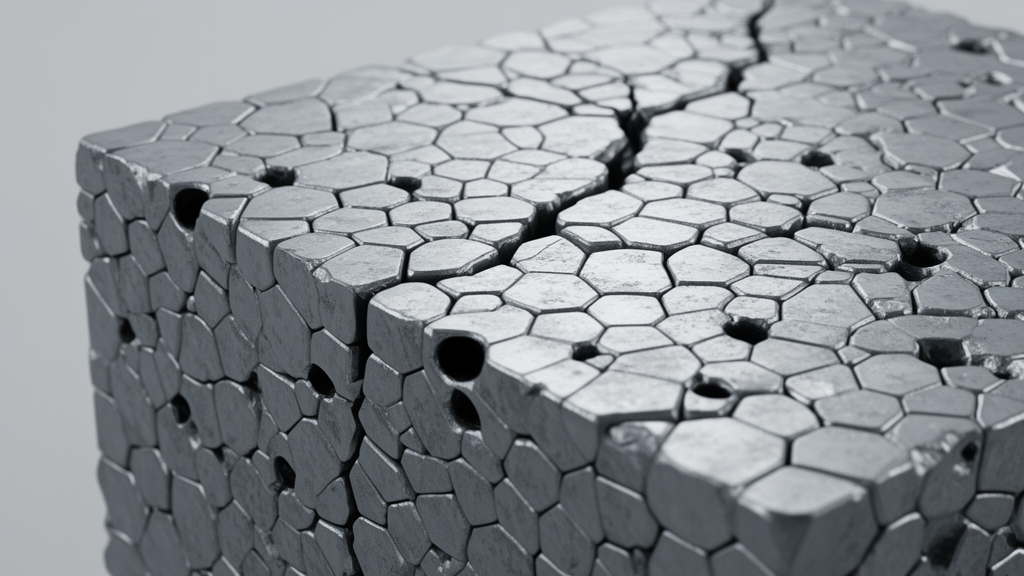
The team constructed 180 atomistic structures by systematically varying four parameters: grain morphology, with equiaxed and columnar grains; grain size, spanning 10, 12.5, 15, 17.5, and 20 nanometers; void shape, either spherical or irregular; and void location, either in the grain interior or at a grain boundary. Porosity was held fixed at 0.5 percent across all samples, isolating the effects of geometry and placement rather than the amount of missing material.
The simulations showed that the mere presence of a void reduced UHTS by 17.8 to 34.8 percent relative to void-free baselines. The highest mean strength values appeared near a grain size of 17.5 nanometers, within the grain-size range associated with previously reported Hall–Petch to inverse Hall–Petch crossover behavior. In columnar nanocrystals, voids sitting at grain boundaries reduced UHTS by 3.6 to 11.0 percent more than voids located within grain interiors, indicating that boundary placement carries an extra strength penalty in that morphology. Equiaxed nanocrystals, by contrast, were insensitive to void location.
Void shape mattered only in a specific setting: within grain-boundary-associated equiaxed nanocrystals, irregular voids yielded 2.4 to 5.3 percent lower UHTS than spherical voids of the same porosity. To rank the importance of the different parameters, the researchers applied SHAP analysis to their model outputs. Void presence emerged as the dominant descriptor, accounting for 51.8 percent of the explained influence, followed by grain morphology and grain size, with void location and void shape acting as secondary factors. According to the authors, this ranking confirms that grain and void characteristics jointly govern hydrostatic strength in these Fe80Cr16Ni4 nanocrystals.
The study is a computational analysis of an idealized model chemistry rather than a test of printed 17-4 PH components, and the article is being shared early as a peer-reviewed, accepted manuscript that remains subject to further edits before the final version of record.
Subject of Research: Machine-learning-guided atomistic simulations of void and grain effects on the strength of nanocrystalline Fe80Cr16Ni4 steel
Article Title: Atomistic and machine-learning analysis of void and grain effects on the strength of nanocrystalline 17-4 PH steel with simplified chemistry
Article References: Fani, M., Akinloye, O., Liu, Y., & Xu, S. (2026). Atomistic and machine-learning analysis of void and grain effects on the strength of nanocrystalline 17-4 PH steel with simplified chemistry. Discover Materials. https://doi.org/10.1007/s43939-026-01047-x
Image Credits: AI Generated
DOI: 10.1007/s43939-026-01047-x
Keywords: nanocrystalline steel, 17-4 PH stainless steel, molecular statics, deep neural network, SHAP analysis, grain boundaries, nanovoids, laser powder bed fusion, Hall-Petch, hydrostatic strength, Fe80Cr16Ni4, machine learning
Cite Scienmag News
Denise Maddox. (October 28, 2026). Voids and grain structure jointly weaken nanocrystalline steel in simulations. Scienmag. https://scienmag.com/voids-and-grain-structure-jointly-weaken-nanocrystalline-steel-in-simulations/
Denise Maddox. "Voids and grain structure jointly weaken nanocrystalline steel in simulations." Scienmag, 28 October 2026, https://scienmag.com/voids-and-grain-structure-jointly-weaken-nanocrystalline-steel-in-simulations/. Accessed 28 October 2026.
Denise Maddox. "Voids and grain structure jointly weaken nanocrystalline steel in simulations." Scienmag. October 28, 2026. https://scienmag.com/voids-and-grain-structure-jointly-weaken-nanocrystalline-steel-in-simulations/