Researchers Abdullah Al Mazrooei and Abdulaziz S. Alofi report in the journal Boundary Value Problems, in an open-access article published on 23 October 2026, a new way to build neural operator models for free boundary problems, the class of equations that describe systems whose spatial domain is not known in advance and evolves in time, from solidification to tumour growth. Their approach replaces the dominant geometric representation in this setting with one that can handle changes in topology, and it attaches a statistical confidence tube to the predicted interface rather than returning a single boundary with no measure of uncertainty.
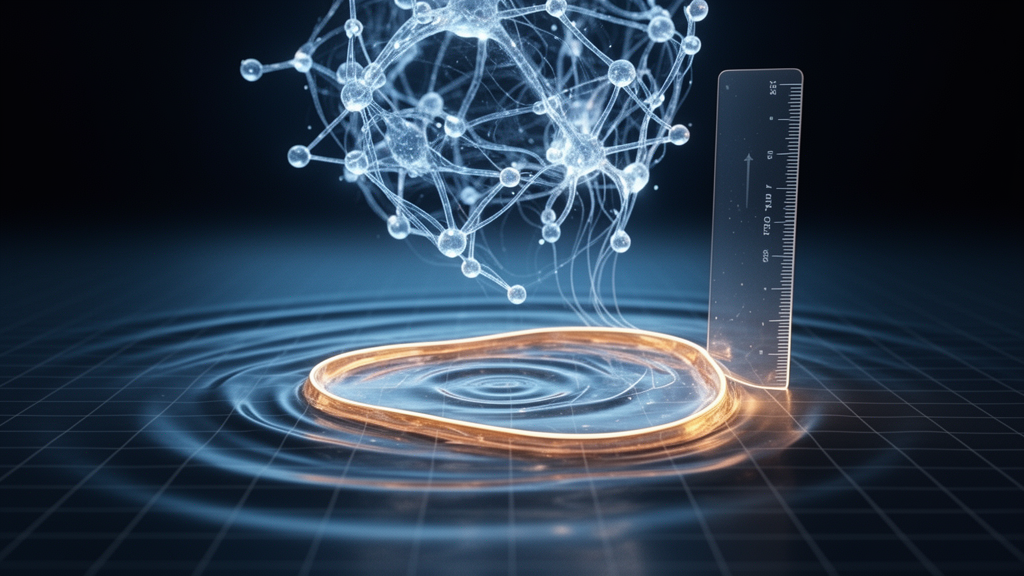
Existing neural operator methods for moving-boundary problems transport every evolving domain, through a learned diffeomorphism, onto one fixed reference domain. A diffeomorphism, by definition, cannot change topology, so the resulting model class excludes coalescence, splitting and hole closure, and the method returns an interface with no measure of confidence. The new work represents the geometry instead as a level set of a continuous phase field on a fixed background domain. With that choice, topological transitions become ordinary events rather than failures of the representation, and the existing operator approximation theory applies once the diffuse problem is well posed.
The theoretical contribution is a set of guarantees rather than a single bound. The authors prove a level-set stability estimate that converts a uniform field error below an explicit threshold into a Hausdorff error of the interface when the level set is regular, a measure bound on the reconstructed domain that holds through transitions, a posteriori residual bounds, a conditional consistency estimate with the sharp interface before the first singular time, and a finite-sample marginal coverage guarantee for a confidence tube around the discretized interface. A phase-field Stefan system is analysed formally; no operator is trained for it. The experiments instead concern the two-dimensional Allen-Cahn flow at one interface width and a short time horizon, a deliberately narrow scope that the authors state plainly.
The numerical results are mixed in ways the paper does not hide. Of 2200 instances used for evaluation, 46.1% change topology, mostly through the disappearance of small drops, while coalescence occurs in 12.5% and is an effect of the finite interface width rather than a genuine physical merging. An ensemble of ten Fourier neural operators achieves a mean relative L2 error of 0.325% against the numerical reference and predicts the number of components correctly in 99.5% of the instances. A U-Net is equally accurate, physics-informed loss terms do not improve the accuracy, and the a posteriori residual bounds turn out to be uninformative in practice. These are model estimates against a numerical reference on a single benchmark configuration, not demonstrations of performance on physical experiments.
The uncertainty guarantee is the part of the work most likely to shape how the method is used, and also the part with the clearest caveats. The coverage guarantee is marginal and does not certify topology: on data generated after all settings were fixed, at the nominal level 0.90 and on average over calibration sets, the observed coverage is 0.892 overall but only 0.805 for the topology-changing instances that retain an interface. In other words, the confidence tube is calibrated for the field as a whole, and the paper is explicit that a boundary drawn through a splitting or vanishing region carries weaker assurance than one in a simpler configuration.
Read as a whole, the article is a careful repositioning of a modelling idea rather than a claim of a solved problem. By moving from a diffeomorphism-based map to a level-set phase field on a fixed background, the authors trade a representation that is clean but topologically rigid for one that is messier but able to express the transitions that make free boundary problems hard in the first place. The formal Stefan analysis, the honest reporting that a simpler U-Net matches the Fourier neural operator ensemble, and the admission that the residual bounds and topology coverage fall short all mark this as an early, peer-reviewed accepted version shared ahead of the final Version of Record, subject to further edits. For researchers tracking how machine learning methods are being reshaped to fit the mathematics of evolving domains, the paper offers both a usable construction and a precise account of where its guarantees currently end.
Subject of Research: Neural operator methods with certified uncertainty for free boundary problems involving topology changes
Article Title: Topology-aware neural operators for free boundary problems with certified uncertainty
Article References: Al Mazrooei, A., & Alofi, A. S. (2026). Topology-aware neural operators for free boundary problems with certified uncertainty. Boundary Value Problems. https://doi.org/10.1186/s13661-026-02377-8
Image Credits: AI Generated
DOI: 10.1186/s13661-026-02377-8
Keywords: neural operators, free boundary problems, level set method, phase field, topology change, uncertainty quantification, Allen-Cahn equation, Fourier neural operator, Hausdorff distance, coverage guarantee, Stefan problem, machine learning
Cite Scienmag News
Cassandra Pierce. (October 28, 2026). Neural operators learn to track changing shapes in free boundary problems, with measured limits. Scienmag. https://scienmag.com/neural-operators-learn-to-track-changing-shapes-in-free-boundary-problems-with-measured-limits/
Cassandra Pierce. "Neural operators learn to track changing shapes in free boundary problems, with measured limits." Scienmag, 28 October 2026, https://scienmag.com/neural-operators-learn-to-track-changing-shapes-in-free-boundary-problems-with-measured-limits/. Accessed 29 October 2026.
Cassandra Pierce. "Neural operators learn to track changing shapes in free boundary problems, with measured limits." Scienmag. October 28, 2026. https://scienmag.com/neural-operators-learn-to-track-changing-shapes-in-free-boundary-problems-with-measured-limits/