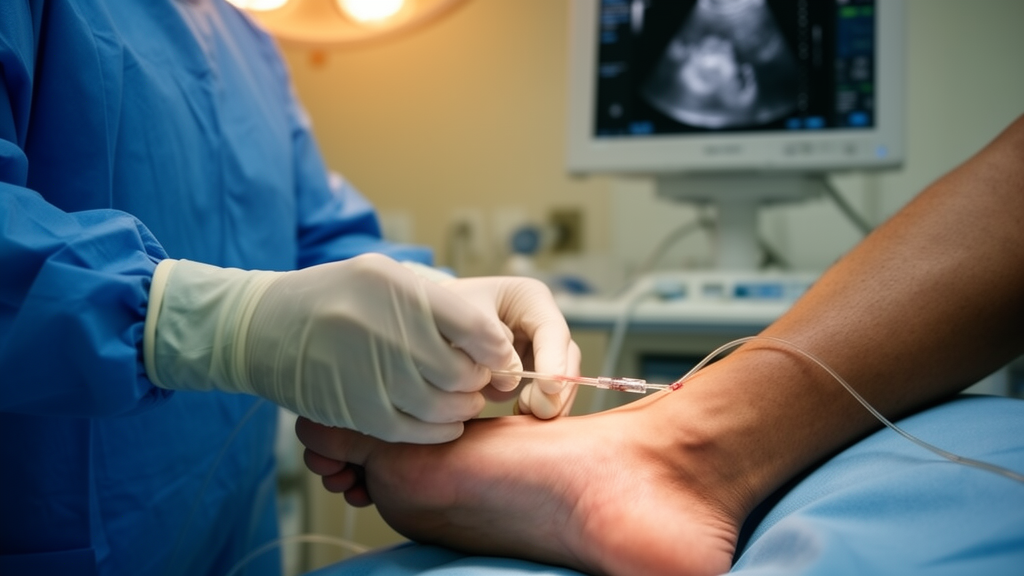
When the groin cannot be used to reach blocked leg arteries, a team of vascular specialists turned instead to the arteries of the foot itself. In a retrospective single-centre cohort study published in CVIR Endovascular, researchers report that tibio-pedal arterial minimally invasive retrograde revascularisation, known as TAMI, was technically feasible in 78 percent of procedures among patients with chronic limb-threatening ischaemia whose conventional femoral access was challenging or contraindicated, with a low observed rate of clinically significant pedal access complications.
Chronic limb-threatening ischaemia represents the end stage of peripheral arterial disease and requires coordinated multidisciplinary management to prevent major amputation and reduce mortality. Conventional endovascular revascularisation is typically performed through antegrade ipsilateral common femoral artery access or a contralateral retrograde crossover technique. Those approaches, however, may be impractical or contraindicated in patients with recent groin surgery, prior aortic bifurcation reconstruction, severe obesity, or limb contractures. TAMI instead uses a primary retrograde pedal arterial approach, in which diagnostic angiography and intervention are performed from a distal tibio-pedal access point, with an additional femoral access used in selected complex cases to facilitate crossing or re-entry.
The study, conducted at a tertiary vascular centre, included 84 TAMI procedures performed across 81 limbs in 77 patients between January 2019 and January 2025. The median age of patients was 72 years and 64 percent were male. Rutherford category 4 was present in 22 percent of patients, with categories 5 and 6 accounting for the remaining 78 percent. Disease complexity was high: according to the GLASS classification, 68 percent of limbs were stage III, 21 percent stage II and 11 percent stage I, reflecting multilevel disease with a heavy burden of chronic total occlusion and calcification. TAMI accounted for just 5 percent of the 1,565 infra-inguinal angioplasty procedures carried out during the five-year period, underlining how selectively the technique was deployed.
The reasons for choosing pedal access were predominantly patient-related. Morbid obesity was the documented indication in 40 percent of procedures, fixed contracture preventing standard positioning in 21 percent, recent groin cut-down within six weeks in 31 percent, and groin infection in 4 percent, with the indication not documented in 3 percent of cases. Absolute contraindications to antegrade femoral access included recent groin cut-down, extensive common femoral artery scarring or prior aortic bifurcation stent-graft reconstruction, while relative contraindications included severe anterior-wall calcification, recent failed femoral access, groin infection, morbid obesity with a pannus, and fixed hip contractures.
The procedural technique relied on careful pre-operative and peri-procedural duplex ultrasound to identify a suitable pedal artery of more than 1.0 mm diameter with a detectable spectral waveform. The dorsalis pedis at the level of the tarsal neck, the posterior tibial artery at the medial malleolus, and the peroneal artery proximal to its bifurcation were interrogated to characterise calcification burden and vessel calibre. Access was obtained predominantly via the dorsalis pedis artery in 71 percent of procedures and the distal posterior tibial artery in 16 percent. Puncture was performed with a 22-gauge micro-access needle under ultrasound guidance, followed by insertion of a nitinol 0.021-inch guidewire and a thin-walled 5 to 7 French sheath. A single patent tibial run-off vessel was considered a relative contraindication, and in four procedures involving a single run-off vessel, an occluded pedal vessel was accessed instead to avoid instrumenting the only patent run-off vessel.
Technical success, defined as restoration of continuous inline flow through at least one infrapopliteal artery to the foot with less than 50 percent residual stenosis on completion angiography, was achieved in 66 of 84 procedures, or 78 percent. In 10 procedures, or 12 percent, TAMI access and lesion crossing were successful but the predefined angiographic endpoint was not met, owing to residual stenosis greater than 50 percent or poor infrageniculate run-off. Eight procedures, or 10 percent, were abandoned because of failure to cross the lesion in six cases, pain intolerance in one, and delirium in one. Three procedures required an additional antegrade superficial femoral artery puncture to assist luminal re-entry during long chronic total occlusion recanalisation, and were retained as bidirectional TAMI-assisted cases. Median procedure duration was 125 minutes, with a median dose-area product of 6.07 Gy.cm2, and 86 percent of procedures were performed under local anaesthetic.
Access vessel safety was a central concern of the study, since puncturing a small pedal artery carries a theoretical risk of compromising flow to the foot. On-table duplex imaging demonstrated asymptomatic access vessel spasm in 35 of 84 procedures, or 42 percent, but this had resolved with a patent access vessel by 24 hours on formal duplex follow-up. Delayed formal imaging follow-up with duplex or CT angiography was available for 50 limbs, or 62 percent, at a median of 184 days. In the 46 cases where a patent pedal vessel had been accessed, the access vessel remained patent, while in four cases where an occluded vessel had been accessed it remained occluded. Formal imaging of the access vessel was not available in 25 limbs, with no reported clinical manifestation of occlusion, and a further six limbs underwent major amputation for progressive chronic limb-threatening ischaemia before subsequent access vessel imaging. One groin haematoma occurred, from a leak at a recent common femoral artery endarterectomy patch, and was classified as unrelated to the pedal access site.
Clinical outcomes were reported with caution given the study design. Within 30 days of the index procedure, one of 77 patients died from a cause not considered procedure-related, a myocardial infarction, and 6 of 81 limbs experienced a major adverse limb event. Longitudinal follow-up beyond 30 days was available for 71 limbs in 68 patients, or 88 percent, with a median follow-up of 150 days. Among these limbs, clinically driven target-vessel reintervention occurred in 22 of 71 limbs, or 30 percent, and major amputation in 14 of 71, or 20 percent. Twenty-five of 68 patients, or 37 percent, died during follow-up, predominantly from ischaemic heart disease and complications of diabetes. Kaplan-Meier analysis estimated freedom from major adverse limb events, defined as major amputation or clinically driven target-vessel reintervention, at 57.9 percent at 6 months and 51.2 percent at 12 months, while estimated freedom from major amputation was 75.2 percent at both 6 and 12 months.
In multivariable Cox proportional hazards regression, none of the evaluated covariates was significantly associated with major adverse limb events. Chronic kidney disease stage 3 or higher had the largest point estimate for increased hazard, with a hazard ratio of 1.81, but this did not reach statistical significance, and neither did GLASS stage III disease, age, diabetes mellitus or smoking history. The overall model was not statistically significant, and the proportional hazards assumption was not violated. There was also no significant difference in MALE-free survival between patients with GLASS stage III disease and those with stage I to II disease on log-rank testing.
The authors emphasise that the findings must be interpreted within the study’s limits. The design was retrospective and single-centre, with no contemporaneous femoral access comparison group, and TAMI was used in a highly selected population in whom conventional access was challenging or not feasible, introducing substantial selection bias and limiting generalisability. Median follow-up of 150 days limits conclusions about longer-term limb outcomes and survival, and formal ultrasound follow-up of the access vessel was available in only 62 percent of cases. Compared with previous TAMI series in mixed peripheral arterial disease populations, which reported technical success rates exceeding 90 percent, the lower rate observed here may reflect the restriction to chronic limb-threatening ischaemia and the high burden of chronic occlusive and heavily calcified disease. The researchers conclude that in this selected, anatomically complex cohort, TAMI provided a feasible alternative access strategy when conventional femoral access was challenging or not technically feasible, and they call for future prospective multicentre studies with prespecified access-site surveillance and comparative cohorts to define patient selection and longer-term outcomes.
Subject of Research: Retrograde tibio-pedal arterial access for endovascular revascularisation in chronic limb-threatening ischaemia
Article Title: Retrograde access revascularization in chronic limb threatening ischaemia
Article References: Gao, Y., Patrone, L., Davies, N., Papadopoulou, A., Woodward, N., Tsui, J., Portou, M., Benaragama, S., & von Stempel, C. (2026). Retrograde access revascularization in chronic limb threatening ischaemia. CVIR Endovascular, 9(1), Article 132. https://doi.org/10.1186/s42155-026-00786-5
Image Credits: AI Generated
DOI: 10.1186/s42155-026-00786-5
Keywords: chronic limb-threatening ischaemia, peripheral arterial disease, TAMI, retrograde pedal access, endovascular revascularisation, technical success, major amputation, target-vessel reintervention, access vessel safety, vascular surgery, GLASS classification, femoral access
Cite Scienmag News
Ophelia Keating. (October 28, 2026). Foot Artery Access Offers Alternative Route for Revascularisation in Complex Limb Ischaemia. Scienmag. https://scienmag.com/foot-artery-access-offers-alternative-route-for-revascularisation-in-complex-limb-ischaemia/
Ophelia Keating. "Foot Artery Access Offers Alternative Route for Revascularisation in Complex Limb Ischaemia." Scienmag, 28 October 2026, https://scienmag.com/foot-artery-access-offers-alternative-route-for-revascularisation-in-complex-limb-ischaemia/. Accessed 28 October 2026.
Ophelia Keating. "Foot Artery Access Offers Alternative Route for Revascularisation in Complex Limb Ischaemia." Scienmag. October 28, 2026. https://scienmag.com/foot-artery-access-offers-alternative-route-for-revascularisation-in-complex-limb-ischaemia/