Researchers have developed and validated a Bayesian network model that predicts not just whether a trauma patient will need a blood transfusion, but how much blood they will require and over what timeframe, using only injury and physiological data available in the early hours after injury. The work, published in Critical Care, was designed for both civilian and military trauma care, where early transfusion decisions are time-critical and are typically made under substantial uncertainty.
According to the study team, existing prediction models generally classify patients against fixed thresholds, such as whether a patient will need massive transfusion, and do not estimate the volume or timing of transfusion. The authors argue that this limitation reduces the usefulness of such models for real-time clinical decision-making and for resource planning, particularly in settings where blood products are scarce or must be moved forward with casualties.
The model was built using data from a prospective civilian cohort and military trauma registries, comprising 2,361 patients. It was informed by domain knowledge as well as clinical data, and it produces estimates of transfusion volume across multiple timeframes: 2, 6, 12, and 24 hours after injury. Rather than a single yes-or-no answer, the model outputs an anticipated requirement by volume and timing, which the researchers suggest is closer to the way clinicians actually plan transfusion and blood product logistics.
Performance was evaluated in two ways. In internal cross-validation and external validation in an independent dataset of 13,347 patients, the model achieved AUROC values of 0.82 to 0.94 for binary outcomes across the timeframes. For ordinal volume predictions, the Ranked Probability Scores were 0.07 for 0–12 hour predictions and 0.04 for 12–24 hour predictions, where lower scores indicate better predictive accuracy.
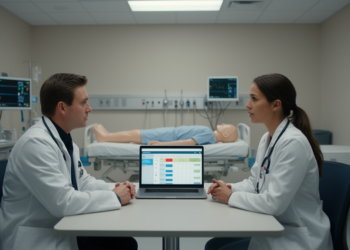
The team also tested the model in a scenario-based evaluation with clinical experts. Agreement with the model’s predictions was observed in 213 of 225 expert assessments, or 95 percent. The authors present this expert assessment as a measure of the model’s practical utility, an aspect they argue is often overlooked when prediction tools are judged only on statistical discrimination metrics.
A central conclusion of the paper is that prediction models based on binary thresholds may have limited impact on clinical decision-making despite showing good statistical performance. The authors suggest that a decision-support approach that estimates transfusion requirements by volume and timing, using early-available clinical data, may provide more clinically useful support in trauma care than threshold-based classification alone.
The study is reported as an open-access research article in Critical Care, published on 26 October 2026. The publisher notes that the article is being shared early to provide faster access to peer-reviewed, accepted research; this version is citable and carries a permanent DOI, but remains subject to further edits and will be replaced by the final Version of Record.
For clinicians and military medical planners, the reported findings point to a shift in how transfusion prediction tools might be judged: not only by how accurately they separate patients who will bleed from those who will not, but by whether their outputs can be acted upon directly, whether at the bedside or when deciding how much blood to carry forward in an austere or deployed setting. The model’s estimates of volume across 2, 6, 12, and 24 hour windows are intended to serve that purpose, and the external validation in a large independent dataset supports the reported performance figures. As with any prediction model described in this early-release version, the authors’ conclusions about clinical utility rest on the reported validation and expert scenario assessments rather than on demonstrated effects on patient outcomes.
Subject of Research: Prediction of blood transfusion volume and timing in civilian and military trauma patients using a Bayesian network model
Article Title: Development and evaluation of a blood transfusion prediction algorithm tailored for precision and utility in civilian and military trauma patients
Article References: Pisirir, E., Tandle, S., Wohlgemut, J. M., Stoner, R. S., Marsden, M. E. R., Goatly, G., Kyrimi, E., Gurney, J., Woolley, T., Brohi, K., Marsh, D. W., Perkins, Z. B., & Tai, N. R. M. (2026). Development and evaluation of a blood transfusion prediction algorithm tailored for precision and utility in civilian and military trauma patients. Critical Care. https://doi.org/10.1186/s13054-026-06389-9
Image Credits: AI Generated
DOI: 10.1186/s13054-026-06389-9
Keywords: trauma, blood transfusion, Bayesian network, prediction model, decision support, military medicine, emergency medicine, AUROC, external validation, critical care, Development, evaluation
Cite Scienmag News
Blake Davidson. (October 28, 2026). New algorithm predicts how much blood trauma patients will need, and when. Scienmag. https://scienmag.com/new-algorithm-predicts-how-much-blood-trauma-patients-will-need-and-when/
Blake Davidson. "New algorithm predicts how much blood trauma patients will need, and when." Scienmag, 28 October 2026, https://scienmag.com/new-algorithm-predicts-how-much-blood-trauma-patients-will-need-and-when/. Accessed 29 October 2026.
Blake Davidson. "New algorithm predicts how much blood trauma patients will need, and when." Scienmag. October 28, 2026. https://scienmag.com/new-algorithm-predicts-how-much-blood-trauma-patients-will-need-and-when/