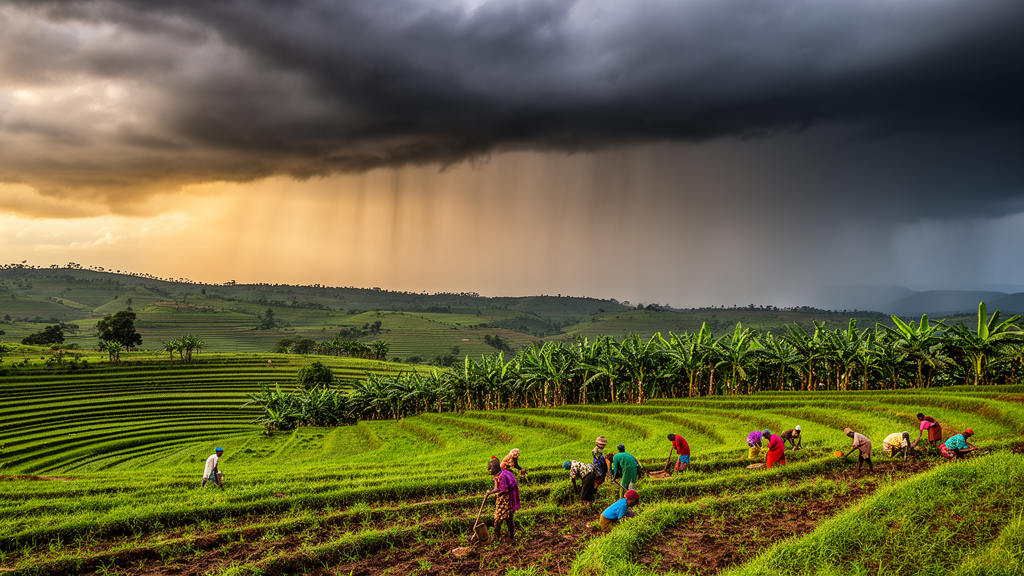
Rwanda’s long rainy season is projected to begin earlier, last longer, and deliver more rainy days across much of the country by the second half of this century, according to a new analysis of observed trends and climate model projections published in Discover Atmosphere. These measures matter intensely in Rwanda, where agriculture is the backbone of the economy and the primary livelihood for much of the population, and where nearly all farming depends on rain rather than irrigation.
The researchers drew on gridded daily rainfall and temperature data from the Rwanda Meteorology Agency covering 1983 to 2021, at a spatial resolution of roughly four kilometres for rainfall. Rwanda has two wet seasons: the long rains of March, April and May, and the short rains of September through December, separated by dry periods in January and February and in June, July and August. Because rainfall and temperature vary considerably across the country’s hills, valleys and highlands, which range from about 900 metres to peaks of 4,507 metres, the team analysed the data across six climatological regions previously classified in earlier work, from the Lake Kivu zone in the west to the Eastern Lowlands.
To define the onset of a season, the study used a demanding criterion: a spell of five consecutive days accumulating at least 25 millimetres of rain, including at least three rainy days, with no dry period of seven days or more in the following thirty days. A rainy day was counted when rainfall reached at least one millimetre. Cessation was identified as the date when accumulated ten-day rainfall fell below half of the corresponding potential evapotranspiration, computed with a modified Hargreaves technique. Seasonal length was then the span between onset and cessation. Trends and their magnitudes were assessed with the Modified Mann-Kendall test and the Theil-Sen slope estimator at the five percent significance level.
The observed record from 1983 to 2021 shows a spatially mixed picture. Seasonal rainfall trends ranged between minus 0.5 and 0.5 millimetres per day per decade, with statistically significant increases over the southwest, parts of the central south and the northeast of the eastern region in both seasons, and significant decreases over the southeast and northwest. Onset and cessation trends each ranged between minus 3 and 3 days per decade, and trends in seasonal length and rainy days between minus 4 and 4 days per decade. Summarised by climate zone, the long rains showed statistically significant increases in rainfall and rainy days in the Lake Kivu zone, the Central Temperate Highlands and the central part of the Central Plateau, while the short rains showed significant increases in rainfall and later cessation dates in all climate zones. The authors suggest this points to a possible dependence of rainfall totals on the number of rainy days in the long rains and on the cessation date in the short rains.
Simulations were run under two Representative Concentration Pathways, RCP2.6 and RCP8.5, representing lower and upper bounds of future forcing of 2.6 and 8.5 watts per square metre by 2100. Because raw model output deviated from observations, the ensemble was bias-corrected with a linear scaling method calibrated against observations for 1983 to 2005, a step the authors report improved correlations and reduced errors. Projected changes were then computed for 2026 to 2060 and 2066 to 2100 relative to a 1986 to 2020 observational baseline, with significance tested using a Student t-test.
The headline projection concerns the long rains. Onset dates are projected to shift earlier countrywide in both future periods under both scenarios. For 2026 to 2060 under RCP2.6, the Eastern Lowlands, the area around Nyungwe National Park and the Congo-Nile Divide extending into the northwestern highlands are projected to see onsets earlier by 20 to 40 days, with central parts earlier by 0 to 20 days. Under RCP8.5 for the same period, the extreme east and south-central regions are projected to be earlier by 20 to 30 days and the rest of the country by 10 to 20 days. For 2066 to 2100, early onsets of 15 to 20 days under RCP2.6 and 20 to 30 days under RCP8.5 are projected in the eastern, western and Congo-Nile Divide regions, with smaller shifts of roughly 5 to 10 days elsewhere.
Seasonal length and rainy-day totals follow the same direction in the long rains. Under RCP2.6, the Central Plateau is projected to see seasons longer by 12 to 16 days and the rest of the country by 16 to 24 days, while under RCP8.5 the increases are more modest, 4 to 8 days in the central-east and southwest and up to 4 days elsewhere. Notably, the study finds that the magnitudes of the earlier onsets and the increases in seasonal length and rainy days are larger under the lower-emission RCP2.6 scenario than under RCP8.5, a pattern the authors note varies spatially from one climate zone to another. By contrast, the short rains show no significant projected changes in onset, cessation, seasonal length or rainy days over the country as a whole in either period under either scenario, although zonal analyses reveal slight significant shifts in a few zones, including shortened seasons of 4 to 8 days in the northern highlands and southeast under RCP2.6 by 2066 to 2100.
The authors are careful to flag the limitations of the model evaluation. Comparisons between observed and simulated rainfall characteristics for the overlapping 1983 to 2005 period showed that the ensemble underestimated long-rain rainfall in most of the country and that Pearson correlations fell as low as the 30 to 60 percent range in some regions for onset dates and rainy days, which the researchers describe as limited model performance requiring cautious interpretation. After bias correction, correlations increased and errors shrank, bringing simulated values closer to observations in all climate zones for both seasons. The study also found that variability in onset dates exceeds that in cessation dates, explaining much of the variability in seasonal length.
The implications for farming are mixed and geographically specific. Earlier onsets, longer seasons and more rainy days in the long rains could extend the growing period and favour crops with long growing cycles, but the authors caution that increased rainy-day totals may raise flood risk. Where the short rains shorten in the northern, northwestern and southeastern regions and along the Congo-Nile Divide, the growing period could contract, with potential consequences for yields and food security. The findings align with earlier work projecting crop yield declines of at least 10 percent under RCP4.5 and 15 percent under RCP8.5 by 2050 in Rwanda’s drier eastern lowlands and central plateau. The authors argue that each sector will need tailored adaptation strategies, from climate-resilient crop varieties and forecast-based planting calendars to rainwater harvesting and stronger climate information services, and they call for further research into the mechanisms driving these projected changes in the timing of Rwanda’s rains.
Subject of Research: Observed trends and future projections of rainfall onset, cessation, seasonal length and rainy days in Rwanda's two rainy seasons
Article Title: Observed trends and future projections of seasonal rainfall onset, cessation, length, and rainy days in Rwanda
Article References: Sebaziga, N. J., Safari, B., Ntwali, D., & Ngaina, J. N. (2026). Observed trends and future projections of seasonal rainfall onset, cessation, length, and rainy days in Rwanda. Discover Atmosphere, 4(1), Article 17. https://doi.org/10.1007/s44292-026-00084-8
Image Credits: AI Generated
DOI: 10.1007/s44292-026-00084-8
Keywords: Rwanda, rainfall onset, cessation date, seasonal length, rainy days, CORDEX-CORE, climate projections, RCP2.6, RCP8.5, long rains, short rains, agriculture
Cite Scienmag News
Sloane Callahan. (October 29, 2026). Rwanda’s Long Rains Set to Start Earlier and Last Longer, Study Finds. Scienmag. https://scienmag.com/rwandas-long-rains-set-to-start-earlier-and-last-longer-study-finds/
Sloane Callahan. "Rwanda’s Long Rains Set to Start Earlier and Last Longer, Study Finds." Scienmag, 29 October 2026, https://scienmag.com/rwandas-long-rains-set-to-start-earlier-and-last-longer-study-finds/. Accessed 4 November 2026.
Sloane Callahan. "Rwanda’s Long Rains Set to Start Earlier and Last Longer, Study Finds." Scienmag. October 29, 2026. https://scienmag.com/rwandas-long-rains-set-to-start-earlier-and-last-longer-study-finds/