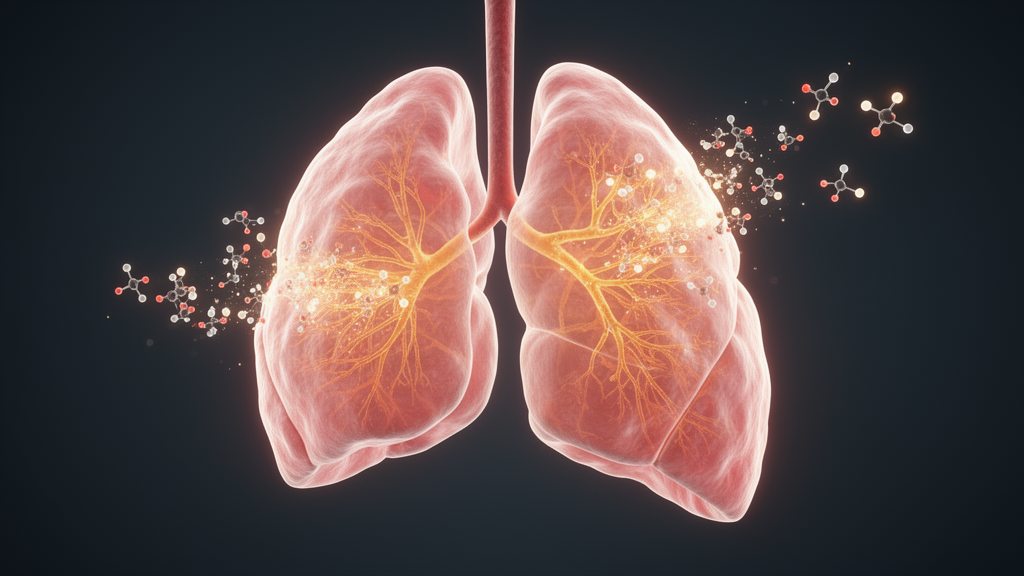
A widely used tire rubber antioxidant called 6PPD, together with its oxidation product 6PPD-quinone, has become an emerging urban environmental pollutant found worldwide. Humans can inhale these compounds through atmospheric particulate matter and aerosols, and previous studies have suggested that such exposure is associated with the occurrence and development of lung cancer. A new computational study, published in Cell Biology and Toxicology, set out to map how 6PPD might interact with molecular machinery in lung cancer cells, using a battery of simulation and machine-learning methods rather than laboratory experiments.
The research team, which includes Hui Zhen, Xin Liu, An Li and colleagues with Lemei Zhu among the listed authors, constructed a multidimensional framework combining network toxicology, weighted gene co-expression network analysis, machine learning, molecular docking and molecular dynamics simulation. The work was published on 24 October 2026 as an open-access article, and the publisher notes that the shared version is subject to further edits before the final Version of Record.
By cross-screening multiple databases, the researchers identified 35 common interaction targets shared between 6PPD and lung cancer, from which candidate hub genes were screened out. Gene ontology and pathway analyses showed that these targets were enriched in cancer-related pathways such as chemical carcinogenesis involving reactive oxygen species and the VEGF pathway, suggesting that oxidative stress may be the core regulatory direction of the compound’s activity.
Machine learning played a central role in narrowing the field. A Ridge prediction model achieved an accuracy of 1.000, with an area under the curve of 0.985, in the training set, and the authors report that it also exhibited good generalization ability in two independent validation datasets. From this analysis, three genes emerged as core biomarkers: CA4, CDC25C and NQO1. All three were significantly overexpressed in lung cancer tissues and showed good diagnostic efficacy for lung cancer in the datasets examined.
The study then turned to structural modeling. Molecular docking followed by 100-nanosecond molecular dynamics simulations indicated that 6PPD possessed strong spontaneous binding ability toward several of the identified targets, including NOX4 with a binding energy of −8.0 kcal/mol, NQO1 at −7.9 kcal/mol, and also KDR, CA4 and CDC25C. The complexes formed with the core targets remained generally stable throughout the simulations, suggesting that 6PPD can persistently bind to target proteins through stable intermolecular interactions.
Trajectory hierarchical clustering analysis added a layer of detail about how each complex behaved over time. The conformational dynamic characteristics of each complex differed: the KDR complex was the most stable, whereas NQO1 and CA4 showed higher conformational diversity.
Bringing the strands together, the authors conclude that 6PPD may participate in oxidative stress pathway activation, DNA damage, cell cycle regulation and tumor angiogenesis through multi-target synergistic effects, and may be associated with lung cancer progression. They emphasize that the core targets identified, CA4, CDC25C and NQO1, may serve as candidate molecular markers for early warning and intervention of lung cancer, pending experimental validation.
It is important to read these findings in context. The study is entirely computational: it predicts plausible interactions and pathways but does not demonstrate that 6PPD causes lung cancer in humans, nor does it measure any biological effect in cells, animals or people. The abstract itself frames the work as providing a computational pathway for deciphering the carcinogenic molecular mechanisms of environmental pollutants and assessing respiratory carcinogenic risk, rather than as clinical evidence.
Nevertheless, the research addresses a growing environmental concern. 6PPD and 6PPD-quinone are distributed worldwide as urban pollutants, and respiratory exposure through airborne particles is a recognized route of human contact.
For now, the contribution is methodological as much as biological. The framework demonstrates how network toxicology, machine learning and molecular simulation can be integrated to generate testable hypotheses about environmental pollutants and respiratory carcinogenic risk, with the core targets proposed as candidates for future early-warning and intervention research in lung cancer.
Subject of Research: Computational modeling of how the tire rubber antioxidant 6PPD may interact with molecular targets in lung cancer
Article Title: Integrating network toxicology, machine learning and molecular dynamics simulation: Revealing the dynamic molecular mechanism by which 6PPD regulates lung cancer progression
Article References: Zhen, H., Liu, X., Li, A., Lin, S., Liu, K., Wang, J., Yang, R., Bing, P., & Zhu, L. (2026). Integrating network toxicology, machine learning and molecular dynamics simulation: Revealing the dynamic molecular mechanism by which 6PPD regulates lung cancer progression. Cell Biology and Toxicology. https://doi.org/10.1007/s10565-026-10317-6
Image Credits: AI Generated
DOI: 10.1007/s10565-026-10317-6
Keywords: 6PPD, 6PPD-quinone, lung cancer, network toxicology, machine learning, molecular docking, molecular dynamics simulation, oxidative stress, biomarkers, environmental pollutants, respiratory exposure, CA4
Cite Scienmag News
Nathaniel Bowman. (October 28, 2026). Computational study links tire rubber antioxidant 6PPD to lung cancer molecular pathways. Scienmag. https://scienmag.com/computational-study-links-tire-rubber-antioxidant-6ppd-to-lung-cancer-molecular-pathways/
Nathaniel Bowman. "Computational study links tire rubber antioxidant 6PPD to lung cancer molecular pathways." Scienmag, 28 October 2026, https://scienmag.com/computational-study-links-tire-rubber-antioxidant-6ppd-to-lung-cancer-molecular-pathways/. Accessed 28 October 2026.
Nathaniel Bowman. "Computational study links tire rubber antioxidant 6PPD to lung cancer molecular pathways." Scienmag. October 28, 2026. https://scienmag.com/computational-study-links-tire-rubber-antioxidant-6ppd-to-lung-cancer-molecular-pathways/