


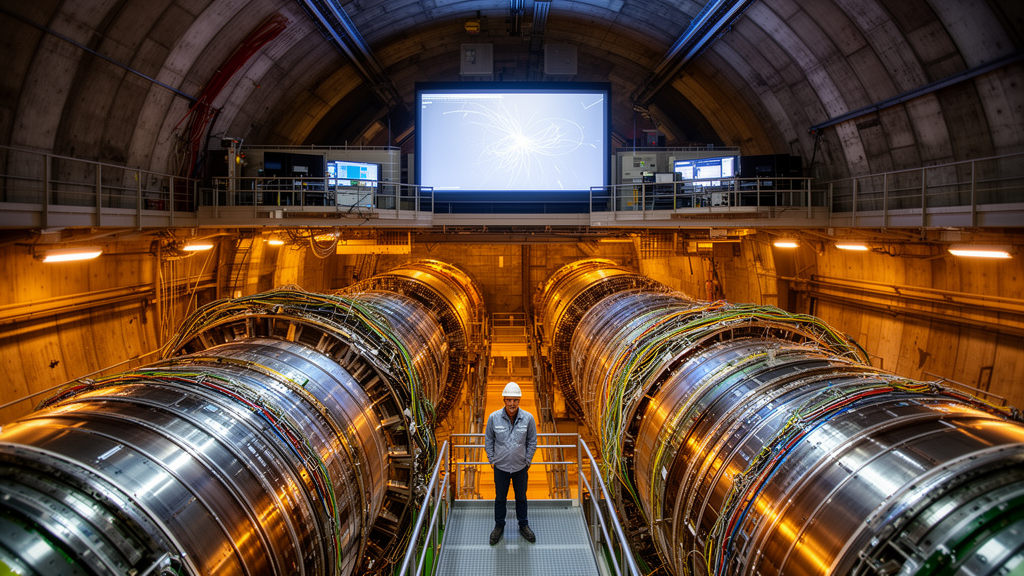
Precision measurements of particle masses sit at the foundation of particle physics, yet they are only as good as the detectors that produce them. A new theoretical and simulation study published in EPJ Techniques and Instrumentation tackles a deceptively simple question: when a spectrometer measures the mass of a particle that decays into two daughters, how exactly do imperfections in the detector distort the answer? The work, carried out by Allison Chu, Yiming Liu and Matthew Needham, develops a general formalism that links observed mass shifts directly to physical detector effects, replacing the rough rules of thumb that experimentalists have often relied upon with a rigorous, data-driven procedure.
The central idea is elegant. For any two-body decay, the reconstructed invariant mass of the parent particle depends on the momenta of its two daughters and the opening angle between them. Rather than treating detector-induced biases as an amorphous systematic uncertainty, the authors show that by fitting the measured mass in subsamples defined by the sum and the difference of the daughter momenta, one can disentangle distinct physical causes of bias: an error in the momentum scale, an imperfect correction for energy loss in detector material, a biased measurement of the opening angle at the decay vertex, and curvature biases from detector misalignment. Each of these effects leaves a different fingerprint on the mass as a function of kinematics, and the formalism makes those fingerprints explicit.
This matters because the usual shortcut, a rule stating that the mass bias scales with the energy release of the decay, turns out to be generally wrong. The authors demonstrate with the symmetric decay of the K0S meson into two pions that scaling by the Q-value would underestimate the mass shift from a momentum-scale error by a factor of roughly 1.6. For light resonances, where the masses of the daughter particles cannot be neglected relative to the parent, such approximations break down. The new equations, derived from the relativistic expression for the two-body invariant mass, account for the momentum asymmetry between the daughters and the specific masses involved, allowing the expected shift for any decay to be calculated directly from tabulated masses.
To make the method concrete, the team turned to a measurement with an unusually strong motivation: the mass of the Λ hyperon, a baryon that decays into a proton and a negative pion. The current world average, reported by the Particle Data Group as 1115.683 ± 0.006 MeV/c², rests entirely on data collected in the 1990s at the Brookhaven AGS by the E766 collaboration. That value was obtained by averaging the statistical and systematic uncertainties as if they were uncorrelated, even though the systematic component stems entirely from the knowledge of the K0S mass used to calibrate the momentum scale. Since the accepted K0S mass has since shifted from 497.671 ± 0.031 MeV/c² to 497.611 ± 0.013 MeV/c², the authors recalculated the average under the assumption of fully correlated systematics and obtained 1115.671 ± 0.005 MeV/c², a shift of about two standard deviations from the quoted PDG value.
The only other measurements of the Λ mass listed by the PDG come from bubble chamber experiments of the 1960s and 1970s, with uncertainties too large to contribute to the average. A fresh measurement is therefore of genuine interest, not least because comparing the masses of the Λ and its antiparticle provides one of the cleanest tests of CPT symmetry, the principle that the laws of physics are identical for matter and antimatter. The PDG currently quotes a CPT violation parameter of (-0.1 ± 1.1) × 10⁻⁵, and the new study suggests that LHCb could probe this quantity at the 10⁻⁶ level, an order-of-magnitude improvement.
The vehicle for the demonstration is the LHCb experiment at the Large Hadron Collider, whose forward geometry and vertex detector extending to 80 centimetres from the interaction point give it exceptional acceptance for long-lived particles such as the Λ hyperon. Enormous numbers of these baryons are produced in high-energy proton-proton collisions, so statistical precision is not the bottleneck; controlling systematic uncertainties is. The authors built their case with the RapidSim fast simulation package, generating samples of K0S and Λ decays with realistic production kinematics based on ALICE measurements at a centre-of-mass energy of 13 TeV, and modelling the QED radiative corrections with Photos. After imposing LHCb acceptance requirements, 14 million K0S and 4 million Λ decays remained, with simulated mass resolutions of 1.2 and 3.5 MeV/c² respectively.
The calibration strategy exploits the fact that the K0S decay into two pions is an ideal control channel: it is topologically similar to the Λ decay, far more abundant, and more sensitive to detector biases. In the relativistic limit, the momentum asymmetry of Λ decays is large, with the proton carrying at least roughly three times the pion momentum in the laboratory frame, whereas the two pions from a K0S decay have nearly equal momenta. Fitting the mass shift of symmetric K0S decays, selected in a narrow window of momentum asymmetry, as a function of the parent momentum determines the momentum-scale error, the energy-loss parameter and the opening-angle bias simultaneously. A second step, fitting the mass in subsamples of the momentum difference across the full K0S sample, quantifies any curvature bias from misalignment, an effect that cancels for symmetric decays but would otherwise distort CPT comparisons of Λ and antilambda masses.
The validation came through pseudoexperiments, one hundred simulated repetitions with randomly drawn detector imperfections within realistic ranges. In the first study, ignoring curvature biases, the calibration recovered the Λ mass with a bias of just 0.1 keV/c² and a spread of 0.2 keV/c², comfortably below the 0.6 keV/c² statistical precision achievable with a sample of 40 million candidates. When curvature biases were included, the systematic uncertainty grew to 0.7 keV/c², still remarkably small. Before calibration, curvature-induced mass shifts reached a standard deviation of 30 keV/c²; after the full procedure, this fell to 1.3 keV/c². The upshot is that tracking-related systematics could be controlled to 0.7 keV/c², leaving the total precision limited at roughly 2.2 keV/c² by the 13 keV/c² uncertainty on the K0S mass itself, a threefold improvement over current knowledge of the Λ mass.
The study also quantifies subtler hazards. Because the LHCb track reconstruction assumes all particles are pions when applying energy-loss corrections, the proton momentum in Λ decays carries a bias of about 2 MeV/c, shifting the reconstructed Λ mass by 6 keV/c², a correction that must be applied. The authors further show how the formalism extends to multibody decays, using the example of ψ(2S) decays to J/ψ plus a pion pair, where constraining the dimuon mass reduces the problem to a quasi-two-body dipion system. Simulated mass shifts for momentum-scale and energy-loss biases matched the predicted functional form almost exactly, and an opening-angle bias produced the expected linear dependence on the dipion momentum, offering a diagnostic for future calibration channels.
Looking forward, the authors note that the proposed FCC-ee collider aims to collect three trillion hadronic Z0 decays, which, with a Λ multiplicity of about 0.388 per event, would yield a vast sample for mass measurements and CPT tests using these same calibration methods. For now, the demonstration at LHCb stands as a blueprint: by tying observed mass shifts to the physical parameters of the detector rather than to ad hoc scaling rules, precision spectroscopy at colliders can be pushed to limits set by fundamental constants rather than by unexamined systematics.
Subject of Research: A formalism for controlling detector-related systematic uncertainties in precision two-body particle mass measurements, illustrated with a proposed Λ hyperon mass measurement at LHCb.
Article Title: Improving systematic uncertainties on precision two-body mass measurements
Article References: Chu, A., Liu, Y., & Needham, M. (2026). Improving systematic uncertainties on precision two-body mass measurements. EPJ Techniques and Instrumentation, 13(1), Article 3. https://doi.org/10.1140/epjti/s40485-026-00121-1
Image Credits: AI Generated
DOI: 10.1140/epjti/s40485-026-00121-1
Keywords: particle physics, mass measurements, LHCb, Λ hyperon, systematic uncertainties, momentum calibration, K0S decay, CPT symmetry, tracking detectors, RapidSim simulation, two-body decays, FCC-ee
Cite Scienmag News
Katie Riggs. (October 28, 2026). New Calibration Method Could Sharpen Particle Mass Measurements at the LHC. Scienmag. https://scienmag.com/new-calibration-method-could-sharpen-particle-mass-measurements-at-the-lhc/
Katie Riggs. "New Calibration Method Could Sharpen Particle Mass Measurements at the LHC." Scienmag, 28 October 2026, https://scienmag.com/new-calibration-method-could-sharpen-particle-mass-measurements-at-the-lhc/. Accessed 28 October 2026.
Katie Riggs. "New Calibration Method Could Sharpen Particle Mass Measurements at the LHC." Scienmag. October 28, 2026. https://scienmag.com/new-calibration-method-could-sharpen-particle-mass-measurements-at-the-lhc/


