Artificial intelligence is no longer knocking politely at the door of the classroom; it is already inside, generating lesson materials, grading student work and tailoring practice problems to individual learners. A new editorial published in the journal AI, Brain and Child argues that this wave of integration amounts to a profound epistemological and pedagogical disruption for K-12 education, one that challenges how knowledge itself is constructed, transferred and evaluated. Computer scientists, pedagogues, psychologists and sociologists came together to confront what the organizers describe as one of the most pressing existential questions of our time: how will AI subvert or restructure the core processes of teaching and learning?
The editorial is explicit that it is a critical, forward-looking analysis rather than an empirical study, and its conclusions are the product of expert consensus at the summit rather than new experimental data. Even so, the consensus that emerged was described as both hopeful and cautionary. Scholars across disciplines agreed that integrating AI into K-12 education is no longer simply a matter of adopting new digital tools to optimize traditional practices. Instead, they argued, it fundamentally challenges and reshapes the pedagogical and social nature of education itself. The increasing reliance on algorithmic systems, the authors write, strikes at the epistemological foundations of schooling, forcing stakeholders to re-examine personalized learning, the evolving role of human educators, the ethical dilemmas of algorithmic black boxes and the need for a dynamic, living knowledge system. Their central thesis is that the future of K-12 education depends on cultivating a symbiotic relationship between human intelligence and artificial capability, not a capitulation to technological determinism.
The first major theme the editorial tackles is the trajectory of individualized teaching and learning. The authors trace the ideal back 2,500 years to Confucius, who articulated the principle of teaching students according to their aptitude, and note that true personalized education has remained a utopian vision ever since. The ecological realities of the traditional classroom, including rigid curricula, standardized testing and unmanageable student-to-teacher ratios, pushed mass education toward a one-size-fits-all industrial model. The arrival of generative AI platforms, they argue, appears to shatter those constraints, offering personalized learning and teaching at an unprecedented scale. During a summit panel, scholars described how AI is evolving from rudimentary adaptive recommendation systems into sophisticated pedagogical agents capable of generating personalized learning trajectories, content and assessment metrics for every student, dynamically assessing individual learning profiles, identifying specific gaps and deploying tailored instructional interventions.
Yet the same panel issued a pointed warning about what researchers call cognitive offloading, the phenomenon in which learners over-rely on technology to perform cognitive tasks, thereby diminishing their own memory and problem-solving capacities. If AI systems seamlessly overcome every intellectual hurdle by providing instant answers and tailored micro-lessons, the authors contend, these advancements risk depriving students of the productive struggle that is essential for deep cognitive development and the formation of mental schemas. The editorial draws on the work of Lodge and Loble, published in 2026, and on Kulesa and colleagues to make the case that friction, not frictionless delivery, is often what builds durable understanding. The authors also caution that true personalized learning must not be conflated with mere algorithmic optimization. An AI program may efficiently drill a student on physics formulas using probabilistic logic, they write, but it lacks the capacity to foster genuine, holistic understanding. The challenge, they argue, is to ensure AI-driven personalization cultivates intellectual resilience and critical inquiry rather than raising a generation of passive consumers reliant on algorithmic spoon-feeding. They invoke Vygotsky’s Zone of Proximal Development, urging educators to leverage AI to scaffold learning without replacing it, gradually removing support to foster independent mastery.
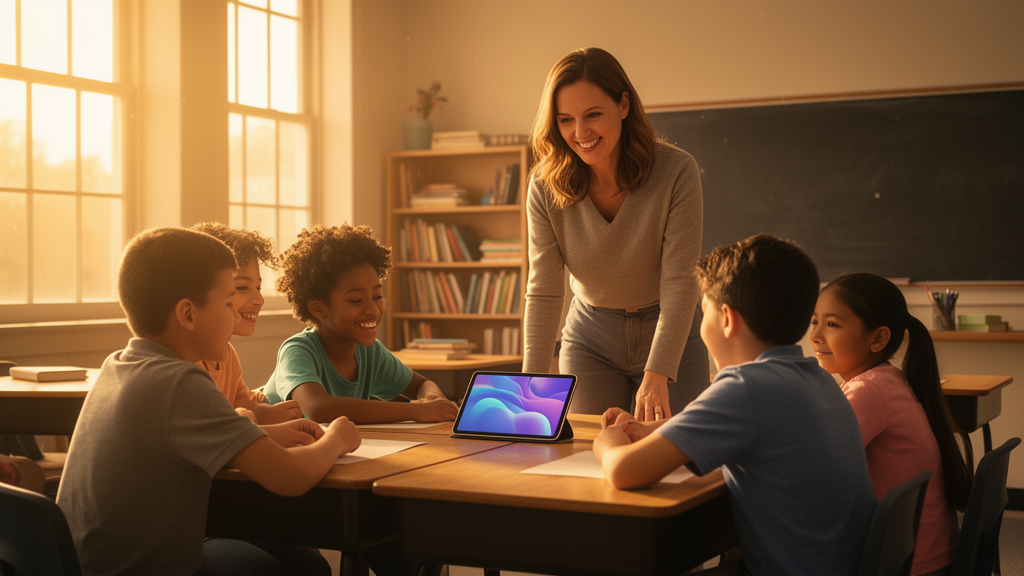
The second theme confronts what the authors call the existential crisis of the human educator. As AI systems become increasingly adept at labor-intensive tasks such as designing curricula and materials and assessing student work, the editorial asks bluntly what is left for the human teacher if an algorithm can deliver a perfectly calibrated lecture and instantly diagnose student misconceptions. The summit experts unanimously agreed that human educators will not be replaced, but that their roles must undergo a radical metamorphosis. The educator of the AI age, they write, must transition from being a sage on the stage to a guide on the side, or more accurately a scaffolding builder and an emotional anchor. Although AI has boundless data-processing capabilities, the authors argue, it lacks the human touch. AI chatbots can mimic human sympathy, but they cannot truly empathize, model moral courage or inspire students through the sheer force of human passion. Citing extensive psychological research on the importance of teacher-student relationships, the editorial contends that in an era increasingly defined by digital isolation and rising psychological anxiety among youth, the teacher’s role as an emotional connector and supporter becomes paramount.
The editorial sketches a concrete vision for this transformed profession. Teachers, it argues, will need to evolve into coaches for complex problem-solving and facilitators of socio-emotional learning, actively reimagining the overarching pedagogical architecture and curating AI tools to serve humanistic ends. The irreplaceability of the human educator will lie in the capacity to cultivate empathy, ethical reasoning and the intrinsic motivation to learn, qualities the authors assert no large language model, however advanced, can replicate. The future educator, they predict, will operate at the intersection of pedagogy and emotional intelligence, using AI as a diagnostic tool while reserving the deeply human work of mentorship and moral development for themselves. This is a normative argument grounded in expert consensus rather than a measured prediction from longitudinal data, and the editorial does not claim that these role changes have already occurred at scale.
The third and, by the authors’ account, most urgent concern raised at the summit panel revolved around the opacity of highly complex AI models, the so-called black box problem. As AI systems take on a more central role in teaching and assessment, the processes by which they reach their conclusions become increasingly opaque to users, fueling anxiety among educators and students who rely on tools they do not fully understand. When an AI platform generates a personalized learning path or evaluates a student’s work, the underlying criteria are often hidden within billions of parameters. The experts highlighted the profound difficulty of verifying whether AI-generated knowledge maps actually align with human cognitive developmental stages, and they called for rigorous, independent evaluation of AI educational tools to ensure they are pedagogically sound rather than merely technologically impressive. As a partial remedy, the editorial champions Explainable AI, or XAI, techniques such as SHAP and LIME, which can reveal which factors, like attendance or quiz scores, most influenced a student’s predicted performance. That transparency, the authors argue, allows educators to trust predictions, understand the reasoning behind them and design targeted interventions for at-risk students.
The editorial also sounds an alarm about equity. Algorithmic bias is well documented, the authors note, and AI models trained on historical data can easily perpetuate and amplify systemic prejudices. If access to premium, highly personalized AI tutors becomes a privilege of the affluent while underfunded rural schools have limited or no access to effective AI systems, they warn, the digital divide will widen into an unbridgeable chasm. The summit experts underscored that the pursuit of AI in education must be linked to a commitment to equity, ensuring these tools democratize learning rather than stratify it, and they called on policymakers to establish ethical frameworks mandating algorithmic transparency and equitable access to AI infrastructure. The fourth theme addresses the curriculum itself: because AI can aggregate and analyze global information in real time, the authors argue that the static, textbook-based model of K-12 schooling is obsolete, and they advocate building a living knowledge system, a dynamic curriculum that co-evolves with AI and a rapidly changing world.
Even here, the experts inserted a critical caveat about the nature of knowledge. AI operates on probabilistic logic, retrieving and presenting existing knowledge based on statistical likelihoods, and generative AI technologies do not create new knowledge in the human sense. AI, the editorial states, lacks true intentionality, intuition and the capacity for paradigm-shifting leaps of imagination. An education system overly reliant on AI-generated content therefore risks becoming an echo chamber of the past. The prescribed response is a pedagogical pivot away from the mere transmission of facts toward cultivating critical thinking and creativity, teaching students not just how to find answers but how to ask the profound, disruptive questions that AI cannot formulate, and training them to critically interrogate AI outputs and treat the machine as a collaborative tool rather than an infallible oracle. The editorial concludes that AI will subvert the mechanics of teaching and learning but cannot replace the soul and spirit of education, and that the guiding principle at the start of this transition must be to preserve and elevate human agency. The ultimate goal, the authors write, is not to produce students who can compete with machines in data processing, but to cultivate their essential humanity with digital well-being. As an expert commentary rather than a data-driven study, the piece offers a framework for debate rather than proof of outcomes, but its warning is unambiguous: the technology should serve human development, not quietly absorb it.
Subject of Research: An editorial synthesizing expert perspectives on how artificial intelligence should reshape K-12 education while preserving human agency, equity and the teacher's role.
Article Title: Reimagining K-12 education in the era of artificial intelligence: a critical paradigm shift toward human-machine symbiosis
Article References: Li, H., Yeung, S. S.-S., Xu, G., Ye, F., Lu, C., Chen, E. E., Yang, W., Wu, D., Tao, S., Zhou, N., Sun, T., Wang, Y., & Ding, K. (2026). Reimagining K-12 education in the era of artificial intelligence: a critical paradigm shift toward human-machine symbiosis. AI, Brain and Child, 2(1), Article 20. https://doi.org/10.1007/s44436-026-00044-4
Image Credits: AI Generated
DOI: 10.1007/s44436-026-00044-4
Keywords: artificial intelligence, K-12 education, personalized learning, human-machine symbiosis, algorithmic opacity, Explainable AI, cognitive offloading, teacher roles, educational equity, digital divide, socio-emotional learning, curriculum innovation
Cite Scienmag News
Courtney Benton. (October 28, 2026). AI Could Reshape K-12 Schooling, but Experts Warn It Must Not Replace the Human Teacher. Scienmag. https://scienmag.com/ai-could-reshape-k-12-schooling-but-experts-warn-it-must-not-replace-the-human-teacher/
Courtney Benton. "AI Could Reshape K-12 Schooling, but Experts Warn It Must Not Replace the Human Teacher." Scienmag, 28 October 2026, https://scienmag.com/ai-could-reshape-k-12-schooling-but-experts-warn-it-must-not-replace-the-human-teacher/. Accessed 28 October 2026.
Courtney Benton. "AI Could Reshape K-12 Schooling, but Experts Warn It Must Not Replace the Human Teacher." Scienmag. October 28, 2026. https://scienmag.com/ai-could-reshape-k-12-schooling-but-experts-warn-it-must-not-replace-the-human-teacher/