


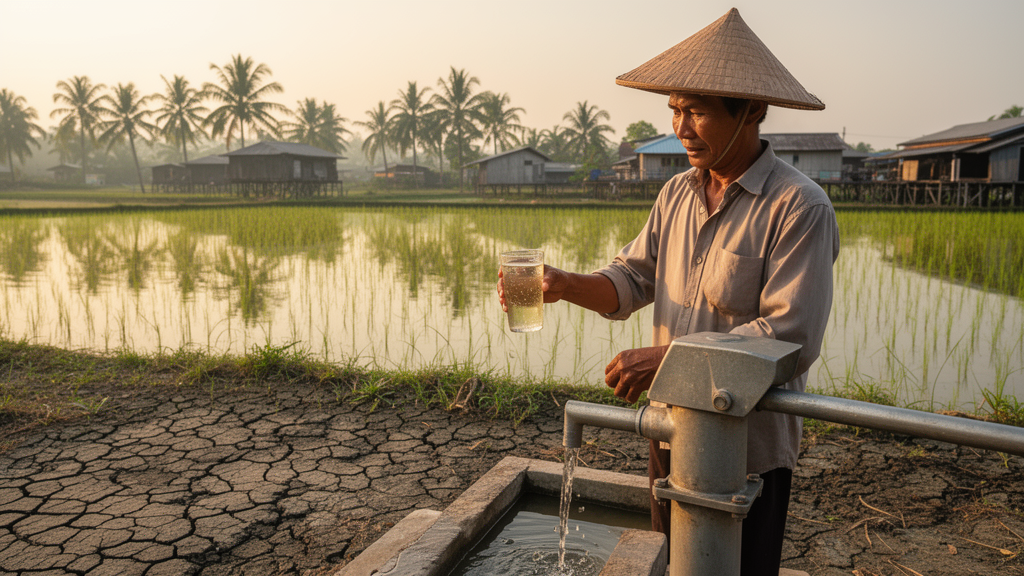
Groundwater across Tien Giang province in the Vietnamese Mekong Delta is largely suitable for irrigation but often fails the country’s stricter drinking water limits, according to a new assessment published in Environmental Systems Research. The study, led by Nguyen Thanh Giao and colleagues, found that iron exceeded domestic water quality limits in 65.6 percent of samples collected in 2020, while chloride was problematic in 20.4 percent of samples that year. In 2022, arsenic exceeded limits in 29.0 percent of samples, iron in 22.6 percent, and manganese in 14.0 percent.
The research team collected groundwater samples from 31 locations during March, June, and September in both 2020 and 2022. The samples were analyzed for key physico-chemical and microbial parameters, providing a repeated snapshot of water conditions across the coastal province over two separate years.
To evaluate the water, the researchers combined direct comparison with Vietnamese national standards with statistical analysis. They used the national groundwater quality standard QCVN 09-MT:2015/BTNMT and the domestic water quality standard QCVN 01-1:2018/BYT as benchmarks, and applied the Integrated Water Quality Index (IWQI), Principal Component Analysis (PCA), and the Absolute Principal Component Score-Multiple Linear Regression (APCS-MLR) method to interpret the data and trace pollution sources.
Against the general groundwater standard, most parameters met the requirements, and the IWQI classified the samples as good and excellent, indicating suitability for irrigation. However, the picture changed sharply when the stricter domestic water regulations were applied. Because QCVN 01-1:2018/BYT sets tighter limits for consumption, many groundwater samples were found unsuitable for drinking without treatment, driven largely by elevated concentrations of iron and chloride in 2020 and by arsenic, iron, and manganese in 2022.
The heavy metal concentrations observed in the study represent a pollution risk, and the authors conclude that water treatment is needed before consumption. This distinction between the two standards is central to the findings: water that scores well under the general groundwater classification can still carry contaminants at levels that fail the limits designed to protect household consumers.
Industrial use also faced constraints. The study found that 12.9 to 22.6 percent of the sampled locations showed corrosion potential according to pH and chloride levels, a concern for infrastructure such as pipes and industrial equipment that comes into contact with the water.
Spatial analysis revealed an uneven distribution of water quality across the province, with poorer groundwater quality concentrated in the central and eastern regions. This geographic pattern gives local managers a clearer picture of where treatment and monitoring efforts may be most needed.
Using PCA and the APCS-MLR source apportionment method, the researchers identified mineralization and ion exchange, together with agricultural impacts, as the primary determinants of groundwater quality in the province. This suggests that both natural geochemical processes and human activity on the land surface shape the chemical character of the aquifer.
The authors state that these findings highlight the need for targeted groundwater treatment and management in Tien Giang to ensure the safety of both domestic and industrial water supply. The study is published as open access research, and the version currently available is a peer-reviewed accepted manuscript shared early for faster access, subject to further edits before the final version of record.
For a delta province where groundwater remains an important resource for households and farming, the study’s repeated sampling across 2020 and 2022 offers a detailed local baseline.
Subject of Research: Groundwater quality, pollution sources and suitability for domestic, irrigation and industrial use in Tien Giang province, Vietnam
Article Title: Assessment of coastal groundwater quality, pollution sources, and fitness-for-purpose in Tien Giang province of the Vietnamese Mekong Delta
Article References: Giao, N. T., Nhien, H. T. H., Nghia, N. H., & Thuptimdang, P. (2026). Assessment of coastal groundwater quality, pollution sources, and fitness-for-purpose in Tien Giang province of the Vietnamese Mekong Delta. Environmental Systems Research. https://doi.org/10.1186/s40068-026-00498-8
Image Credits: AI Generated
DOI: 10.1186/s40068-026-00498-8
Keywords: groundwater, Tien Giang, Mekong Delta, Vietnam, water quality, heavy metals, arsenic, iron, manganese, chloride, irrigation, IWQI
Cite Scienmag News
Violet Maxwell. (October 27, 2026). Heavy metals and salt push Mekong Delta groundwater past drinking limits in Tien Giang. Scienmag. https://scienmag.com/heavy-metals-and-salt-push-mekong-delta-groundwater-past-drinking-limits-in-tien-giang/
Violet Maxwell. "Heavy metals and salt push Mekong Delta groundwater past drinking limits in Tien Giang." Scienmag, 27 October 2026, https://scienmag.com/heavy-metals-and-salt-push-mekong-delta-groundwater-past-drinking-limits-in-tien-giang/. Accessed 27 October 2026.
Violet Maxwell. "Heavy metals and salt push Mekong Delta groundwater past drinking limits in Tien Giang." Scienmag. October 27, 2026. https://scienmag.com/heavy-metals-and-salt-push-mekong-delta-groundwater-past-drinking-limits-in-tien-giang/


