Thursday, October 29, 2026
Science
No Result
View All Result
  • Login
  • HOME
  • SCIENCE NEWS
  • CONTACT US
  • HOME
  • SCIENCE NEWS
  • CONTACT US
No Result
View All Result
Scienmag
No Result
View All Result
Home Science News Technology and Engineering

Review Maps How Machine Learning Estimates Electric Vehicle Remaining Range

October 27, 2026
in Technology and Engineering
Blake Davidson
By Blake Davidson Scienmag Editorial Profile - Data Science
Reading Time: 2 mins read
0
Review Maps How Machine Learning Estimates Electric Vehicle Remaining Range

Review Maps How Machine Learning Estimates Electric Vehicle Remaining Range

65
SHARES
587
VIEWS
Share on FacebookShare on Twitter
ADVERTISEMENT

A newly published review in Energy Informatics examines how researchers estimate the remaining driving range of electric vehicles, a figure that sits at the center of what drivers call range anxiety. The paper, authored by Mrugank Gandhi and Archana Y. Chaudhari and published on 20 October 2026, surveys the data, features, and modeling approaches used to predict how far an EV can travel before its battery runs down.

The review traces a shift in the field. Earlier systems relied on conventional rule-based methods, while recent data-driven modeling allows intelligent systems to learn complex relationships among driving styles, battery dynamics, and interactions with the external environment. According to the authors, this transition has transformed how remaining driving range is calculated, moving estimation away from fixed rules toward models that adapt to how a vehicle is actually being driven.

A central finding of the review is that combining real-time sensor data with machine learning and deep learning models improves the accuracy of range estimation. These approaches capture multifaceted relationships among driving speed, acceleration, temperature, road topology, and the battery’s state of charge, the variable that describes how much energy remains in the pack. Because range depends on all of these factors at once, models that can learn their interactions have an advantage over simpler calculations.

The authors frame accurate range estimation as more than a convenience for drivers. They describe it as essential for alleviating range anxiety, improving energy management, and supporting sustainable mobility in public spaces.

Accuracy is not the review’s only concern. The authors identify interpretability and trustworthiness as significant challenges that remain unresolved in current approaches.

Looking forward, the review argues that causal inference and uncertainty quantification should become essential components of future predictive systems.

The article is published open access, and the version released on 20 October 2026 is an early-release copy of the peer-reviewed, accepted research. It carries a permanent DOI and is citable, but the publisher notes that this version is subject to further edits and will be replaced automatically by the final Version of Record.

By organizing the field’s data sources, input features, and modeling techniques in one place, the authors provide a reference point for researchers working on the next generation of range predictors, and they make the case that the field’s future lies in models that are not only accurate but also interpretable and honest about their own uncertainty.

Subject of Research: A review of data, features, and modeling approaches for estimating the remaining driving range of electric vehicles.

Article Title: A comprehensive review of data, features, and modeling approaches for estimating remaining driving range in electric vehicle

Article References: Gandhi, M., & Chaudhari, A. Y. (2026). A comprehensive review of data, features, and modeling approaches for estimating remaining driving range in electric vehicle. Energy Informatics. https://doi.org/10.1186/s42162-026-00698-7

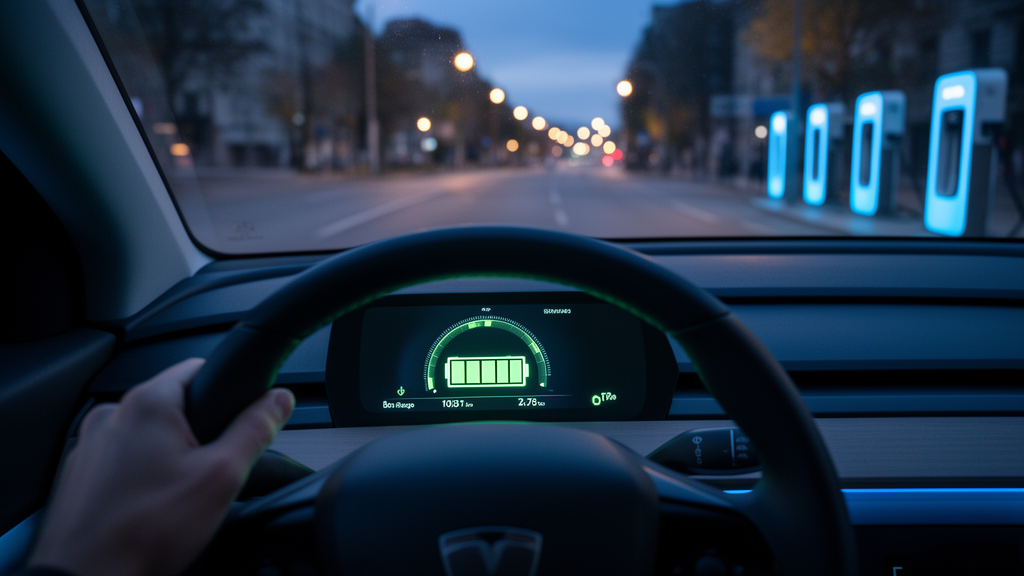
Image Credits: AI Generated

DOI: 10.1186/s42162-026-00698-7

Keywords: electric vehicles, remaining driving range, range anxiety, machine learning, deep learning, state of charge, battery dynamics, sensor data, interpretability, uncertainty quantification, energy management, review

Cite Scienmag News

Blake Davidson. (October 27, 2026). Review Maps How Machine Learning Estimates Electric Vehicle Remaining Range. Scienmag. https://scienmag.com/review-maps-how-machine-learning-estimates-electric-vehicle-remaining-range/


Blake Davidson. "Review Maps How Machine Learning Estimates Electric Vehicle Remaining Range." Scienmag, 27 October 2026, https://scienmag.com/review-maps-how-machine-learning-estimates-electric-vehicle-remaining-range/. Accessed 29 October 2026.

Blake Davidson. "Review Maps How Machine Learning Estimates Electric Vehicle Remaining Range." Scienmag. October 27, 2026. https://scienmag.com/review-maps-how-machine-learning-estimates-electric-vehicle-remaining-range/

Tags: advancements in energy informatics for electric vehiclesbattery dynamicsdata-driven modeling for EV rangedeep learningdeep learning for EV battery state of charge predictionElectric vehicle remaining driving range estimationelectric vehiclesenergy managementenvironmental factors influencing EV range accuracyimpact of driving styles on EV rangeinterpretabilityMachine learningmachine learning in EV range predictionmultifaceted factors affecting EV driving rangerange anxietyreal-time sensor data utilization in electric vehicle range predictionreducing range anxiety through improvedremaining driving rangereviewsensor datasensor data integration in electric vehicle range estimationshift from rule-based to AI models in EV range estimationstate of chargeuncertainty quantification
Share26Tweet16
Previous Post

New interpretability method reveals how deep learning predicts El Niño

Next Post

Serum Asprosin Tracks Sex, Not Fibrosis, in Chronic Hepatitis C

Related Posts

DOE-led BattMan Accelerator aims to push battery innovation from lab to US factory floor
Technology and Engineering

DOE-led BattMan Accelerator aims to push battery innovation from lab to US factory floor

October 29, 2026
Convolution-Inspired Spiking Neural P Circuit Achieves Lossless 75 Percent Image Resizing in Reversible Data-Hiding Framework for DICOM Medical Images
Technology and Engineering

Convolution-Inspired Spiking Neural P Circuit Achieves Lossless 75 Percent Image Resizing in Reversible Data-Hiding Framework for DICOM Medical Images

October 29, 2026
Simulated Graphene-GaN Nanopillar Photodetector Runs on Zero Power for UV Wireless Links
Technology and Engineering

Simulated Graphene-GaN Nanopillar Photodetector Runs on Zero Power for UV Wireless Links

October 29, 2026
Neural Network Learns to Predict Carreau Nanofluid Flow in Seconds
Technology and Engineering

Neural Network Learns to Predict Carreau Nanofluid Flow in Seconds

October 29, 2026
Multi-criteria decision making offers new route to community detection in complex networks
Technology and Engineering

Multi-criteria decision making offers new route to community detection in complex networks

October 29, 2026
Blockchain-Backed Fog Nodes Team Up to Catch IoT Intrusions
Technology and Engineering

Blockchain-Backed Fog Nodes Team Up to Catch IoT Intrusions

October 29, 2026
Next Post
Serum Asprosin Tracks Sex, Not Fibrosis, in Chronic Hepatitis C

Serum Asprosin Tracks Sex, Not Fibrosis, in Chronic Hepatitis C

  • Mothers who receive childcare support from maternal grandparents show more optimized

    Mothers who receive childcare support from maternal grandparents show more parental warmth, finds NTU Singapore study

    27656 shares
    Share 11059 Tweet 6912
  • University of Seville Breaks 120-Year-Old Mystery, Revises a Key Einstein Concept

    1061 shares
    Share 424 Tweet 265
  • Bee body mass, pathogens and local climate influence heat tolerance

    682 shares
    Share 273 Tweet 171
  • Researchers record first-ever images and data of a shark experiencing a boat strike

    546 shares
    Share 218 Tweet 137
  • Groundbreaking Clinical Trial Reveals Lubiprostone Enhances Kidney Function

    531 shares
    Share 212 Tweet 133
Science

Embark on a thrilling journey of discovery with Scienmag.com—your ultimate source for cutting-edge breakthroughs. Immerse yourself in a world where curiosity knows no limits and tomorrow’s possibilities become today’s reality!

RECENT NEWS

  • Scoping review maps WASH evidence gaps in soil-transmitted helminth control
  • Serum miRNA-29b and miRNA-99b show no clear link to stroke in young adults
  • Research report: Short-term outcomes associated with oral prednisolone versus posterior sub-Tenon triamcinolone acetonide in acute ocular Vogt-Koyanagi-Harada disease
  • Cyprus Ties NICE Kidney Guideline to Better CKD Care in First Year

Categories

  • Agriculture
  • Anthropology
  • Archaeology
  • Athmospheric
  • Biology
  • Biotechnology
  • Blog
  • Bussines
  • Cancer
  • Chemistry
  • Climate
  • Earth Science
  • Editorial Policy
  • Marine
  • Mathematics
  • Medicine
  • Pediatry
  • Policy
  • Psychology & Psychiatry
  • Science Education
  • Science News
  • Social Science
  • Space
  • Technology and Engineering

Subscribe to Blog via Email

Enter your email address to subscribe to this blog and receive notifications of new posts by email.

Join 5,151 other subscribers

© 2025 Scienmag - Science Magazine

Welcome Back!

Login to your account below

Forgotten Password?

Retrieve your password

Please enter your username or email address to reset your password.

Log In
No Result
View All Result
  • HOME
  • SCIENCE NEWS
  • CONTACT US

© 2025 Scienmag - Science Magazine

Discover more from Science

Subscribe now to keep reading and get access to the full archive.

Continue reading