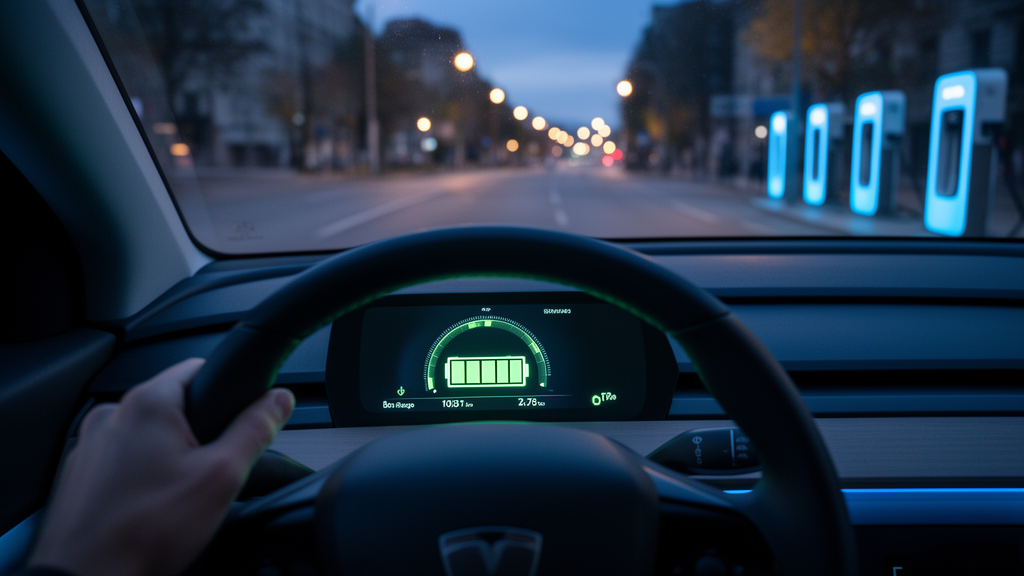
A newly published review in Energy Informatics examines how researchers estimate the remaining driving range of electric vehicles, a figure that sits at the center of what drivers call range anxiety. The paper, authored by Mrugank Gandhi and Archana Y. Chaudhari and published on 20 October 2026, surveys the data, features, and modeling approaches used to predict how far an EV can travel before its battery runs down.
The review traces a shift in the field. Earlier systems relied on conventional rule-based methods, while recent data-driven modeling allows intelligent systems to learn complex relationships among driving styles, battery dynamics, and interactions with the external environment. According to the authors, this transition has transformed how remaining driving range is calculated, moving estimation away from fixed rules toward models that adapt to how a vehicle is actually being driven.
A central finding of the review is that combining real-time sensor data with machine learning and deep learning models improves the accuracy of range estimation. These approaches capture multifaceted relationships among driving speed, acceleration, temperature, road topology, and the battery’s state of charge, the variable that describes how much energy remains in the pack. Because range depends on all of these factors at once, models that can learn their interactions have an advantage over simpler calculations.
The authors frame accurate range estimation as more than a convenience for drivers. They describe it as essential for alleviating range anxiety, improving energy management, and supporting sustainable mobility in public spaces.
Accuracy is not the review’s only concern. The authors identify interpretability and trustworthiness as significant challenges that remain unresolved in current approaches.
Looking forward, the review argues that causal inference and uncertainty quantification should become essential components of future predictive systems.
The article is published open access, and the version released on 20 October 2026 is an early-release copy of the peer-reviewed, accepted research. It carries a permanent DOI and is citable, but the publisher notes that this version is subject to further edits and will be replaced automatically by the final Version of Record.
By organizing the field’s data sources, input features, and modeling techniques in one place, the authors provide a reference point for researchers working on the next generation of range predictors, and they make the case that the field’s future lies in models that are not only accurate but also interpretable and honest about their own uncertainty.
Subject of Research: A review of data, features, and modeling approaches for estimating the remaining driving range of electric vehicles.
Article Title: A comprehensive review of data, features, and modeling approaches for estimating remaining driving range in electric vehicle
Article References: Gandhi, M., & Chaudhari, A. Y. (2026). A comprehensive review of data, features, and modeling approaches for estimating remaining driving range in electric vehicle. Energy Informatics. https://doi.org/10.1186/s42162-026-00698-7
Image Credits: AI Generated
DOI: 10.1186/s42162-026-00698-7
Keywords: electric vehicles, remaining driving range, range anxiety, machine learning, deep learning, state of charge, battery dynamics, sensor data, interpretability, uncertainty quantification, energy management, review
Cite Scienmag News
Blake Davidson. (October 27, 2026). Review Maps How Machine Learning Estimates Electric Vehicle Remaining Range. Scienmag. https://scienmag.com/review-maps-how-machine-learning-estimates-electric-vehicle-remaining-range/
Blake Davidson. "Review Maps How Machine Learning Estimates Electric Vehicle Remaining Range." Scienmag, 27 October 2026, https://scienmag.com/review-maps-how-machine-learning-estimates-electric-vehicle-remaining-range/. Accessed 28 October 2026.
Blake Davidson. "Review Maps How Machine Learning Estimates Electric Vehicle Remaining Range." Scienmag. October 27, 2026. https://scienmag.com/review-maps-how-machine-learning-estimates-electric-vehicle-remaining-range/