


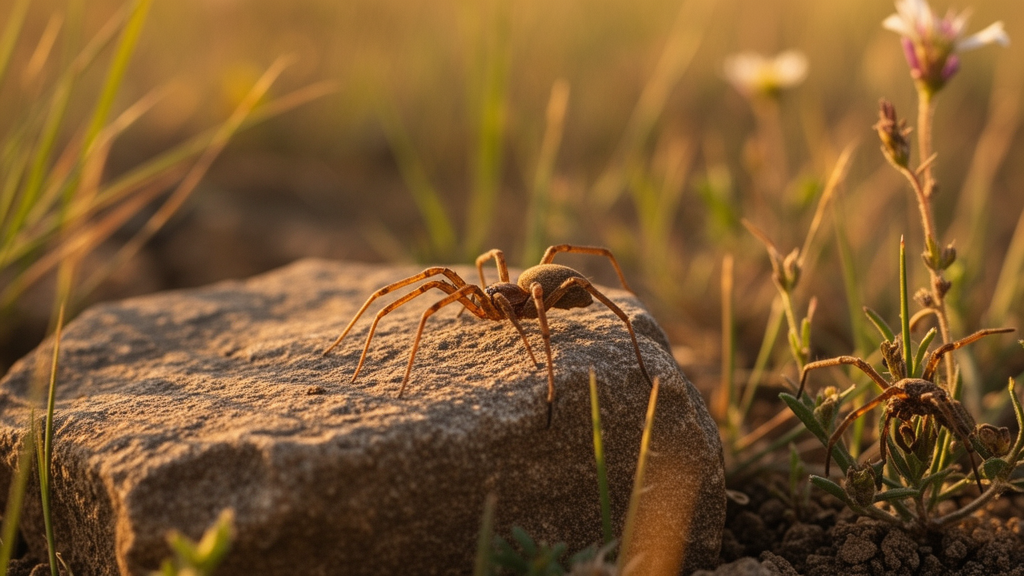
Two spider species previously unknown to science have been discovered in Armenia, according to a new taxonomic study published in the journal ZooKeys. The species belong to the genus Zora, a group of spiders in the family Miturgidae, and were found during fieldwork carried out in May 2021 in several provinces of the country. Alongside the two new species, named Zora armeniaca and Zora bicoloripes, the study reports two species, Zora pardalis and Zora spinimana, for the first time from Armenia, raising the number of Zora species known from the country to five.
The genus Zora comprises 22 currently known species distributed exclusively in the Holarctic realm. Twenty of these species occur in the Palaearctic, while two are endemic to the Nearctic. In Eurasia, the genus reaches as far north as 70 degrees north in Fennoscandia and 62 degrees north in eastern Siberia. Despite this broad distribution, the fauna of the South Caucasus had never been revised, and records from the region had mostly appeared as parts of general faunistic surveys rather than dedicated taxonomic treatments.
Before the new study, only a single Zora species, Zora silvestris, had been reported from Armenia, based on an old and obscure record from Meghri published in 1986. By comparison, three species were known from Azerbaijan and six from Georgia. The recent revision of the North Caucasus fauna by Ponomarev and colleagues in 2024 recognized 12 species in that region, including three described as new to science, indicating that the Caucasus as a whole holds a substantial share of the genus’s global diversity. More than half of the known species diversity of Zora has already been documented in the Caucasus, which made the discovery of further species in Armenia a plausible outcome of targeted collecting.
The fieldwork behind the new descriptions took place in 2021 and covered sites in Ararat Province, Vayot Dzor Province and the city of Yerevan. Specimens were collected by Y.M. Marusik at localities including the surroundings of Urtsadzor, the Goravan Sands State Sanctuary, Garni Gorge along the Azat River, the Gnishik River canyon near the road to Noravank Monastery, and the botanical garden in Yerevan. Elevations at the collecting sites ranged from roughly 1200 to 1400 metres, and habitats included clay slopes and river canyons.
The specimens were studied using an Olympus Camedia E-520 camera mounted on an Olympus SZX16 stereomicroscope at the Zoological Museum of the University of Turku in Finland. Digital images captured at multiple focal planes were stacked with Helicon Focus 8.1.1 to produce sharp composite photographs. The endogyne, the internal female reproductive structure, was photographed after soft tissues were digested in a 10 percent aqueous potassium hydroxide solution. Leg measurements were taken dorsally and reported as total length of the femur, patella, tibia, metatarsus and tarsus, with all measurements given in millimetres. Comparative photographs of Zora manicata and Zora silvestris taken by Pierre Oger were consulted through an online image archive, and type material was deposited in the Zoological Museum of Moscow University and the Zoological Museum of the University of Turku.
Zora armeniaca was described from both sexes. The male holotype, collected near Urtsadzor in Ararat Province at 1200 to 1300 metres on a clay slope, has a total length of 2.85 millimetres and a carapace 1.40 millimetres long and 1.15 millimetres wide. The species is pale yellowish brown in overall coloration, with greyish brown submedian bands and lateral markings on the carapace, and the abdomen carries a brown cardiac mark with posterior chevrons and scattered pale grey and dark brown markings. Paratypes include males from Goravan Sands and Garni Gorge, males and females from the Gnishik River canyon in Vayot Dzor Province, and males and females from the Yerevan botanical garden. The species is currently known only from these listed localities in Armenia.
The diagnosis of Zora armeniaca rests on a combination of somatic and genitalic characters. Among Caucasian species with two pairs of ventral spines on the first and second metatarsi, the new species differs from Zora caucasia, Zora manicata and Zora osetica in its lighter overall body coloration, and from Zora alpina and Zora dagestana in the shape of the retrolateral tibial apophysis, a structure of the male palp. In both sexes, the dark marginal stripe of the carapace is interrupted rather than continuous, and the metatarsi and tarsi are not darkened, unlike in Zora silvestris. The male further differs from Zora alexeevi and Zora silvestris in having the base of the retrolateral tibial apophysis inclined rather than forming a right angle, and the female differs from Zora alpina in the shape of the fovea and from Zora alexeevi and Zora silvestris in having shorter copulatory ducts. The male palp shows a curved retrolateral tibial apophysis with a broad base and a bifurcated tip, and the epigyne has a heart-shaped fovea anteriorly, broad copulatory ducts making a single medial loop, and closely spaced circular receptacles.
The second new species, Zora bicoloripes, is known only from a single male, the holotype, collected in Garni Gorge along the Azat River in Ararat Province at 1240 metres. The species name derives from Latin and means “two-colored legs,” referring to the contrasting coloration of the legs: the femora are dark brown while the remaining leg segments are light yellow. The male has a total length of 2.80 millimetres and a carapace 1.45 millimetres long and 1.15 millimetres wide, with a pale yellowish brown carapace bearing dark brown broad submedian and lateral bands, dark brown chelicerae, maxillae and labium, and a reddish brown sternum with a black median band. The female of the species is unknown. Among Caucasian species with two pairs of ventral spines on the first and second metatarsi, Zora bicoloripes resembles Zora manicata and Zora osetica in overall body coloration and the shape of the retrolateral tibial apophysis, but it differs from Zora manicata in having only the femora darkened, and from Zora osetica in having five rather than six pairs of ventral tibial spines, a subdivided rather than undivided tip of the retrolateral tibial apophysis, black rather than brown femora on all legs, and a lighter abdomen with fewer brown spots.
In addition to the two new species, the study documents Zora pardalis and Zora spinimana from Armenia for the first time, both based on material collected near Aghavnadzor in Kotayk Province in May 2021. Zora pardalis is a West Palaearctic species distributed from the Iberian Peninsula to Kazakhstan, and Zora spinimana is a trans-Palaearctic species ranging from the Iberian Peninsula to Kamchatka. Both records came from a single sampling locality, where one male of Zora pardalis and two males, six females and three juveniles of Zora spinimana were collected. With these additions, five species of Zora are now known from Armenia, where previously only Zora silvestris had been reported.
The authors note that the 2024 revision of the Caucasian species by Ponomarev and colleagues did not include Armenia within the known range of Zora silvestris, and it is possible that the old Armenian record from Meghri actually pertains to Zora armeniaca, which closely resembles Zora silvestris in both the shape of the retrolateral tibial apophysis and the coloration pattern. The two species described here are the first members of the genus described from the South Caucasus, and apart from a record of Zora osetica from Georgia, all other regional records belong to widely distributed species and may have been misidentified. Several species treated in the 2024 revision had previously been misidentified, including Zora caucasia, which had been recorded as Zora silvestris in North Ossetia and Adygeya and as Zora manicata in Karachay-Cherkessia. The study also highlights that there is remarkable homogeneity in the structure of the male palp and the epigyne among species of the genus, so species delimitation relies largely on somatic characters such as spination and color patterns, raising the possibility that additional undescribed species have been overlooked or misidentified. The authors suggest that revision of existing records and museum material from neighbouring countries would likely reveal further undescribed species, noting that six species are currently known from Iran, all of which, apart from the endemic Zora huseynovi known only from its type locality in northern Iran, have wide distributions and are likewise in need of revision.
Subject of Research: Taxonomic description of two new Zora spider species and two new country records from Armenia
Article Title: New species and records of Zora C.L. Koch, 1847 ( Araneae , Miturgidae ) from Armenia
Article References: Zamani, A., Kosyan, A., & Marusik, Y. M. (2026). New species and records of Zora C.L. Koch, 1847 (Araneae, Miturgidae) from Armenia. ZooKeys, 1287, 1-10. https://doi.org/10.3897/zookeys.1287.203444
Image Credits: AI Generated
DOI: 10.3897/zookeys.1287.203444
Keywords: Zora, Miturgidae, Armenia, spider taxonomy, new species, South Caucasus, arachnology, faunistics, ZooKeys, biodiversity, species description, Palaearctic
Cite Scienmag News
Drew Townsend. (October 27, 2026). Two New Spider Species Discovered in Armenia Expand the Genus Zora in the South Caucasus. Scienmag. https://scienmag.com/two-new-spider-species-discovered-in-armenia-expand-the-genus-zora-in-the-south-caucasus/
Drew Townsend. "Two New Spider Species Discovered in Armenia Expand the Genus Zora in the South Caucasus." Scienmag, 27 October 2026, https://scienmag.com/two-new-spider-species-discovered-in-armenia-expand-the-genus-zora-in-the-south-caucasus/. Accessed 27 October 2026.
Drew Townsend. "Two New Spider Species Discovered in Armenia Expand the Genus Zora in the South Caucasus." Scienmag. October 27, 2026. https://scienmag.com/two-new-spider-species-discovered-in-armenia-expand-the-genus-zora-in-the-south-caucasus/


