


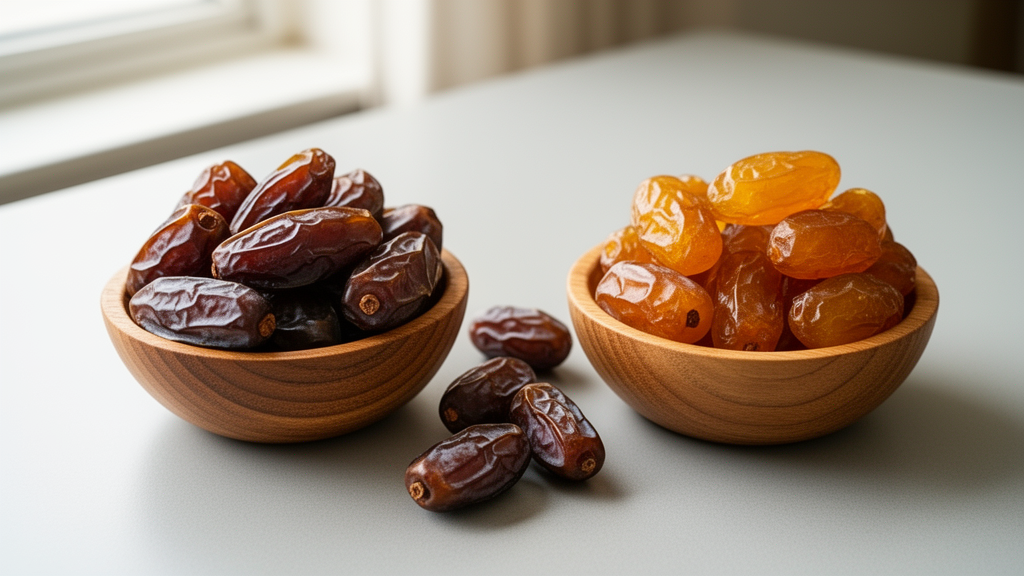
Dates from fourteen Pakistani cultivars and six Saudi Arabian cultivars have been analysed side by side using the same laboratory procedures, in one of the few direct comparisons of date palm fruit from South Asia and the Middle East carried out under a single analytical protocol. The study, published in Food Chemistry: X, measured the proximate composition, nine essential minerals, multivariate compositional patterns and estimated dietary exposure for twenty date varieties, and found high cultivar-to-cultivar variability but no overall significant difference in most macronutrients between the two countries.
The Pakistani varieties, including Aseel, Asul kurh, Basra, Began, Dadhy, Fasly, Gajar, Kashu wari, Karbalain, Kupro, Nakkul, Oatakin, Pathri and Pir wari, were collected from date palm farms in the Sukkur and Khairpur districts of Sindh province during the July to August 2018 harvesting season. The Saudi Arabian varieties, Ajwa, Amber, Kalmi, Safawi, Sukkari and Suqai, were purchased from local markets near date palm farms in the Madina region during the same two-month window. Sample sizes ranged from eight to sixteen independent batches per cultivar, giving twenty pooled composite samples in total.
The authors were explicit about what their sampling could and could not support. Cultivar names were taken from the identification information available at harvest or purchase, and there was no systematic documentation of maturation status, exact harvest or purchase dates, or the number of batches behind the market-bought Saudi samples. Because fruits from each variety were pooled and homogenised before analysis, the three replicate measurements per variety were technical or analytical replicates rather than independent biological replicates. The team therefore framed all observed differences as compositional observations rather than evidence about growing conditions.
Proximate analysis followed Association of Official Analytical Chemists methods, with moisture determined by method 930.15 and ash, protein, fat and fibre by methods 942.05, 984.13, 920.39 and 978.10 respectively. Carbohydrate was calculated by difference from 100 after subtracting protein, fat, moisture and ash. All analyses were performed in triplicate at ISO-certified laboratories, with relative standard deviations below 3.0 percent. Pakistani dates contained between 2.78 and 4.55 grams of protein per 100 grams on a dry-weight basis, with Aseel the highest at an average of 4.55 grams and Nakkul close behind at 4.46 grams. Among the Saudi varieties, Ajwa reached 4.11 to 4.15 grams. The authors noted that protein levels were comparatively low across both countries, indicating that date palm is not a strong protein source.
Fat contents were modest throughout. The lowest values among the Pakistani dates appeared in Basra, Kashu wari and Gajar, ranging from roughly 1.97 to 2.25 grams per 100 grams, while the remaining Pakistani varieties fell between 2.40 and 3.43 grams. Saudi Arabian varieties stayed below 3.5 grams, with the highest in Suqai. Fibre ranged widely among the Pakistani cultivars, from 2.49 up to 10 grams per 100 grams, while all six Saudi varieties exceeded 5.43 grams. Carbohydrates, the dominant macronutrient, peaked in the Pakistani varieties Dedhi, Pir wari and Gajar at 78.6 to 78.9, 75.9 to 76.3 and 74.2 to 74.5 grams per 100 grams respectively, with other Pakistani dates between 63.6 and 73.6 grams and all Saudi varieties above 65 grams. Ash content in the Pakistani dates ranged from 1.33 to 2.86 grams per 100 grams. A one-way analysis of variance found no significant differences between the two countries for moisture, ash, protein, fat, fibre or carbohydrate, with p-values all above 0.05.
Mineral analysis was performed by atomic absorption spectrometry after acid digestion, with calibration curves showing coefficients of determination above 0.990 for every element. The method was validated against two certified reference materials, wholemeal flour BCR-189 and beech leaves BCR-100, with percentage recoveries above 97 percent and no significant difference between measured and certified values at the 95 percent confidence level. Potassium emerged as the predominant mineral in every variety, consistent with earlier reports in which potassium ranged from 6789 to 8171 milligrams per kilogram across seven Saudi varieties. In the new dataset, Pathri from Pakistan had the highest potassium content at 6.58 to 6.62 milligrams per gram, while Nakkul had the lowest at 0.83 to 0.91 milligrams per gram. Among the Saudi dates, Amber was highest at 6.45 to 6.58 milligrams per gram and Suqai lowest at 3.01 to 3.14 milligrams per gram.
The statistical picture for minerals was more nuanced than for macronutrients. Potassium and magnesium levels showed no significant difference between the Pakistani and Saudi groups, with p-values of 0.222 and 0.111 respectively. Sodium and calcium, however, did differ significantly between the two sets of cultivars, with p-values of 0.047 and 0.001. Among trace elements, Fasly showed the highest chromium among Pakistani dates at 1.65 to 1.88 micrograms per gram and Kupro the lowest at 0.69 to 0.81, while Kashu wari carried the most copper at 4.00 to 4.63 micrograms per gram and iron peaked in Kashu wari at 55.0 to 55.5 micrograms per gram against a low of 13.9 to 14.6 in Basra. For the Saudi varieties, Suqai had the highest iron and Sukkari the lowest, and the iron level was descriptively higher in the Saudi group overall, though this difference was not statistically significant. The authors cautioned that soil composition, irrigation water, humidity and other environmental factors were not directly measured, so their specific contributions to the observed mineral differences cannot be established, and the absence of statistical significance for most elements suggests natural variability rather than a true geographical effect.
Multivariate analysis added a compositional map of the twenty cultivars. Principal component analysis on fifteen variables showed the first component explaining 22.5 percent of total variance, with positive loadings for carbohydrate, calcium, magnesium, copper and zinc and inverse associations for moisture, ash, protein, fat, fibre and iron. The second component accounted for a further 17.9 percent, and six components together explained 82.8 percent. Hierarchical cluster analysis divided the cultivars into two major groups: one containing Basra from Pakistan alongside the Saudi varieties Kalmi, Safawi and Sukkari, and a second containing the remaining sixteen cultivars, including pairings such as Gajar Wari with Ajwa and Began with Suqai. The authors stressed that the dendrogram groupings are exploratory, were not statistically validated, and should not be read as biological equivalence or geographical grouping, particularly given only twenty cultivar-level observations based on pooled fruit.
Dietary exposure was estimated for adults consuming three dates per day, with consumption rates ranging from 7.10 grams per day for Basra to 28.2 grams per day for Amber. Potassium contributed the highest estimated daily intake among the macrominerals at 0.77 to 1.98 milligrams per day, followed by calcium at 0.13 to 0.41 and magnesium at 0.05 to 0.22 milligrams per day, with sodium intake from Pakistani dates between 0.01 and 0.08 milligrams per day. Trace metal intakes were led by iron at 1.69 to 20.6 micrograms per day for Pakistani varieties, with zinc at 1.50 to 5.17 and copper at 0.11 to 1.60 micrograms per day. Using the United States Environmental Protection Agency target hazard quotient framework, the combined hazard index for chromium, copper, iron, manganese and zinc remained below 1.0 for every variety, the threshold below which adverse health effects are not expected. The authors concluded that consumers are unlikely to face toxicity risk from these microminerals at typical consumption levels, while also emphasising that the exposure calculations rest on scenario assumptions and should be regarded as estimates rather than direct measures of individual health risk. They called for future work with balanced sampling, biological replication, standardised post-harvest handling, and direct measurement of environmental variables, mineral speciation and bioavailability.
Subject of Research: Comparative analysis of proximate composition, mineral profiles and dietary mineral exposure in Pakistani and Saudi Arabian date palm cultivars
Article Title: Comparative proximate composition, mineral profiles and dietary exposure assessment of Pakistani and Saudi Arabian date cultivars
Article References: Baig, J. A., Shah, Z. A., Hol, A., Solangi, I. B., Perveen, S., Raza, N., & Algethami, F. K. (2026). Comparative proximate composition, mineral profiles and dietary exposure assessment of Pakistani and Saudi Arabian date cultivars. Food Chemistry: X, 40, Article 104672. https://doi.org/10.1016/j.fochx.2026.104672
Image Credits: AI Generated
DOI: 10.1016/j.fochx.2026.104672
Keywords: date palm, Phoenix dactylifera, proximate analysis, mineral composition, atomic absorption spectrometry, principal component analysis, cluster analysis, dietary exposure, target hazard quotient, Pakistan, Saudi Arabia, food chemistry
Cite Scienmag News
Bethany Barker. (October 27, 2026). Dates from Pakistan and Saudi Arabia compared nutrient by nutrient in single study. Scienmag. https://scienmag.com/dates-from-pakistan-and-saudi-arabia-compared-nutrient-by-nutrient-in-single-study/
Bethany Barker. "Dates from Pakistan and Saudi Arabia compared nutrient by nutrient in single study." Scienmag, 27 October 2026, https://scienmag.com/dates-from-pakistan-and-saudi-arabia-compared-nutrient-by-nutrient-in-single-study/. Accessed 27 October 2026.
Bethany Barker. "Dates from Pakistan and Saudi Arabia compared nutrient by nutrient in single study." Scienmag. October 27, 2026. https://scienmag.com/dates-from-pakistan-and-saudi-arabia-compared-nutrient-by-nutrient-in-single-study/


