

Tuesday, October 27, 2026
Science
No Result
View All Result
  • Login
  • HOME
  • SCIENCE NEWS
  • CONTACT US
  • HOME
  • SCIENCE NEWS
  • CONTACT US
No Result
View All Result
Scienmag
No Result
View All Result
Home Science News Climate

Molecularly Thin Bilayer Carbon Membranes Deliver Sharp CO2 Sieving

October 27, 2026
in Climate
Sloane Callahan
By Sloane Callahan Scienmag Editorial Profile - Climate Mitigation
Reading Time: 2 mins read
0
Molecularly Thin Bilayer Carbon Membranes Deliver Sharp CO2 Sieving

Molecularly Thin Bilayer Carbon Membranes Deliver Sharp CO2 Sieving

65
SHARES
587
VIEWS
Share on FacebookShare on Twitter
ADVERTISEMENT

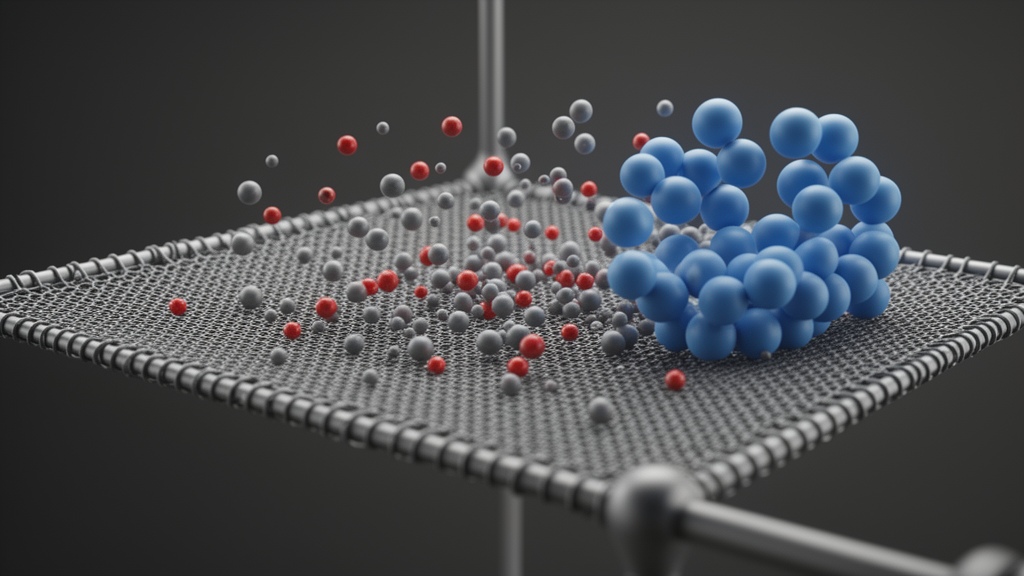
Researchers report graphene–amorphous carbon bilayer membranes that combine molecular-level thinness, precise sub-nanometre porosity and exceptional mechanical robustness, addressing a longstanding trilemma in separation science. The work, published in Nature Sustainability, targets membrane-based carbon capture as an energy-efficient and scalable alternative to conventional chemical absorption of CO2.

The membranes were produced through a graphene-guided polymer conversion approach. Leveraging a super-spreading effect, the team coated graphene with a uniform, ultra-smooth polymer-derived carbon layer as thin as 2 nanometres. Controlled pyrolysis of the polymer precursor then generated a carbon network featuring narrowly distributed, high-precision ultramicropores.

Mechanical performance was a central design goal. The resulting carbon films achieved a high Young’s modulus of approximately 26.8 gigapascals, providing the structural integrity needed for films only a few nanometres thick to remain robust during separation.

In gas separation tests, the graphene–amorphous carbon membranes exhibited sharp molecular sieving, with selectivity greater than 60 for CO2/N2, greater than 70 for H2/CO2 and greater than 70 for CO2/CH4. These selectivities indicate that the ultramicropores discriminate between molecules on the basis of subtle differences in size and shape.

Alongside this selectivity, the membranes delivered an exceptional CO2 permeance of up to 5,000 gas permeation units, which the authors report as surpassing existing benchmarks.

The combination of structural integrity and separation performance, the authors state, enables efficient carbon capture across varied flue gas, syngas and natural gas streams.

The study positions graphene–amorphous carbon membranes as a versatile, energy-efficient platform for sustainable molecular separations.

The reported performance figures come from the published abstract of the Nature Sustainability paper by Shilin Guo, Yueqing Shen, Jing Zhao and colleagues, with corresponding contributions from teams including those of Zhongyi Jiang, Guangwei He, Runnan Zhang and Kumar Varoon Agrawal.

Subject of Research: Development of molecularly thin graphene–amorphous carbon bilayer membranes for selective CO2 separation

Article Title: Efficient carbon dioxide separation with molecularly thin bilayer carbon membranes

Article References: Guo, S., Shen, Y., Zhao, J., Ma, H., He, M., Fu, J., Zhang, D., Feng, S., Yuan, S., Zhang, H., Zhao, Q., Pan, Q., Xie, E., Wang, S., Song, S., Gong, X., Zeng, Y., Zhang, R., Agrawal, K. V., … Jiang, Z. (2026). Efficient carbon dioxide separation with molecularly thin bilayer carbon membranes. Nature Sustainability. https://doi.org/10.1038/s41893-026-01973-x

Image Credits: AI Generated

DOI: 10.1038/s41893-026-01973-x

Keywords: carbon capture, graphene, amorphous carbon, membranes, molecular sieving, CO2 separation, ultramicropores, gas permeance, pyrolysis, Nature Sustainability, energy efficiency, flue gas

Cite Scienmag News

Sloane Callahan. (October 27, 2026). Molecularly Thin Bilayer Carbon Membranes Deliver Sharp CO2 Sieving. Scienmag. https://scienmag.com/molecularly-thin-bilayer-carbon-membranes-deliver-sharp-co2-sieving/

Sloane Callahan. "Molecularly Thin Bilayer Carbon Membranes Deliver Sharp CO2 Sieving." Scienmag, 27 October 2026, https://scienmag.com/molecularly-thin-bilayer-carbon-membranes-deliver-sharp-co2-sieving/. Accessed 27 October 2026.

Sloane Callahan. "Molecularly Thin Bilayer Carbon Membranes Deliver Sharp CO2 Sieving." Scienmag. October 27, 2026. https://scienmag.com/molecularly-thin-bilayer-carbon-membranes-deliver-sharp-co2-sieving/


Tags: amorphous carbonand CO2/CH4 separationcarbon captureCO2 separationenergy efficiencyflue gasgas permeancegrapheneGraphene-amorphous carbon bilayer membranesgraphene-guided polymer conversion synthesisH2/CO2high CO2high selectivity for CO2/N2mechanical robustness of ultrathin carbon filmsmembranesmolecular sievingmolecular-level thinness in gas separationNature Sustainabilitypyrolysisscalable membrane-based carbon capture technologysub-nanometre porosity for CO2 sievingultra-smooth 2-nanometre carbon coatingsultramicroporesultramicropores for molecular discrimination
Share26Tweet16
Previous Post

Regular Black Bounce Objects in Modified Gravity Show Distinct Thermodynamic and Radiation Signatures

Next Post

WEE1 kinase guards quiescent cells’ path back into the cell cycle

Related Posts

Borneo’s Forest Frontier Faces a $74 Billion Carbon Bill by 2050
Climate

Borneo’s Forest Frontier Faces a $74 Billion Carbon Bill by 2050

October 27, 2026
Coconut Husk Biochar Shows Promise for Trapping Landfill Gases in Soil Covers
Climate

Coconut Husk Biochar Shows Promise for Trapping Landfill Gases in Soil Covers

October 27, 2026
Acetamiprid Resistance in Cowpea Aphid Carries Measurable Fitness Costs, Study Finds
Climate

Acetamiprid Resistance in Cowpea Aphid Carries Measurable Fitness Costs, Study Finds

October 27, 2026
Weather Data Alone Struggles to Predict Building Heating Demand, Norwegian Machine Learning Study Finds
Climate

Weather Data Alone Struggles to Predict Building Heating Demand, Norwegian Machine Learning Study Finds

October 27, 2026
Simple Wind Speed Descriptors Enough for Accurate Turbine Fatigue Load Models, Preprint Finds
Climate

Simple Wind Speed Descriptors Enough for Accurate Turbine Fatigue Load Models, Preprint Finds

October 27, 2026
Machine learning maps where Dhaka is most likely to flood after rain
Climate

Machine learning maps where Dhaka is most likely to flood after rain

October 27, 2026
Next Post
WEE1 kinase guards quiescent cells’ path back into the cell cycle

WEE1 kinase guards quiescent cells' path back into the cell cycle

  • Mothers who receive childcare support from maternal grandparents show more optimized

    Mothers who receive childcare support from maternal grandparents show more parental warmth, finds NTU Singapore study

    27656 shares
    Share 11059 Tweet 6912
  • University of Seville Breaks 120-Year-Old Mystery, Revises a Key Einstein Concept

    1061 shares
    Share 424 Tweet 265
  • Bee body mass, pathogens and local climate influence heat tolerance

    682 shares
    Share 273 Tweet 171
  • Researchers record first-ever images and data of a shark experiencing a boat strike

    546 shares
    Share 218 Tweet 137
  • Groundbreaking Clinical Trial Reveals Lubiprostone Enhances Kidney Function

    531 shares
    Share 212 Tweet 133
Science

Embark on a thrilling journey of discovery with Scienmag.com—your ultimate source for cutting-edge breakthroughs. Immerse yourself in a world where curiosity knows no limits and tomorrow’s possibilities become today’s reality!

RECENT NEWS

  • SWOT satellite reveals fine-scale ocean eddies boost global surface chlorophyll
  • WEE1 kinase guards quiescent cells’ path back into the cell cycle
  • Molecularly Thin Bilayer Carbon Membranes Deliver Sharp CO2 Sieving
  • Regular Black Bounce Objects in Modified Gravity Show Distinct Thermodynamic and Radiation Signatures

Categories

  • Agriculture
  • Anthropology
  • Archaeology
  • Athmospheric
  • Biology
  • Biotechnology
  • Blog
  • Bussines
  • Cancer
  • Chemistry
  • Climate
  • Earth Science
  • Editorial Policy
  • Marine
  • Mathematics
  • Medicine
  • Pediatry
  • Policy
  • Psychology & Psychiatry
  • Science Education
  • Science News
  • Social Science
  • Space
  • Technology and Engineering

Subscribe to Blog via Email

Enter your email address to subscribe to this blog and receive notifications of new posts by email.

Join 5,151 other subscribers

© 2025 Scienmag - Science Magazine

Welcome Back!

Login to your account below

Forgotten Password?

Retrieve your password

Please enter your username or email address to reset your password.

Log In
No Result
View All Result
  • HOME
  • SCIENCE NEWS
  • CONTACT US

© 2025 Scienmag - Science Magazine

Discover more from Science

Subscribe now to keep reading and get access to the full archive.

Continue reading