
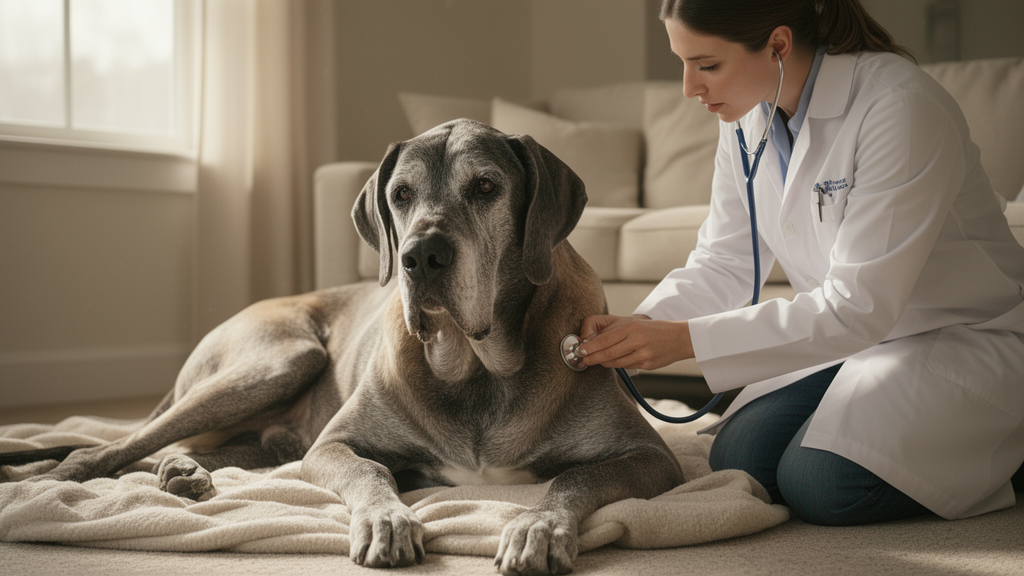
A sweeping analysis of more than 41,000 companion dogs enrolled in the Dog Aging Project has produced one of the most detailed pictures yet of what shapes canine lifespan. The study, published in GeroScience, used owner-reported mortality data collected through 2024 to quantify how body size, breed background, sex, geography and hundreds of survey-reported lifestyle and health factors relate to survival in pet dogs living across the United States.
The team analyzed the 2024 Curated Data Open Access Release, which contains records for 50,188 dogs. After excluding animals without a known age at enrollment or without any follow-up survival assessment, the analytic cohort comprised 41,047 dogs. These animals contributed a combined 90,230 dog-years of observation, during which 11,739 deaths were recorded, with a median follow-up of 2.1 years. The median age at enrollment was 6.4 years. All data other than survival status came from the baseline Health and Life Experience Survey completed by owners, and mortality was defined as an owner-reported death, including euthanasia, with a recorded date.
The strongest demographic signal was body size. Using Kaplan–Meier survival curves and Cox regression models, the researchers found a strong, consistent inverse relationship between size and lifespan across breed status and sex, with a log-rank p-value below one in a million. Median lifespans ranged from 13 to 14 years in the toy and small categories down to 9 to 10 years in giant American Kennel Club-recognized breeds. Notably, the interquartile range of lifespan within each size or weight stratum was consistently about four years, ranging from 3.5 to 4.6 years, meaning that variability among dogs of the same size class remained substantial even though size strongly determined the median.
Breed background also mattered. Within each size and sex stratum, AKC-recognized single breed dogs generally lived modestly shorter lives than mixed-breed or non-AKC dogs, with median lifespan differences of 0.7 to 1.6 years for males but only 0.4 to 0.6 years for females. The pattern held in sensitivity analyses and is consistent with a small hybrid vigor effect, in which reduced genetic diversity and breed-specific disease risks shorten life in some purebred populations. Sex differences favoring females were real but small: females lived slightly longer in most strata, with statistically significant gaps of 0.6 to 0.9 years in standard, large and giant single breed dogs. Among the sixteen most common breeds in the cohort, sex effects of at least one year appeared in German Shepherds, Australian Shepherds, Great Danes and Boxers, and no breed showed a significant male advantage.
Geography produced one of the study’s most striking findings. In unadjusted analyses, apparent differences in lifespan emerged by home area type, census division and state, with rural dogs showing higher unadjusted mortality hazard than suburban dogs and dogs in Texas faring worse than those in Washington or California. But once the models accounted for size, breed status and sex, the rural-suburban-urban differences vanished entirely, with a log-rank p-value of 0.94, indicating that where dogs live in terms of city versus countryside is largely explained by which kinds of dogs live there. Regional and state-level differences, however, persisted after demographic adjustment, with log-rank p-values of 0.038 and 0.035 respectively.
To probe what those persistent geographic patterns might mean, the researchers compared demographically adjusted dog mortality hazard ratios by state with human age-adjusted mortality rates for 2019 through 2023 from the CDC National Vital Statistics System. Both measures were expressed as deviations from the count-weighted average across states. The correlation was significant and positive, with a Pearson coefficient of 0.43, a Spearman coefficient of 0.63 and a p-value of 0.0017. The regression slope of 0.31 implies that roughly every three percent increase in dog mortality hazard corresponds to a one percent increase in human age-adjusted mortality. Consistent results emerged using 2023-only mortality data and state-level life expectancy, where a five-year increase in human life expectancy was associated with lower dog mortality risk, with a hazard ratio of 0.93 and a p-value of 0.0052. Because dogs share human air quality, climate, socioeconomic conditions and neighborhood environments, the authors suggest that place-based factors may influence aging in both species, though the correlation itself cannot establish which shared exposures are responsible.
The third major component of the study was a survey-wide association study, or SWAS, an agnostic screen modeled on genome-wide association studies. The team tested 804 baseline survey variables, spanning dog demographics, owner contact, physical activity, environment, behavior, diet, medications and preventatives, health status and owner demographics, using Cox models stratified by size, breed status and sex, with false discovery rate control via the Benjamini-Yekutieli procedure. Seventy-two variables emerged as significantly associated with mortality. As a pipeline check, the analysis was repeated with randomly permuted survey responses, and no variables passed the significance threshold, indicating a very low false discovery rate.
Many of the strongest associations came from the health status domain: poorer owner-reported general health and the presence of chronic conditions were linked to higher mortality risk, with owner-reported general health showing the single most significant association in the entire screen, at a q-value of 2 times 10 to the power of minus 204. Physical activity variables were also highly significant, with higher intensity and more frequent exercise associated with lower mortality risk. Behavioral indicators of energy and playfulness tracked with lower risk, as did frequency of chasing small animals, barking, and obeying stay and sit commands. Conversely, dogs that defecated or urinated when left alone more frequently showed higher mortality risk. In the environment domain, visits to parks or open spaces and eating grass were associated with lower risk, while in the diet domain, eating less than usual was associated with higher risk. The only significant owner demographic variable was education. Many ordinal and numeric variables showed monotonic exposure-response patterns, which the authors say strengthens confidence in the associations.
The researchers are careful to frame the SWAS as exploratory and associative. Because the analysis used only baseline survey data, dogs were not followed longitudinally for changes in behavior, health or environment, and the observational design cannot rule out reverse causation, in which declining health drives both the survey responses and the mortality outcome. The authors illustrate the point directly: dogs that eat grass more often may simply be healthier, more active animals with more opportunities to graze, and feeding grass to dogs would not necessarily extend their lives. Unmeasured confounding and selection bias in enrollment and retention further limit causal inference. The findings therefore serve as a hypothesis-generating map of factors that now warrant targeted longitudinal and interventional investigation, not as a list of proven longevity levers.
Several sensitivity analyses bolstered the main results. Repeating the SWAS restricted to mature adult dogs, a subset of 20,505 animals, identified 45 significant variables, 38 of which also appeared in the main analysis. Restricting to the sixteen most common single breeds, which reduces the sample by about three quarters but limits genetic heterogeneity, yielded 13 significant variables, 11 of which appeared in both other analyses. The demographic findings were likewise robust to alternative size definitions based on owner-reported weight rather than breed standards. The study’s limitations include reliance on owner-reported ages and death dates, and a participant population that differs demographically from the broader dog-owning public. Still, with standardized data collection, nationwide recruitment and systematic mortality ascertainment, the Dog Aging Project has established a foundational mortality baseline that will be updated with each annual data release, and future work will incorporate geocoded environmental data, longitudinal health trajectories, genetic and molecular profiling, and formal comparisons of canine and human aging patterns.
Subject of Research: Demographic, geographic and survey-based factors associated with longevity in companion dogs from the Dog Aging Project cohort
Article Title: Factors associated with longevity in companion dogs: initial findings from the Dog Aging Project
Article References: Chiu, W. A., Dunbar, M. D., Han, G., Harrison, B. R., Keyser, A. J., Litwin, P. E., Dog Aging Project Consortium, Akey, J. M., Anderson, R. M., Borenstein, E., Castelhano, M. G., Coleman, A. E., Fajt, V. R., Hoffman, J. M., Jonlin, E. C., Kaeberlein, M., Karlsson, E. K., Kerr, K. F., Ma, J., … Creevy, K. E. (2026). Factors associated with longevity in companion dogs: initial findings from the Dog Aging Project. GeroScience. https://doi.org/10.1007/s11357-026-02448-9
Image Credits: AI Generated
DOI: 10.1007/s11357-026-02448-9
Keywords: Dog Aging Project, canine longevity, geroscience, body size, purebred versus mixed-breed, mortality geography, survey-wide association study, physical activity, owner-reported health, comparative aging, cohort study, Factors
Cite Scienmag News
William Thompson. (October 27, 2026). Large dogs die young and dog mortality mirrors human death patterns across states. Scienmag. https://scienmag.com/large-dogs-die-young-and-dog-mortality-mirrors-human-death-patterns-across-states/
William Thompson. "Large dogs die young and dog mortality mirrors human death patterns across states." Scienmag, 27 October 2026, https://scienmag.com/large-dogs-die-young-and-dog-mortality-mirrors-human-death-patterns-across-states/. Accessed 27 October 2026.
William Thompson. "Large dogs die young and dog mortality mirrors human death patterns across states." Scienmag. October 27, 2026. https://scienmag.com/large-dogs-die-young-and-dog-mortality-mirrors-human-death-patterns-across-states/