


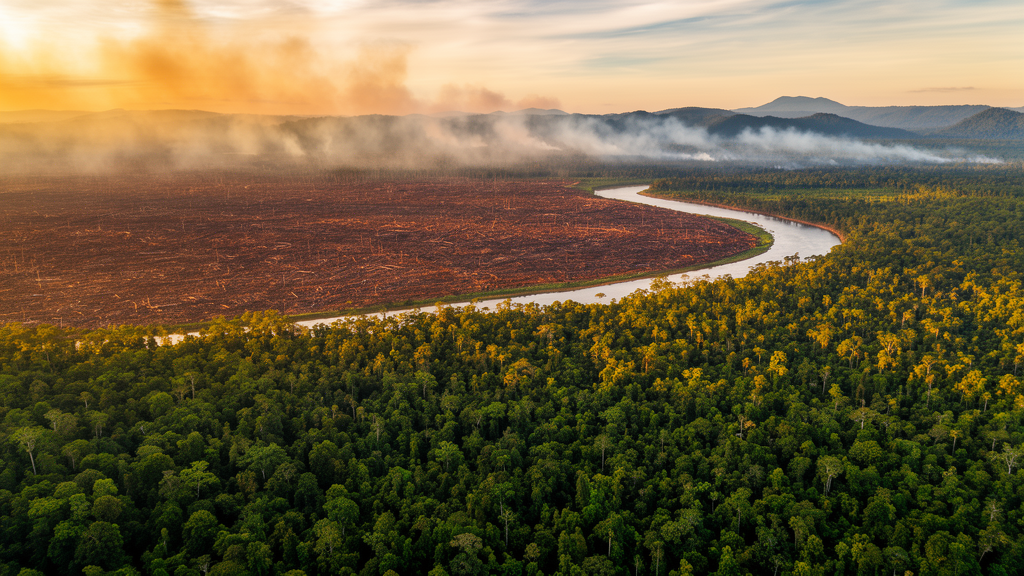
In one of Borneo’s last great rainforest strongholds, the difference between a conservation-minded future and an extractive one amounts to roughly USD 74 billion in social carbon costs, according to a new modeling study of Kapuas Hulu Regency in West Kalimantan, Indonesia. The research, published in Environmental and Sustainability Indicators, translated governance scenarios developed with local stakeholders into spatially explicit land-use projections and then attached economic values to the ecosystem services gained or lost under each pathway through 2050.
Kapuas Hulu covers 31,318 square kilometers and is home to about 272,300 people. It anchors the headwaters of the Kapuas River, the longest river in Kalimantan at 1,145 kilometers, which drains roughly two-thirds of West Kalimantan province. The regency still retains more than 65 percent forest cover, including intact lowland mixed dipterocarp forest, peat swamp forest, kerangas, freshwater swamp, riparian and montane forests. Two merged national parks, Betung Kerihun and Danau Sentarum, cover about 30 percent of its area, with a further 50 percent designated as production or watershed protection forest. Since 2003 the regency has held formal Conservation Regency status, and in 2018 the entire area was designated a UNESCO Man and the Biosphere Reserve.
Yet the landscape is under mounting pressure. Satellite imagery analyzed at three points in time, 2000, 2010 and 2020, showed oil palm plantations expanding by 254.9 percent in the first decade and 131.6 percent in the second. Peat and mixed peat swamp forests declined by 3.2 percent and then 7.0 percent, an accelerating loss, while freshwater swamp forests fell by 6.8 percent and then 3.5 percent. A 2013 revision of the regency’s spatial plan increased convertible land by more than 19 percent, facilitating oil palm permits and allowing plantations to expand toward national park buffer zones. Illegal logging and artisanal gold mining continue to fragment intact forest.
The study builds on a participatory prospective analysis in which 19 participants, selected through stakeholder network analysis to represent government agencies, Dayak and Malay customary leaders, farmers, fishers, local NGOs, private sector actors and youth, identified drivers of landscape change and drafted four contrasting scenarios over a 30-year horizon. The research team then translated those qualitative storylines into quantitative land-conversion rules, validated against the observed 2000 to 2020 trends, and ran them through the InVEST modeling suite developed by the Natural Capital Project. The four scenarios were Business As Usual, Collaborative, Ecocentric and Opportunistic.
The scenarios diverge sharply. Under Business As Usual, more than half of the forest cover remains intact by 2050, but peatlands, freshwater swamp forests and riparian zones degrade, and oil palm expands by 187 percent over its current area, largely replacing grasslands, shrubs, fallows and some peat swamp forest, including forest edges of the Danau Sentarum-Betung Kerihun National Park. Under the Opportunistic scenario, forest cover falls to about 40 percent, oil palm expands by 360 percent, industrial logging is reinstated in hill zones, and gold mining grows exponentially. The Collaborative scenario holds forest cover at about 60 percent through participatory governance and limits oil palm to a 60 percent increase, while the Ecocentric scenario halts forest and peatland conversion entirely and allows oil palm to grow only 30 percent.
The carbon arithmetic dominates the results. Under the Opportunistic scenario, projected land-use change produces a net loss of 386.4 million megagrams of carbon by 2050, corresponding to a discounted social cost of USD 74.3 billion, using a social cost of carbon of USD 30 per tonne of CO2 equivalent and declining discount rates of 7, 5 and 3 percent across successive decades. Business As Usual loses 47.4 million megagrams of carbon, a social cost of about USD 9.1 billion. By contrast, the Ecocentric and Collaborative scenarios yield net sequestration of 71.7 and 22.2 million megagrams of carbon, generating discounted social benefits of USD 13.8 billion and USD 4.3 billion respectively. The largest emissions hotspots appear where lowland, hill and swamp forests are converted to oil palm or swidden agriculture, particularly in the national park buffer zone and the hill forests of the south and southeast.
Hydrological and soil services follow the same gradient. The 2020 baseline water yield is 75 billion cubic meters, and by 2050 water retention declines by 531 million cubic meters under the Opportunistic scenario and 362 million under Business As Usual, compared with 273 and 246 million under the Collaborative and Ecocentric scenarios. Flood damage to oil palm plantations is projected at USD 878.8 million under the Opportunistic scenario versus USD 241.0 million under the Ecocentric one. Potential soil loss from the regency’s watersheds, estimated at 134 million tons in 2020, rises to 163 million tons under Opportunistic and 157 million under Business As Usual, against 149 and 145 million under Collaborative and Ecocentric. Annual nutrient replacement costs, calculated from Indonesian fertilizer prices, range from about USD 1.55 million under Ecocentric to USD 2.07 million under Opportunistic.
Provisioning services tell the mirror-image story. Oil palm could reach 271,935 hectares by 2050 under Business As Usual and up to 561,000 hectares under Opportunistic, valued at USD 10.16 billion and USD 18.13 billion respectively over 30 years, based on a fresh fruit bunch price of USD 250 per ton and yields of 16 tons per hectare. Annual logging revenues range from USD 176.6 million under Ecocentric to USD 1.56 billion under Opportunistic, and gold mining revenue climbs from zero under Ecocentric to USD 105.4 million under Opportunistic. Fisheries move the other way: the regency produced an estimated 25,655 tons of freshwater fish in 2023, worth USD 25.97 million, and projected annual fishery value in 2050 falls to USD 12.98 million under Opportunistic while rising to USD 36.36 million under Ecocentric. Gold mining already affects roughly half the regency’s villages, with 312 of 677 villages downstream of mining areas and about 45 percent reporting fish declines, most likely from pollution and turbidity. Health costs associated with mining were estimated at half of gold revenue.
When all services are summed, the Ecocentric scenario achieves the highest total economic value at about USD 20.7 billion, followed by Collaborative at USD 12.9 billion, Business As Usual at USD 1.2 billion, and Opportunistic at a net loss of USD 55.3 billion. The authors stress that these totals hinge on how carbon is priced: the Ecocentric total is dominated by USD 13.8 billion in carbon benefits, and when carbon is excluded or undervalued, as under current Indonesian market conditions, the extractive scenarios appear economically superior, which partly explains why conversion pressure persists. They also caution that the models were not validated in a predictive sense, that outputs should be read as indicative comparisons rather than forecasts, and that no formal sensitivity analysis was performed. Non-material cultural services and biodiversity were excluded from the valuation because reliable spatially explicit data were lacking.
During consultations, stakeholders judged the Ecocentric vision aspirational but difficult to achieve in full, and many were skeptical about securing international funding. The resulting action plan focuses on three priorities: updating land allocation maps from 1:250,000 to 1:50,000 scale, establishing agroforestry programs in fallow and degraded areas under the Social Forestry framework at an estimated USD 800 to 1,500 per hectare, and developing climate adaptation measures including flood prevention. The authors note that the regency’s protected area budget stands at roughly USD 12 per hectare per year, an order of magnitude below the USD 50 to 100 estimated as necessary for effective management, and argue that closing this financing gap is the single most important enabling condition for the more sustainable pathways to become achievable.
Subject of Research: Economic valuation of ecosystem services under participatory land-use scenarios in Kapuas Hulu Regency, Indonesian Borneo
Article Title: Economic valuation of ecosystem services across land-use scenarios in Borneo's threatened forest frontier landscapes
Article References: Laumonier, Y., Adzan, G., Ickowitz, A., Liswanti, N., & Reed, J. (2026). Economic valuation of ecosystem services across land-use scenarios in Borneo's threatened forest frontier landscapes. Environmental and Sustainability Indicators, 32, Article 101587. https://doi.org/10.1016/j.indic.2026.101587
Image Credits: AI Generated
DOI: 10.1016/j.indic.2026.101587
Keywords: Borneo, Kapuas Hulu, ecosystem services, InVEST, land-use scenarios, carbon sequestration, oil palm, social cost of carbon, participatory modeling, deforestation, West Kalimantan, flood risk
Cite Scienmag News
Sloane Callahan. (October 27, 2026). Borneo’s Forest Frontier Faces a $74 Billion Carbon Bill by 2050. Scienmag. https://scienmag.com/borneos-forest-frontier-faces-a-74-billion-carbon-bill-by-2050/
Sloane Callahan. "Borneo’s Forest Frontier Faces a $74 Billion Carbon Bill by 2050." Scienmag, 27 October 2026, https://scienmag.com/borneos-forest-frontier-faces-a-74-billion-carbon-bill-by-2050/. Accessed 27 October 2026.
Sloane Callahan. "Borneo’s Forest Frontier Faces a $74 Billion Carbon Bill by 2050." Scienmag. October 27, 2026. https://scienmag.com/borneos-forest-frontier-faces-a-74-billion-carbon-bill-by-2050/


