


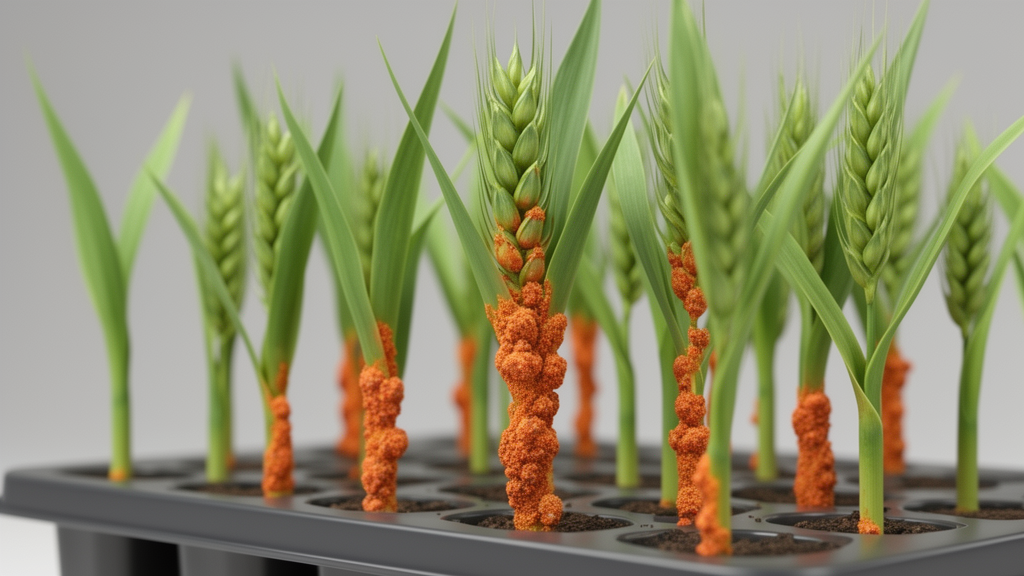
North American spring wheat breeding lines carry very little seedling resistance to the world’s most dangerous stem rust races, including the notorious Ug99 lineage, but they hold valuable adult-plant resistance that persists in African field nurseries, according to a new study published in Theoretical and Applied Genetics. The research, led by Harsimardeep S. Gill of the University of Minnesota and colleagues, screened 383 hard red spring wheat genotypes from the university’s breeding program against four virulent races of the stem rust fungus Puccinia graminis f. sp. tritici, and evaluated the same lines over five growing seasons in Ethiopia and Kenya. The results confirm a long-standing vulnerability in one of the world’s most important wheat classes, while also pinpointing a promising resistance locus on chromosome 7AL that could be bred into future varieties.
Stem rust has haunted wheat farmers for more than a century. In the early to mid-twentieth century, severe epidemics swept the Northern Great Plains of North America, cutting yields by up to 50 percent in Minnesota and North Dakota and causing an estimated 356 million dollars in losses. Decades of breeding for race-specific resistance genes, combined with the eradication of the common barberry, the fungus’s alternate host, pushed the disease into retreat by the 1960s, and stem rust remained rare for more than five decades. That calm has been broken. New virulent races have emerged over the past 25 years, driving significant outbreaks and epidemics in Africa, Europe, and Asia, and the threat of these exotic races eventually reaching North America looms over the region’s wheat supply.
The most feared of these pathogens is race TTKSK, the original member of the Ug99 race group, first identified in Uganda in 1998. TTKSK is virulent against Sr31, a widely deployed resistance gene that had protected wheat around the world. Fifteen variants of the Ug99 lineage have now been identified, and the lineage continues to expand geographically, with confirmed reports from countries in East and southern Africa, Yemen, Iran, Egypt, and, most recently, Nepal in 2024. Beyond Ug99, genetically distinct races in clades III and IV, represented by TRTTF and TKTTF, have spread rapidly and contributed to epidemics in East Africa, Europe, the Caucasus region of Eurasia, and Central Asia. Previous screening efforts had already shown that roughly 85 to 90 percent of North American wheat cultivars and breeding lines, particularly in the hard red spring class, are susceptible to Ug99 and other races present in eastern Africa.
To characterize the problem in detail, the team assembled a mapping panel of 383 hard red spring wheat genotypes, including advanced experimental lines and 20 elite lines frequently used as crossing parents, drawn from breeding programs at the University of Minnesota, North Dakota State University, South Dakota State University, and private seed companies. At the seedling stage, the panel was tested against four races with broad virulence: TTKSK, TTKSF+, TKTTF, and TRTTF. Infection types were recorded 14 days after inoculation using the classic Stakman scale, with each test repeated in two independent replicates. An additional cold-temperature assay against TTKSK was run to detect the presence of the resistance gene Sr15, which is effective against that race only at lower temperatures.
The seedling results were sobering. Race TKTTF proved the least virulent, with 314 lines, or 82 percent of the panel, showing resistant infection types, and only nine lines susceptible. Everything else was far worse. Roughly 88 percent of lines were susceptible to TRTTF and about 94 percent to TTKSF+. TTKSK was the most virulent of all: 368 lines, approximately 97 percent, were susceptible, with only 11 lines showing resistant or moderately resistant responses. The cold-temperature assay told a similar story, with 95 percent of lines rated susceptible. Just five lines showed a highly resistant response to all four races, and 17 lines were susceptible to TTKSK yet resistant to the other three. Pairwise correlations among race responses ranged from low to moderate, indicating that resistance to one race offers little guarantee against another.
Gene postulation, based on comparing each line’s infection-type pattern across the four races with published patterns on differential lines, revealed why the panel behaves this way. Sr7a was by far the most common all-stage resistance gene, postulated in 354 of the 383 lines, roughly 92 percent. Because TKTTF is avirulent on Sr7a, this single gene explains the panel’s apparent strength against that race. Other genes appeared at low frequencies: Sr8a in 20 lines, Sr11 in 20 lines, and Sr31 in 15 lines, mostly in combination with Sr7a and/or Sr11. Molecular genotyping with a KASP marker for the 1BL.1RS rye translocation confirmed that 14 of the 15 lines postulated to carry Sr31 were indeed positive for the translocation. Only two lines were postulated to carry Sr15 or Sr1RSAmigo. The researchers noted that a few lines, including MN10370, showed low infection types characteristic of the genes Sr22 and Sr24, both effective against all four races, but the races used could not distinguish between them, and molecular confirmation would be required.
Field evaluations told a more encouraging story. The panel was grown at the international wheat stem rust nursery at Debre Zeit in Ethiopia in 2016, 2017, and 2018, and at the international stem rust phenotyping platform at Njoro, Kenya, in 2016 and 2017, with nurseries artificially inoculated with bulk inoculum including TTKSK and other races. Disease was scored using infection response and severity on the modified Cobb scale, combined into a coefficient of infection. Mean values ranged from 17.2 in Kenya in 2017, the mildest environment, to 36.6 in Ethiopia in 2018, the most severe. Pairwise correlations among environments ranged from 0.2 to 0.5, indicating moderately stable genotypic performance across years and locations. Crucially, at least 14 lines showed consistently low coefficients of infection, in the bottom 10 percent, across multiple environments, demonstrating that quantitative, adult-plant resistance exists within adapted North American germplasm even where seedling resistance is absent.
Genome-wide association mapping using 13,846 SNP markers and a multilocus mixed model identified 37 significant marker-trait associations for seedling resistance, representing 17 unique genomic regions on chromosomes 1B, 3B, 3D, 4A, 5B, 5D, 6A, 6B, and 7B. No associations passed the stringent Bonferroni threshold for TTKSK, likely because so few lines were resistant. The strongest signals matched known genes: the top association for TKTTF on chromosome 4AL corresponds to Sr7a, a second TKTTF signal on 6BL matches Sr11, and the strongest association for TRTTF fell in the Sr8a region on 6AS. For TTKSF+, 19 of 23 associations clustered on the short arm of chromosome 1B, which the authors attribute to Sr31 and its limited recombination in the 1BL.1RS translocation rather than to independent loci.
For field response, 15 significant associations were detected on chromosomes 1B, 2B, 2D, 3B, 7A, and 7B, representing eight unique genomic regions. One region stood out: a segment on the long arm of chromosome 7A, spanning roughly 712.1 to 719.6 megabases, was highly significant in four of the five environments, with log10 P values reaching 13.8. Allelic-effect analysis showed that the SNP Tdurum_contig12454_585, mapped at 719.6 megabases, differentiated resistant and susceptible allele classes across all five environments, supporting a robust effect for the interval. The locus appears to confer adult-plant resistance: no association was detected in the same interval for seedling responses to any race, and the low frequency of lines with Sr15-like seedling patterns, tested explicitly through the cold-temperature assay, rules out that gene as the basis of the signal. The authors suggest the locus may be independent of known stem rust resistance genes in the region and could correspond to the QSr-sparc-7A quantitative trait locus previously mapped in Kenyan environments in a biparental population of North American spring wheat.
To make the finding usable, the team developed a KASP marker targeting Tdurum_contig12454_585 for marker-assisted selection of the 7AL locus. The assay showed distinct clustering between the two allelic groups and 99 percent concordance with the original 90 K SNP array genotype calls in the panel, though the authors caution that further validation across diverse genetic backgrounds is needed before the marker can be deployed for targeted introgression into breeding lines. The study, published open access on 27 October 2026 as volume 139, article 318 of Theoretical and Applied Genetics, highlights a clear picture: North American spring wheat depends heavily on a narrow set of race-specific genes, chiefly Sr7a, that offer little protection against Ug99 and other exotic races, but the germplasm harbors small- to moderate-effect field resistance loci, including the 7AL adult-plant resistance region, that could underpin more durable defenses if breeders act before those exotic races arrive.
Subject of Research: Seedling and field resistance to virulent stem rust races in North American spring wheat germplasm
Article Title: Stem rust resistance in North American spring wheat to Ug99 and other virulent pathotypes of Puccinia graminis f. sp. tritici
Article References: Gill, H. S., Conley, E., Ndung’u, K. C., Firpo, P. O., Brault, C., Kosgey, Z., Degete, A. G., Bhavani, S., Bajgain, P., Rouse, M. N., Jin, Y., & Anderson, J. A. (2026). Stem rust resistance in North American spring wheat to Ug99 and other virulent pathotypes of Puccinia graminis f. sp. tritici. Theoretical and Applied Genetics, 139(11), Article 318. https://doi.org/10.1007/s00122-026-05352-0
Image Credits: AI Generated
DOI: 10.1007/s00122-026-05352-0
Keywords: stem rust, wheat, Ug99, Puccinia graminis f. sp. tritici, North American spring wheat, adult-plant resistance, GWAS, chromosome 7AL, Sr7a, KASP marker, Ethiopia, Kenya
Cite Scienmag News
Alan Morgan. (October 27, 2026). North American spring wheat shows weak seedling defense against Ug99 stem rust. Scienmag. https://scienmag.com/north-american-spring-wheat-shows-weak-seedling-defense-against-ug99-stem-rust/
Alan Morgan. "North American spring wheat shows weak seedling defense against Ug99 stem rust." Scienmag, 27 October 2026, https://scienmag.com/north-american-spring-wheat-shows-weak-seedling-defense-against-ug99-stem-rust/. Accessed 27 October 2026.
Alan Morgan. "North American spring wheat shows weak seedling defense against Ug99 stem rust." Scienmag. October 27, 2026. https://scienmag.com/north-american-spring-wheat-shows-weak-seedling-defense-against-ug99-stem-rust/


