


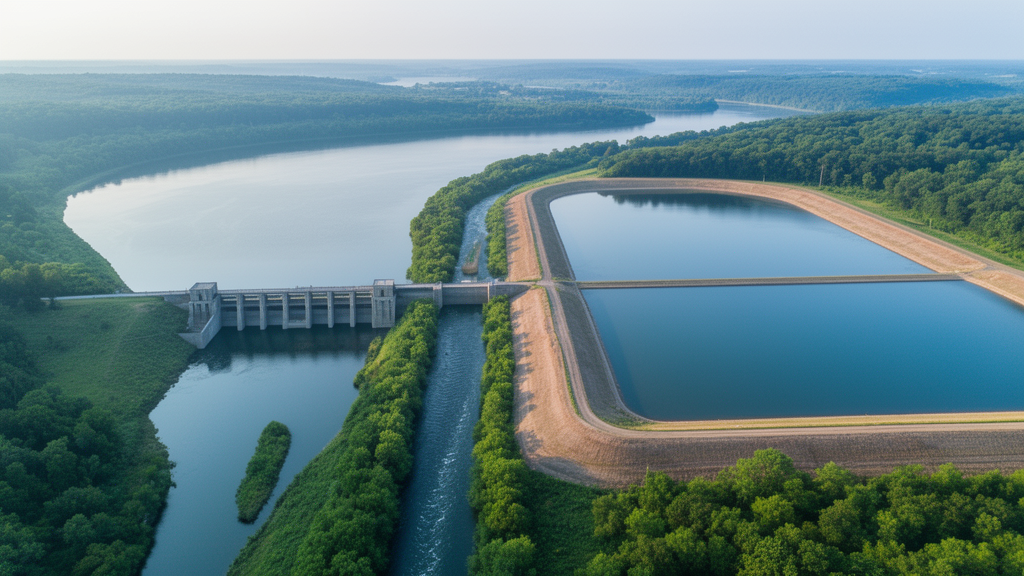
When extreme floods threaten a river basin, engineers often rely on two kinds of infrastructure working together: a large reservoir that can hold back floodwater behind a dam, and a flood detention basin, a designated area that can be deliberately flooded to protect downstream cities. A new study in Water Resources Management examines how the storage capacity of these two structures can be treated as equivalent, so that a reservoir and a flood detention basin can be operated as a coordinated group rather than as separate assets.
The research, led by Zhengyu Wang, Dedi Liu, Zhengyu Mu and Yuling Zhang, focuses on a concept the authors call equivalent flood control storage. The idea is to quantify how much flood storage in a flood detention basin corresponds to a given amount of storage in a reservoir, expressed through an equivalent ratio. According to the abstract, the derived equivalent flood control storage is independent of the detention basin’s operation rules and of the inherent characteristics of individual flood events, which makes it a general tool for planning joint operations.
The researchers drove their analysis with four representative design flood events, which are standardized flood hydrographs used in engineering to test how flood control systems would perform under defined conditions.
Within that framework, the team investigated how several factors influence the equivalent ratio. These include the operation period of the flood detention basin, the magnitude of the flood as characterized by its exceedance frequency, the shape of the upstream reservoir inflow hydrograph, and the amount of flood control storage in the downstream detention basin that has already been used before the operation begins.
The results point to a consistent pattern. An earlier-started and shorter-duration operation period for the flood detention basin generally contributes to a larger equivalent ratio, as does a lower pre-utilized flood control storage in the basin. In other words, when the detention basin is activated promptly and retains more of its capacity, a given volume of detention storage counts for more in the equivalent relationship with the reservoir.
Flood characteristics matter as well. The study reports that flood events with larger magnitude, and inflow hydrographs with a delayed peak, also tend to produce a larger equivalent ratio. This means the relationship between reservoir storage and detention basin storage is not fixed but shifts with the nature of the flood being managed and with how the inflow to the upstream reservoir unfolds over time.
For flood control managers, the practical significance lies in the derived equivalent flood control storage itself. Because it does not depend on the detention basin’s specific operation rules or on the details of a particular flood event, it can be used to support the flood control operation of reservoir and flood detention basin groups more broadly, helping operators decide how to allocate storage between the two structures during joint flood control operations.
Joint flood control operation of a reservoir and a flood detention basin plays a critical role in mitigating extreme flood disasters, the authors note in the abstract. Improving the flood control efficiency of a coupled reservoir and flood detention basin group requires precisely this kind of quantification, so that the two components can be compared on a common basis when planning how to absorb a severe flood.
The findings are reported as a modeling and analysis study based on design flood events for a single case study group, and the abstract does not report real-time operational trials.
Subject of Research: Quantifying equivalent flood control storage between a reservoir and a flood detention basin
Article Title: Equivalent Flood Control Storage Relationship Between a Reservoir and a Flood Detention Basin
Article References: Wang, Z., Liu, D., Mu, Z., & Zhang, Y. (2026). Equivalent Flood Control Storage Relationship Between a Reservoir and a Flood Detention Basin. Water Resources Management, 40(14), Article 545. https://doi.org/10.1007/s11269-026-04901-y
Image Credits: AI Generated
DOI: 10.1007/s11269-026-04901-y
Keywords: flood control, reservoir operation, flood detention basin, equivalent storage, Three Gorges Reservoir, Jingjiang, design flood, flood risk management, water resources, hydrology, Equivalent, Flood
Cite Scienmag News
Violet Maxwell. (October 27, 2026). Reservoirs and Flood Detention Basins Can Share Flood Storage Equivalently, Study Shows. Scienmag. https://scienmag.com/reservoirs-and-flood-detention-basins-can-share-flood-storage-equivalently-study-shows/
Violet Maxwell. "Reservoirs and Flood Detention Basins Can Share Flood Storage Equivalently, Study Shows." Scienmag, 27 October 2026, https://scienmag.com/reservoirs-and-flood-detention-basins-can-share-flood-storage-equivalently-study-shows/. Accessed 27 October 2026.
Violet Maxwell. "Reservoirs and Flood Detention Basins Can Share Flood Storage Equivalently, Study Shows." Scienmag. October 27, 2026. https://scienmag.com/reservoirs-and-flood-detention-basins-can-share-flood-storage-equivalently-study-shows/


