


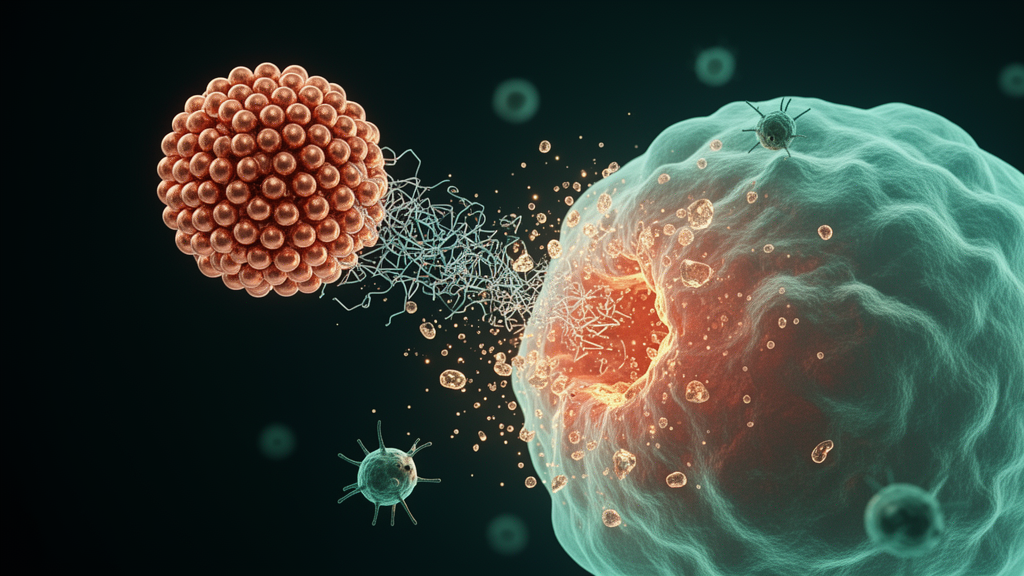
The formulation, called siC@CuPP, combines copper-doped polypyrrole nanoparticles with short interfering RNA that targets Cpt1a, the gene encoding carnitine palmitoyltransferase 1A, the rate-limiting enzyme of fatty acid oxidation. In orthotopic 4T1 breast tumors in BALB/c mice, the nanocomplex achieved a tumor growth inhibition rate of 73.87 percent, compared with 41.05 percent for the copper nanozyme alone, and left lung tissue with almost no detectable metastatic lesions.
The design addresses two barriers that the researchers identified as limiting ferroptosis-based cancer therapy. Ferroptosis is a form of regulated cell death driven by iron-dependent lipid peroxidation, and it can act as an immunogenic cell death modality: dying tumor cells release damage-associated molecular patterns that promote dendritic cell maturation, antigen presentation, and cytotoxic T lymphocyte activation. But the study found that ferroptotic cells also release the enzyme glutathione peroxidase 4, or GPX4, into the extracellular space, where it behaves as an immunosuppressive signal that inhibits dendritic cell function. At the same time, copper-induced ferroptotic stress activates a compensatory metabolic program, the AMPK–CPT1A–fatty acid oxidation pathway, which depletes the pool of peroxidation-prone polyunsaturated fatty acids and preserves NADPH-dependent antioxidant defenses.
The evidence for extracellular GPX4 came from experiments with 4T1 mouse breast cancer cells. Treatment with erastin, a canonical ferroptosis inducer, markedly increased GPX4 levels in cell culture supernatants, and co-treatment with the ferroptosis inhibitor liproxstatin-1 largely abolished this increase, confirming that ferroptotic cells actively release the enzyme. Neither copper chloride nor the copper nanozyme CuPP raised extracellular GPX4 above untreated control levels. The pattern held in vivo: mice immunized subcutaneously with pretreated 4T1 cells showed elevated serum GPX4 only in the erastin group, while the copper-treated groups showed no apparent increase.
Functional testing in a Transwell co-culture system showed why this matters immunologically. Bone marrow-derived dendritic cells exposed to erastin-treated tumor cells increased expression of Il10 mRNA, a marker associated with tolerogenic dendritic cells, and neutralizing GPX4 with a monoclonal antibody abolished that increase. Erastin-induced ferroptotic tumor cells also downregulated the dendritic cell functional markers MHC-II, CD80, and CD86, an effect reversed by GPX4 blockade. In contrast, dendritic cells co-cultured with copper-treated tumor cells showed enhanced expression of all three markers, unaffected by GPX4 antibody, indicating that copper-driven ferroptosis preserves the immunogenicity of dying tumor cells by avoiding accumulation of the suppressive enzyme.
Copper treatment, however, carried a metabolic cost. Both copper chloride and CuPP upregulated Cpt1a expression in 4T1 cells, accompanied by increased phosphorylation of AMPK, pointing to activation of an AMPK–CPT1A signaling axis in response to copper-induced metabolic stress. Lipidomic analysis revealed that CuPP-treated cells showed significant downregulation of 61 polyunsaturated fatty acid-containing phospholipid species relative to untreated controls, a lipid profile unfavorable for ferroptosis induction. Data from The Cancer Genome Atlas analyzed through GEPIA2 supported the target’s clinical relevance: among 1,069 breast cancer patients, high CPT1A expression correlated with worse survival, with a hazard ratio of 1.60 for high versus low expression and a log-rank p value of 0.0032.
The nanocomplex itself is built through a one-pot polymerization in which copper chloride serves as both oxidant and copper source, producing PEI-modified copper-doped polypyrrole nanoparticles with a hydrodynamic diameter of 81.7 nanometers and a positive zeta potential of 23.1 millivolts. Agarose gel retardation assays showed complete siRNA loading at a mass ratio of 20:1, and a DSPE-PEG2000 coating via nanoprecipitation reversed the surface charge to negative and enlarged the particle to 133.3 nanometers. The final formulation retained siRNA stably, released it upon heparin displacement, and protected it from RNase degradation. Biodegradation tests showed the particles remained intact in neutral pH buffer for 24 hours but collapsed within 12 hours under acidic or glutathione-rich conditions, the fastest under combined acidity and reducing stress, consistent with tumor microenvironment responsiveness.
Catalytically, X-ray photoelectron spectroscopy confirmed coexisting Cu+ and Cu2+ species, whose interconversion endows the particle with multienzyme-like activity. Under acidic conditions the nanocomplex depleted 60.8 percent of glutathione within 240 minutes in a glutathione peroxidase-mimetic reaction, and methylene blue degradation assays plus electron spin resonance spectroscopy confirmed hydroxyl radical generation indicative of peroxidase-mimetic activity. In cells, the nanocomplex was internalized progressively, reaching maximum uptake at six hours, and reduced Cpt1a mRNA by approximately 26.98 percent at 24 hours and 52.16 percent at 48 hours relative to the copper-only formulation. It suppressed the compensatory rise in fatty acid oxidation activity, further depleted ATP, raised the NADP+/NADPH ratio to impair reducing-equivalent replenishment, and produced substantially higher reactive oxygen species levels than the copper nanozyme alone.
Lipidomics tied these metabolic effects directly to ferroptosis substrate availability. Untargeted analysis identified 353 polyunsaturated fatty acid-containing phospholipid species, and 126 species were significantly more abundant in nanocomplex-treated cells than in copper-only treated cells. The copper nanozyme significantly decreased the canonical ferroptosis substrates arachidonic acid-containing phosphatidylethanolamines 16:0_20:4 and 18:1_20:4 and the adrenic acid-containing species 18:0_22:4, while the full nanocomplex restored their levels. Confocal microscopy showed that the nanocomplex also promoted lipophagy: the autophagy marker LC3B progressively accumulated around lipid droplets, driving extensive droplet degradation within 24 hours, which reduces sequestration of polyunsaturated fatty acids in storage and redirects them toward membrane phospholipid synthesis.
These changes translated into immunogenic cell death. Nanocomplex-treated cells showed markedly enhanced calreticulin surface exposure and HMGB1 release, classic damage-associated molecular patterns, and elicited the strongest dendritic cell maturation in co-culture, raising the proportion of CD80-positive CD86-positive dendritic cells to about 42.4 percent. Adding recombinant GPX4 partially reversed this maturation, from 42.4 percent to 34.6 percent, while the copper-only group fell from 32.5 percent to 25.3 percent, demonstrating that limiting extracellular GPX4 contributes to dendritic cell activation while Cpt1a silencing retains an additional immunostimulatory effect. In the presence of interferon-γ, which upregulates ACSL4, the nanocomplex drove lipid peroxidation levels of 28.3 percent versus 17.6 percent for the copper nanozyme alone, produced the highest malondialdehyde accumulation, and with interferon-γ achieved 85.8 percent killing of 4T1 cells at the highest tested concentration.
In the therapeutic study, mice with orthotopic 4T1 tumors received intravenous injections of the nanocomplex on days 1, 3, and 5, and fluorescence imaging showed tumor accumulation detectable within one hour, peaking at four hours and persisting for at least 24 hours. Treated tumors showed extensive TUNEL-positive cell death, downregulated CPT1A and GPX4, and elevated interferon-γ. Seven days after treatment, mature dendritic cells in tumor-draining lymph nodes rose from about 35.98 percent in the control group to about 50.96 percent with the copper nanozyme and about 65.04 percent with the full nanocomplex, alongside the highest infiltration of CD8-positive and CD4-positive T cells, increased CD8-positive granzyme B-positive cytotoxic lymphocytes, and elevated tumor lipid peroxidation. At day 28, splenic memory T cell frequency reached about 23.63 percent versus 8.56 percent in controls, suggesting durable immunological memory. No significant body weight fluctuations, systemic toxicity, or organ damage were detected across treatment groups. The authors note that the findings establish a mechanistic sequence linking CPT1A-dependent fatty acid oxidation suppression to accumulation of ferroptosis-susceptible membrane lipids, coordinated with copper-mediated restriction of extracellular GPX4, as a framework for ferroptosis-driven cancer immunotherapy in preclinical mouse models.
Subject of Research: A copper-based RNAi nanocomplex that induces immunogenic ferroptosis in breast cancer by reversing fatty acid oxidation-mediated metabolic resistance and suppressing extracellular GPX4.
Article Title: A copper-based RNAi nanocomplex unleashes immunogenic ferroptosis by reversing metabolic adaptation and suppressing extracellular GPX4
Article References: Yu, M., Liu, Y., Yu, J., Sun, S., Chen, Y., Fang, Y., Chung, Y. C. A., Zhu, X., Cai, H., & Wu, M. (2026). A copper-based RNAi nanocomplex unleashes immunogenic ferroptosis by reversing metabolic adaptation and suppressing extracellular GPX4. Materials Today Bio, 41, Article 103775. https://doi.org/10.1016/j.mtbio.2026.103775
Image Credits: AI Generated
DOI: 10.1016/j.mtbio.2026.103775
Keywords: ferroptosis, copper nanozyme, siRNA nanocomplex, CPT1A, fatty acid oxidation, breast cancer, immunogenic cell death, GPX4, dendritic cells, lipid peroxidation, antitumor immunity, nanomedicine
Cite Scienmag News
Nathaniel Bowman. (October 27, 2026). Copper RNAi Nanocomplex Reverses Metabolic Resistance to Trigger Immunogenic Ferroptosis in Breast Cancer. Scienmag. https://scienmag.com/copper-rnai-nanocomplex-reverses-metabolic-resistance-to-trigger-immunogenic-ferroptosis-in-breast-cancer/
Nathaniel Bowman. "Copper RNAi Nanocomplex Reverses Metabolic Resistance to Trigger Immunogenic Ferroptosis in Breast Cancer." Scienmag, 27 October 2026, https://scienmag.com/copper-rnai-nanocomplex-reverses-metabolic-resistance-to-trigger-immunogenic-ferroptosis-in-breast-cancer/. Accessed 27 October 2026.
Nathaniel Bowman. "Copper RNAi Nanocomplex Reverses Metabolic Resistance to Trigger Immunogenic Ferroptosis in Breast Cancer." Scienmag. October 27, 2026. https://scienmag.com/copper-rnai-nanocomplex-reverses-metabolic-resistance-to-trigger-immunogenic-ferroptosis-in-breast-cancer/


