


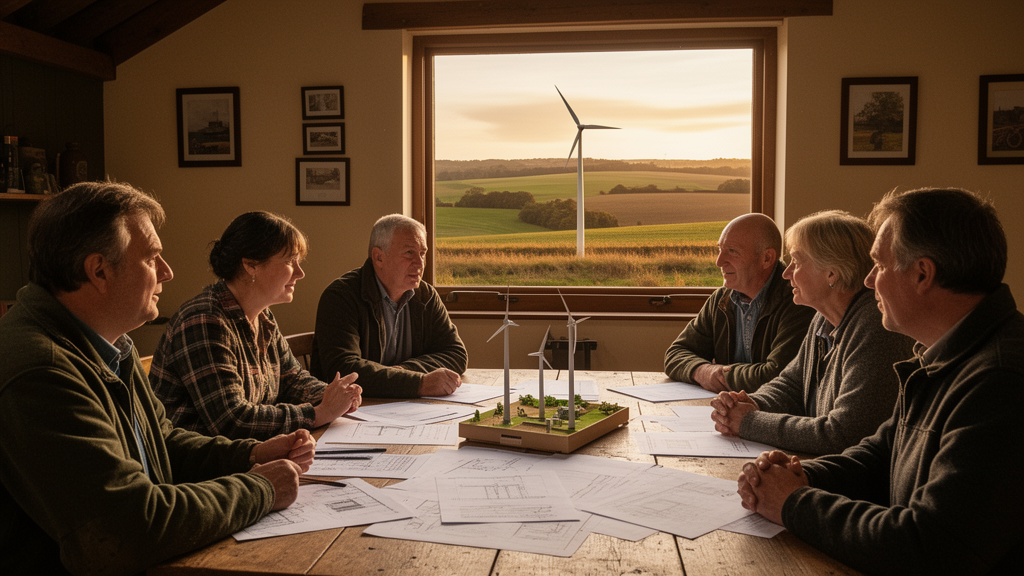
A team of education researchers writing in Frontiers in Education argues that the world’s rush toward renewable energy is overlooking a crucial group of stakeholders: the rural communities on whose lands solar farms, wind installations, and other energy infrastructure are built. In an editorial introducing a special issue on learning and identity in rural communities amid sustainable energy transitions, the editors, Elizabeth Suazo-Flores, Heidi Cian, Cheryl Hunter, and Joshua Hunter, contend that socially and ecologically just energy development requires amplifying Indigenous and place-based knowledge held within rural communities, rather than treating technical expertise as the sole legitimate basis for decision-making.
The editorial, published in the journal’s section on Leadership in Education, does not report new empirical findings. Instead, it synthesizes the arguments of the special issue and related research to make a normative case: that renewable energy transitions could be more just and sustainable when rural communities are recognized as knowledge producers and decision makers, and when Indigenous and place-based knowledge is brought into dialogue with, rather than positioned simply against, STEM disciplinary knowledge and practices.
The authors acknowledge that STEM disciplinary knowledge and practices have enabled the development of renewable energy infrastructure to meet growing energy demands, particularly in densely populated areas, while mitigating the pollution that drives global warming. But they argue that renewable energy development can also reproduce colonial relationships, by overriding Indigenous connections to land, marginalizing place-based knowledge, and sidelining local histories. From an urban perspective, rural areas may appear to offer abundant land and natural resources for large-scale energy projects. For rural residents, however, these landscapes are lived spaces shaped by history, work, ecological relationships, and collective memory.
Writing from rural America, on the ancestral lands of Indigenous peoples, the editors emphasize that rural identities and community histories are deeply connected to land, waterways, and place. For many rural residents, an open winter landscape may carry the layered memories of generations whose livelihoods, family histories, and community identities have been shaped by working and living with the land. Such histories, they stress, must also be situated within the longer and continuing relationships that Indigenous peoples have maintained with these lands. The editorial argues that recognizing these forms of knowledge as essential contributions to evaluating the social, ecological, and ethical consequences of energy transition infrastructure is fundamental to sustaining communities whose members are consistently called upon to adjust their social and economic industries to address global needs.
The editors also point to shifting demographics as a reason the stakes are rising. Internationally, connections to rural places have been reshaped and, in some contexts, intensified since the COVID-19 pandemic, as migration to rural places has increased. According to the editorial, this movement has been associated with renewed attention to relationships with nature, the perceived value of open spaces, and forms of local food production and harvesting.
A central thread of the editorial is the role of mathematics education in energy debates. Drawing on Skovsmose’s call to use critical mathematics to address social exclusion and suppression, racism, erosion of democracy, and sustainability, the editors argue that critical mathematics can open new possibilities for students to explore the relationship between mathematics, ethics, crises, and critique. They illustrate the point with examples from the special issue itself. One contribution suggests that variables that can be readily quantified, such as the number of solar panels installed or the amount of energy generated, may displace considerations that are more difficult to represent numerically, including the emotional, cultural, and relational significance of a space.
Another article in the collection, by Cordoves-Sánchez and colleagues, examines how the installation of energy projects in Chilean rural communities affects access to water, biodiversity, aesthetics, cultural memory, justice, democratic participation, and whose interests are prioritized. The editorial also suggests that when rural communities are supported in using critical mathematics, they could demonstrate, for instance, how wind-energy expansion could reduce water availability in local rivers or transform landscapes inhabited and visited by generations of the living world. These examples, the editors argue, show how rural communities can be positioned as informed advocates for their places and the people who live there.
The editorial highlights two further contributions, by Adgerson and by Charmaz and colleagues, as offering frameworks through which educators and researchers can engage rural communities in critical inquiry while recognizing community members as legitimate producers and users of place-based knowledge. The underlying principle, according to the editors, is that rural communities must be positioned as legitimate knowers of their contexts whose views are needed for decision-making. One way to achieve this, they write, is through critical mathematics education perspectives that enable present and future generations to evaluate, question, and contest the evidence used to justify energy transitions.
The editors describe the motivation behind the special issue as a desire to encourage dialogue about what would need to happen so that members of rural communities can be positioned as holding Indigenous and/or place-based knowledge, and use it to participate in energy decisions, countering technical expertise that is so often presented as the sole legitimate basis for decision-making through a top-down process. They argue that these perspectives can support learners and communities in bringing Indigenous and place-based knowledge into energy decision-making, challenging narrow definitions of efficiency and progress, and developing more reciprocal relationships with the living world.
Underpinning the whole collection is a reframing of how land itself is understood. The editorial argues that Indigenous and place-based perspectives allow us to understand land as relationally connected to the living world, rather than treating it as a fixed background subordinate to human demands, even when proposed land use seeks to repair histories of human-caused harm. The articles in the special issue, the editors conclude, give them hope by showing how rural communities can be positioned as informed advocates for their places.
Subject of Research: The role of Indigenous and place-based knowledge in education and decision-making during rural renewable energy transitions
Article Title: Editorial: Learning and identity in rural communities amid sustainable energy transitions: global perspectives on education and place-based identity
Article References: Suazo-Flores, E., Cian, H., Hunter, C., & Hunter, J. (2026). Editorial: Learning and identity in rural communities amid sustainable energy transitions: global perspectives on education and place-based identity. Frontiers in Education, 11, Article 1992694. https://doi.org/10.3389/feduc.2026.1992694
Image Credits: AI Generated
DOI: 10.3389/feduc.2026.1992694
Keywords: renewable energy, rural communities, Indigenous knowledge, place-based knowledge, energy transition, critical mathematics education, STEM education, land use, environmental justice, Frontiers in Education, special issue, editorial
Cite Scienmag News
Faith Mcneil. (October 27, 2026). Editors Call for Rural Voices in Renewable Energy Decisions. Scienmag. https://scienmag.com/editors-call-for-rural-voices-in-renewable-energy-decisions/
Faith Mcneil. "Editors Call for Rural Voices in Renewable Energy Decisions." Scienmag, 27 October 2026, https://scienmag.com/editors-call-for-rural-voices-in-renewable-energy-decisions/. Accessed 27 October 2026.
Faith Mcneil. "Editors Call for Rural Voices in Renewable Energy Decisions." Scienmag. October 27, 2026. https://scienmag.com/editors-call-for-rural-voices-in-renewable-energy-decisions/


