


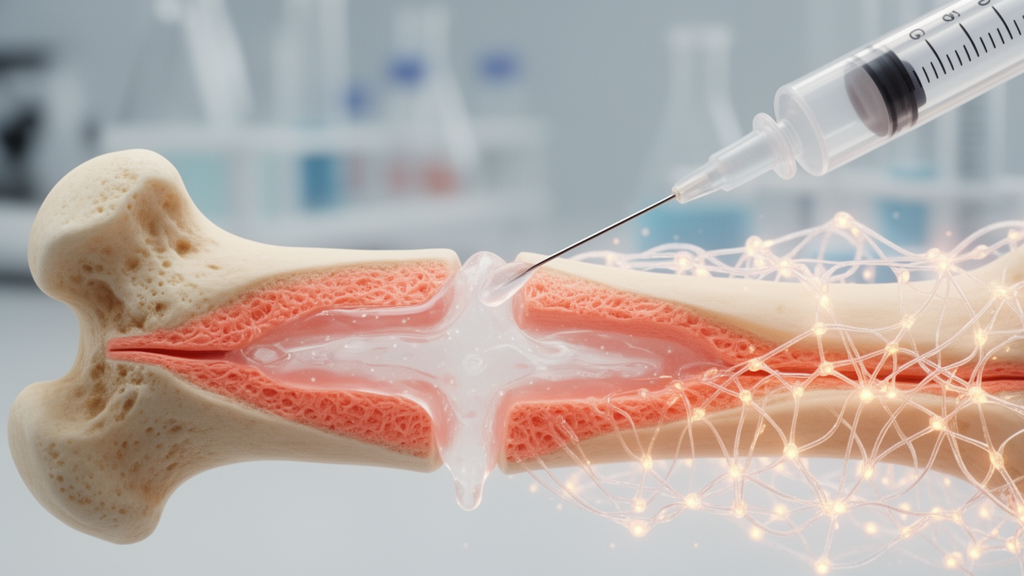
Critical-sized bone defects—gaps in bone too large for the body to bridge on its own—remain one of the most stubborn problems in orthopedic and craniofacial surgery. Whether caused by trauma, tumor resection, or congenital disorders, these defects are conventionally treated with bone grafts, but the clinical gold standard, the autograft, comes with real costs: donor site morbidity, limited supply, and prolonged surgery. Allografts ease the supply problem but carry risks of immune rejection, disease transmission, and inconsistent osteogenic potential. A research team in China now reports a synthetic alternative: an injectable, self-healing hydrogel that in a rat model significantly promoted bone regeneration compared with saline-treated controls, while showing no detectable pathological abnormalities in major organs.
The material, described in Frontiers in Materials, was built from two designed polymers. The first is hyaluronic acid modified with phenylboronic acid groups (HA-PBA), synthesized by carbodiimide-mediated coupling and purified by dialysis and lyophilization. Nuclear magnetic resonance spectroscopy showed the phenylboronic acid moieties were successfully grafted onto the HA backbone, with a degree of substitution of approximately 45%—a grafting density the authors describe as moderate, providing enough boronic acid groups for dynamic crosslinking while preserving the hydrophilicity and flexibility of the parent polymer. The second component, p-EGDE, is an amine-functionalized poly(ethylene glycol diglycidyl ether) prepared by ring-opening polymerization of EGDE with primary amines. Two variants were made: p-EGDE1 using n-propylamine, with a number-average molecular weight of 3574 g/mol, and p-EGDE2 using ethanolamine, with a lower Mn of 2698 g/mol.
What makes the chemistry interesting is the pairing of two dynamic interactions. Boronic ester bonds are widely used to build reversible hydrogel networks because they exchange rapidly under mild, physiological conditions, but hydrogels relying on boronic esters alone often lack mechanical robustness and stability in water. The team addressed this by adding boron–nitrogen coordination, which previous studies have shown can regulate boronic ester dynamics, suppress hydrolytic dissociation, and enhance network stability. When HA-PBA and p-EGDE solutions were mixed in phosphate-buffered saline at room temperature, gelation occurred spontaneously within 10 to 60 seconds depending on concentration and composition. NMR experiments with model compounds confirmed that both p-EGDE variants react with PBA groups, forming boronic ester bonds and boron–nitrogen coordination interactions.
Rheological measurements at 37 °C revealed a material with tunable mechanics. The storage modulus increased as the polymer concentration rose, reflecting a denser network of dynamic crosslinking points. Stress sweep tests showed the hydrogels remained solid-like—storage modulus above loss modulus—over a wide stress range, and the two representative formulations, Gel6 (HA-PBA/p-EGDE1) and Gelf (HA-PBA/p-EGDE2), both at 2 wt% and a 1:0.75 weight ratio, only failed at a strain of approximately 631%. The gels also displayed pronounced shear-thinning: their complex viscosity decreased with increasing angular frequency, a behavior consistent with efficient network disentanglement under shear. In practical terms, the hydrogel could be extruded through a syringe without clogging, even forming predefined patterns such as the letters “ABCD”—a macroscopic demonstration that the rheological data translate into real injectability.
Self-healing was assessed both microscopically and macroscopically. In step-strain tests, applying a high strain of 1000% collapsed the storage modulus below the loss modulus, indicating a gel-to-sol transition and network disruption. When the strain returned to 1%, both moduli recovered to their original values within seconds, and the disruption–recovery cycle could be repeated across five consecutive cycles without noticeable degradation of mechanical performance. At the visible scale, two severed hydrogel pieces—one stained with rhodamine B, the other with calcein—spontaneously healed within roughly 10 seconds of contact, forming an integrated monolith that could be handled without visible fracture at the interface. The authors attribute this rapid, autonomous repair to the reversible dissociation and reformation of boronic ester bonds and B–N coordination across the damaged surface.
Adhesion to wet tissue is a prized property for bone repair materials, and here the formulation mattered. Pristine HA and HA-PBA showed negligible adhesive strength in lap-shear tests, while the crosslinked hydrogels adhered markedly better. Among concentrations, 2 wt% gels outperformed 1 wt% gels, but pushing to 3 wt% significantly reduced adhesion—likely because lower water content and reduced chain mobility limit interfacial interactions. At 2 wt%, increasing the p-EGDE content gradually decreased adhesive strength, attributed to higher crosslink density leaving fewer exposed functional groups for interfacial bonding. The HA-PBA/p-EGDE2 gels consistently adhered more strongly than the p-EGDE1 versions, possibly because the ethanolamine-derived network carries additional hydroxyl groups. The proposed adhesion mechanisms include hydrogen bonding between hydroxyl groups and polar groups on tissue surfaces, reversible boronic ester interactions with diol-containing biological molecules, and energy dissipation through dynamic bond rupture during detachment. Quantitative adhesion testing on freshly excised bone and soft tissues, the authors note, remains for future work.
Degradation behavior was measured gravimetrically in PBS at 37 °C, and the study was explicit that only hydrolytic degradation was evaluated—enzymatic degradation was not tested, even though hyaluronic acid is susceptible to hyaluronidase-mediated breakdown in the body. The gels remained structurally stable while losing mass gradually, and the rate depended on concentration: 1 wt% hydrogels lost roughly 50% of their mass after 72 hours, whereas 2 wt% hydrogels reached a similar level only after 144 hours, consistent with denser crosslinking restricting water penetration. Gelf degraded faster than Gel6, which the team ascribes to the lower molecular weight of p-EGDE2 producing a less stable network. Compared with conventional boronic ester hydrogels, the added B–N coordination was reported to enhance resistance to hydrolytic degradation, offering more sustained structural support.
Cytocompatibility was assessed with CCK-8 assays using bone marrow mesenchymal stem cells exposed to hydrogel extracts at concentrations from 2 to 32 mg/mL. Cell survival exceeded 90% in all groups at 24, 48, and 72 hours, with no significant cytotoxic effects relative to untreated controls. The in vivo test then moved to a rat critical-sized calvarial defect model: female Sprague–Dawley rats received two symmetrical 5 mm circular defects drilled into the calvarium, filled with either HA-PBA/p-EGDE1, HA-PBA/p-EGDE2, or saline alone, with four animals per group. Micro-computed tomography at 4 and 8 weeks showed negligible bone formation in the control group but significantly enhanced osteogenesis in both hydrogel groups. At 4 weeks, bone volume fraction (BV/TV) was significantly higher than control, with bone mineral density following the same trend; by week 8, trabecular number increased and trabecular separation decreased significantly in both treatment groups (p < 0.05), indicating improved trabecular microstructure.
Biosafety was evaluated at 8 weeks, when major organs—heart, liver, spleen, lungs, and kidneys—were harvested, sectioned, and stained with hematoxylin and eosin. Histological observation revealed no detectable pathological abnormalities, which the authors take as evidence of favorable systemic biocompatibility. As for why the material supports bone formation, the researchers point to plausible but unverified mechanisms: the HA backbone may provide an extracellular-matrix-mimetic microenvironment supporting mesenchymal stem cell adhesion and proliferation, the interconnected porous structure—confirmed by scanning electron microscopy—may facilitate nutrient transport and vascular ingrowth, and the stable yet dynamic network may maintain structural support during early healing. At the molecular level, they speculate about HA-mediated CD44/integrin signaling, the integrin–FAK–PI3K/Akt axis, YAP/TAZ mechanotransduction, and BMP/Smad and Wnt/β-catenin cascades—but they are careful to state these pathways were not directly verified in this study.
The team is candid about the limits of the work. Long-term in vivo degradation and bone remodeling outcomes should be tracked over extended implantation periods, such as 12 to 16 weeks, to confirm complete defect closure and material resorption. Incorporating bioactive molecules such as bone morphogenetic protein-2 could potentially enhance osteogenic efficacy, and the platform’s use as a drug delivery vehicle for bone infections or tumor resection defects merits exploration. Translation to large animal models—rabbits or minipigs—with non-critical or segmental defects would provide more clinically relevant evidence.
Subject of Research: An injectable self-healing HA-PBA/p-EGDE hydrogel for bone defect repair evaluated in vitro and in a rat calvarial defect model.
Article Title: Self-healing injectable hydrogels with moist adhesion and osteogenic activity for bone tissue regeneration
Article References: Sun, L., Wang, W., Wang, K., Zhu, C., Cui, J., Han, Y., Zhao, Y., Li, D., & Cai, B. (2026). Self-healing injectable hydrogels with moist adhesion and osteogenic activity for bone tissue regeneration. Frontiers in Materials, 13, 1908192. https://doi.org/10.3389/fmats.2026.1908192
Image Credits: AI Generated
DOI: 10.3389/fmats.2026.1908192
Keywords: injectable hydrogel, self-healing materials, boronic ester, boron–nitrogen coordination, hyaluronic acid, bone regeneration, critical-sized defect, rat calvarial model, shear-thinning, wet adhesion, biomaterials, cytocompatibility
Cite Scienmag News
Denise Maddox. (October 27, 2026). Injectable self-healing hydrogel speeds bone repair in rat study. Scienmag. https://scienmag.com/injectable-self-healing-hydrogel-speeds-bone-repair-in-rat-study/
Denise Maddox. "Injectable self-healing hydrogel speeds bone repair in rat study." Scienmag, 27 October 2026, https://scienmag.com/injectable-self-healing-hydrogel-speeds-bone-repair-in-rat-study/. Accessed 27 October 2026.
Denise Maddox. "Injectable self-healing hydrogel speeds bone repair in rat study." Scienmag. October 27, 2026. https://scienmag.com/injectable-self-healing-hydrogel-speeds-bone-repair-in-rat-study/


