


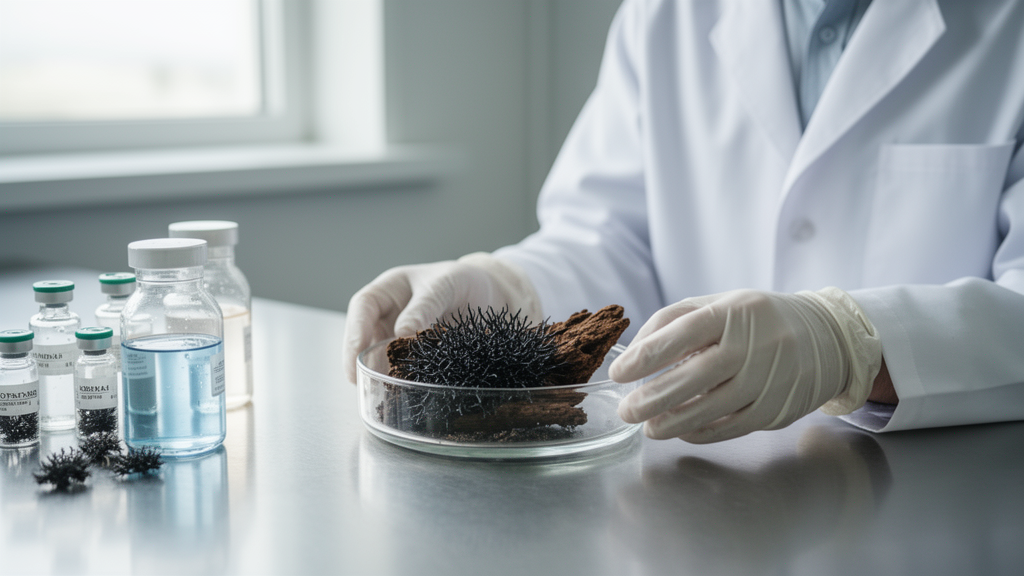
More than a hundred bioactive compounds derived from marine fungi have been analysed in a new review, and the picture that emerges is one of remarkable chemical richness paired with a stubborn commercial bottleneck. The study, published in the journal 3 Biotech, examined these natural products across their chemical diversity, biological activities, commercialisation status, economic relevance and Technology Readiness Levels, and found that only around 10 to 20 of the reviewed compounds have ever been marketed.
Marine fungi produce an unusually varied arsenal of secondary metabolites. The compounds catalogued in the review span polyketides, alkaloids, terpenoids, peptides, azaphilones and other bioactive classes, with potential uses spanning pharmaceuticals, nutraceuticals, cosmeceuticals, industrial processes and environmental applications. This breadth of chemistry is precisely what makes marine fungi attractive to bioprospectors, who systematically explore natural resources in search of bioactive molecules that can be developed into commercially valuable products.
The commercial reality, however, lags far behind the discovery pipeline. The review’s Technology Readiness Level assessment showed that most marine fungal-derived products remain concentrated at TRL 1 to 3, the earliest stages of the development scale, where researchers are still validating basic principles and proving concepts in the laboratory. A smaller number of compounds and bioprocesses have progressed to TRL 4 to 5, and only highly commercialised products reach TRL 9, the level of full market deployment.
The authors also broke the assessment down by application area and geography, with a particular focus on India. In the Indian context, pharmaceutical applications involving anticancer, antimicrobial and antiviral compounds were assessed at TRL 3 to 5, while nutraceuticals had advanced further, to TRL 5 to 7. Cosmeceuticals reached TRL 6 to 8, and industrial enzymes fared best of all, sitting at TRL 7 to 9.
Why do so many promising molecules stall at low readiness levels? The review identifies a cluster of interlocking barriers. Low and unstable metabolite yields make production unreliable and expensive. The structural complexity of many marine fungal compounds complicates synthesis and scale-up. Inadequate translational investment and industrial infrastructure compound the problem, and high financial and technical risks during late-stage development deter the partners needed to carry products across the finish line.
The review does not simply diagnose the problem; it also maps out a toolkit of integrated approaches that could raise production levels and push products up the readiness scale. These include strain improvement and fermentation optimization, which address the yield problem directly, as well as chemoenzymatic synthesis and in-situ product removal, which can ease downstream processing. On the discovery and engineering side, the authors highlight OSMAC approaches, genome mining, metabolic engineering, chemi-genomic approaches and CRISPR/Cas-based pathway engineering as opportunities to unlock silent biosynthetic gene clusters and redirect fungal metabolism toward valuable products.
Taken together, the findings demonstrate what the authors describe as a substantial discovery-to-commercialization gap in marine fungal biotechnology. The ocean’s fungi are prolific chemists, but the industrial machinery needed to convert their metabolites into approved, profitable products has not kept pace with the rate of discovery. Closing that gap, the review argues, is not a matter of any single fix but of coordinated progress on several fronts at once.
According to the review, advancing strain development, scalable bioprocessing, safety and regulatory validation, synthetic biology, industrial partnerships and translational infrastructure is essential to convert promising low-TRL discoveries into commercially viable products. The authors frame this effort not only as an economic opportunity but as a way to strengthen the contribution of marine fungi to a sustainable circular bioeconomy, in which biological resources are used and reused with minimal waste.
The review also connects its findings to broader policy frameworks, noting that the links between fungal metabolites, the BioE3 policy and the Sustainable Development Goals are clearly outlined in the analysis. The work proposes strategies to raise discoveries to higher TRLs specifically in service of that circular bioeconomy vision, and emphasizes integrated strategies for marine fungal secondary metabolite production as a central theme.
For researchers and investors watching the marine biotechnology space, the review’s central message is sobering but actionable. The chemical diversity is real, the biological activities are documented, and a handful of products have proven that commercialisation is possible. What remains scarce is the translational infrastructure, patient capital and process engineering capacity needed to move the majority of these compounds out of the early-stage pipeline and into the market.
Subject of Research: Technology readiness and commercialisation status of bioactive natural products derived from marine fungi
Article Title: Recent biotechnological advances and technology readiness level of natural products derived from marine fungi
Article References: Chetapalli, C., Karuppaiah, N. D., Garlapati, D., Veeraragavan, S., Sreeharsha, R. V., Valsalan, V. N., Gopal, D., & Ramakrishnan, B. (2026). Recent biotechnological advances and technology readiness level of natural products derived from marine fungi. 3 Biotech, 16(11), 481. https://doi.org/10.1007/s13205-026-05113-2
Image Credits: AI Generated
DOI: 10.1007/s13205-026-05113-2
Keywords: marine fungi, natural products, bioprospecting, technology readiness level, secondary metabolites, commercialisation, drug discovery, fermentation, metabolic engineering, circular bioeconomy, India, biotechnology
Cite Scienmag News
Gregory Coleman. (October 27, 2026). Marine Fungal Drugs Remain Stuck at Early Development Stages, Review Finds. Scienmag. https://scienmag.com/marine-fungal-drugs-remain-stuck-at-early-development-stages-review-finds/
Gregory Coleman. "Marine Fungal Drugs Remain Stuck at Early Development Stages, Review Finds." Scienmag, 27 October 2026, https://scienmag.com/marine-fungal-drugs-remain-stuck-at-early-development-stages-review-finds/. Accessed 27 October 2026.
Gregory Coleman. "Marine Fungal Drugs Remain Stuck at Early Development Stages, Review Finds." Scienmag. October 27, 2026. https://scienmag.com/marine-fungal-drugs-remain-stuck-at-early-development-stages-review-finds/


