


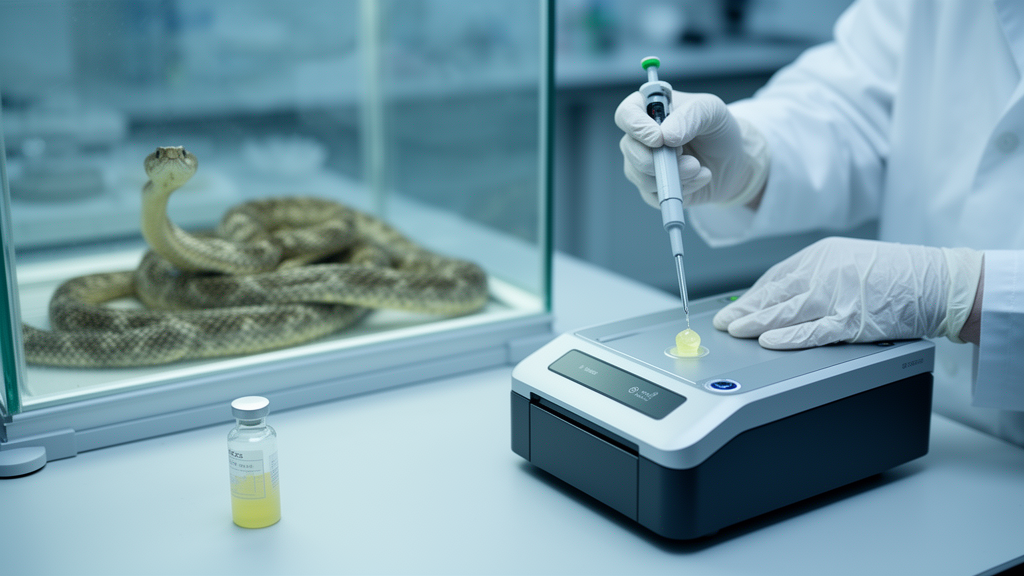
Scientists in Belgium and France have unveiled a streamlined laboratory workflow that can pluck receptor-binding peptide toxins out of extraordinarily complex animal venoms and identify them by mass spectrometry, all without the radioactive or fluorescent labels that traditional binding assays demand. The study, published in Frontiers in Chemistry, demonstrates the technique on two pharmacologically distinct receptor families: a human G protein-coupled receptor and a ligand-gated ion channel, and shows that it can recover both tiny endogenous hormones and bulky, disulfide-rich snake toxins from partially purified venom fractions and even from crude venom itself.
Animal venoms are among the richest untapped libraries of drug-like molecules on Earth. More than 200,000 venomous species have been described, and each one may produce hundreds of bioactive peptides and proteins that evolution has tuned over millions of years to bind membrane receptors with remarkable affinity and selectivity. Venom-derived molecules have already yielded approved therapeutics for hypertension, chronic pain, diabetes, thrombosis and coagulation disorders. Yet only a small fraction of venom peptides have been pharmacologically characterized, largely because picking out the few receptor-specific ligands hiding among hundreds of unrelated components remains experimentally demanding.
The new workflow, developed by Loïc Quinton and colleagues at the University of Liège together with collaborators at Alphabiotoxine Laboratory and CEA Paris-Saclay, combines native membrane preparations, label-free affinity capture, MALDI-TOF mass spectrometry and LC-MS/MS-based shotgun proteomics in a single pipeline. The researchers start with membranes containing the receptor of interest, incubate them with a venom sample at 27 degrees Celsius for two hours in ammonium acetate buffer, and then spin the mixture down. Peptides that did not bind stay in the supernatant, the so-called unbound fraction. The membrane pellet is washed, and a jolt of 5 percent trifluoroacetic acid at pH 2 disrupts the receptor structure, releasing any captured ligands into a bound fraction that is then desalted and analyzed.
Validation came first from well-characterized receptor-ligand pairs. For the human vasopressin type 2 receptor, a GPCR overexpressed in Chinese hamster ovary cell membranes, the team spiked the natural hormone arginine vasopressin, which binds with a dissociation constant of 0.18 nanomolar, into a complex background of roughly 100 detectable peptides from a digested bovine serum albumin. Despite that peptide-rich environment, the background stayed exclusively in the unbound fraction while vasopressin was selectively retained. When the same experiment was run on CHO membranes lacking the receptor, vasopressin vanished from the bound fraction, confirming that retention required the receptor rather than nonspecific membrane sticking. A parallel validation used the muscle-type nicotinic acetylcholine receptor from Torpedo marmorata electric organ membranes and the synthetic α-conotoxin GI, which was likewise efficiently enriched.
The real test came with larger venom toxins. Mambaquaretin-1, a 57-amino-acid Kunitz-type peptide from the green mamba Dendroaspis angusticeps and the first natural peptide known to selectively antagonize the human vasopressin V2 receptor, was captured from a reverse-phase HPLC venom fraction containing at least ten toxins of six to nine kilodaltons. Comparing the reference spectrum with the unbound fraction showed a substantial drop in the mambaquaretin-1 signal, while the bound fraction showed clear enrichment of that same signal. Proteomics also flagged a weaker bound-fraction signal belonging to H-toxin TA2, which remained mostly unbound. Neither toxin appeared in the bound fraction of receptor-free control membranes, underscoring the selectivity of the capture.
Competition experiments added a dynamic dimension. When increasing amounts of vasopressin, from 1 to 100 picomoles, were added alongside the fixed mambaquaretin-1-containing fraction, the toxin’s bound-fraction signal fell while its unbound signal rose, a redistribution consistent with competitive displacement. The authors are careful to note that this pattern cannot by itself distinguish overlapping binding sites from steric interference or allosteric coupling, and that the apparent transition in the micromolar range should not be compared directly with published nanomolar affinity values, because the experiment used an unpurified venom fraction of unknown toxin concentration and was run as an exploratory proof of concept without independent replicates.
The team then turned to the monocled cobra, Naja kaouthia, a medically significant elapid whose venom is dominated by α-neurotoxins targeting nicotinic acetylcholine receptors. Reverse-phase HPLC split one milligram of venom into 62 fractions, and selected fractions were fished against the Torpedo membranes. MALDI-TOF spectra and shotgun proteomics together revealed 28 distinct mass signals, and the identified toxins fell into four behavioral groups. α-Cobratoxin, one of the best-characterized muscle-type nAChR antagonists, showed intense bound-fraction enrichment with mean normalized bound signals above 80 percent, as did several cytotoxins, nakoroxin and cobrotoxin. Others, including muscarinic toxin-like protein 1, which reportedly has practically no affinity for muscle-type nAChRs, stayed predominantly unbound, matching its known pharmacology.
Not every enriched toxin fit expectations, and the authors treat those surprises as hypotheses rather than conclusions. Cytotoxin 4 and a Naja sumatrana cytotoxin 1 isoform, both pore-forming toxins that disrupt lipid bilayers, were strongly retained despite lacking established nAChR affinity, suggesting that nonspecific membrane association contributes to capture on native, phospholipid-rich preparations. Nakoroxin, which does not block α-bungarotoxin binding but enhances it at the acetylcholine-binding protein, showed preferential association with the Torpedo preparation in crude-venom comparisons, leaving open both cholinergic-protein and lipid-mediated explanations. The direct comparison of Torpedo-bound and CHO-bound fractions by label-free quantification, analyzed in MaxQuant and Perseus with a 1 percent permutation-based false discovery rate, proved most informative when read alongside each toxin’s known activity and membrane propensity.
Applying the workflow directly to crude venom, without fractionation, produced mixed results. The crude Naja kaouthia venom spectrum displayed tens of mass signals between m/z 2,000 and 15,000, and comparison of bound and unbound profiles revealed selective capture behavior. However, mambaquaretin-1 could not be confidently detected in the bound fraction when crude D. angusticeps venom was used, a difference the authors attribute to ion suppression, the dominance of abundant components, and the reduced relative representation of the toxin in the unfractionated mixture. Fractionation, they conclude, remains an essential first step for discovery, while crude-venom experiments are best reserved for assessing whether candidates can still be recovered in the complete mixture and for comparing retention across membrane preparations.
The researchers argue that the platform’s versatility extends well beyond venoms. Because it preserves receptors in a near-native lipid environment, it may maintain receptor conformations better than purified recombinant proteins, and because mass spectrometry is label-free, it can monitor many ligands simultaneously with high molecular specificity. The workflow could be adapted to virtually any membrane receptor with an overexpression system, opening applications in endogenous peptide discovery, antibody screening, synthetic peptide libraries, natural product research and even oncology-focused ligand hunting. The authors also anticipate that artificial intelligence tools for structure prediction and docking, combined with machine learning on large proteomic datasets, could help prioritize candidate toxins and separate true ligands from nonspecific binders before experimental validation. For now, the method detects retained molecules rather than pharmacological activity, so functional assays remain necessary to determine whether any captured peptide is an agonist, antagonist or allosteric modulator, but as a rapid, label-free way to prioritize bioactive peptides from nature’s most complex mixtures, the approach marks a significant analytical advance. The proteomic data have been deposited in ProteomeXchange under identifier PXD084762.
Subject of Research: A mass spectrometry-based affinity-capture workflow for identifying receptor-binding peptide ligands in complex animal venoms
Article Title: Mass spectrometry-based affinity capture of peptide ligands from complex venom mixtures
Article References: Freuville, L., Fourmy, R., Violette, A., Brans, A., Aráoz, R., Gilles, N., & Quinton, L. (2026). Mass spectrometry-based affinity capture of peptide ligands from complex venom mixtures. Frontiers in Chemistry, 14, 1971257. https://doi.org/10.3389/fchem.2026.1971257
Image Credits: AI Generated
DOI: 10.3389/fchem.2026.1971257
Keywords: mass spectrometry, animal venoms, affinity capture, ligand fishing, membrane receptors, GPCR, nicotinic acetylcholine receptor, snake toxins, proteomics, MALDI-TOF, drug discovery, mambaquaretin-1
Cite Scienmag News
Drew Townsend. (October 27, 2026). Mass spectrometry workflow fishes receptor-binding toxins straight from snake venom. Scienmag. https://scienmag.com/mass-spectrometry-workflow-fishes-receptor-binding-toxins-straight-from-snake-venom/
Drew Townsend. "Mass spectrometry workflow fishes receptor-binding toxins straight from snake venom." Scienmag, 27 October 2026, https://scienmag.com/mass-spectrometry-workflow-fishes-receptor-binding-toxins-straight-from-snake-venom/. Accessed 27 October 2026.
Drew Townsend. "Mass spectrometry workflow fishes receptor-binding toxins straight from snake venom." Scienmag. October 27, 2026. https://scienmag.com/mass-spectrometry-workflow-fishes-receptor-binding-toxins-straight-from-snake-venom/


