


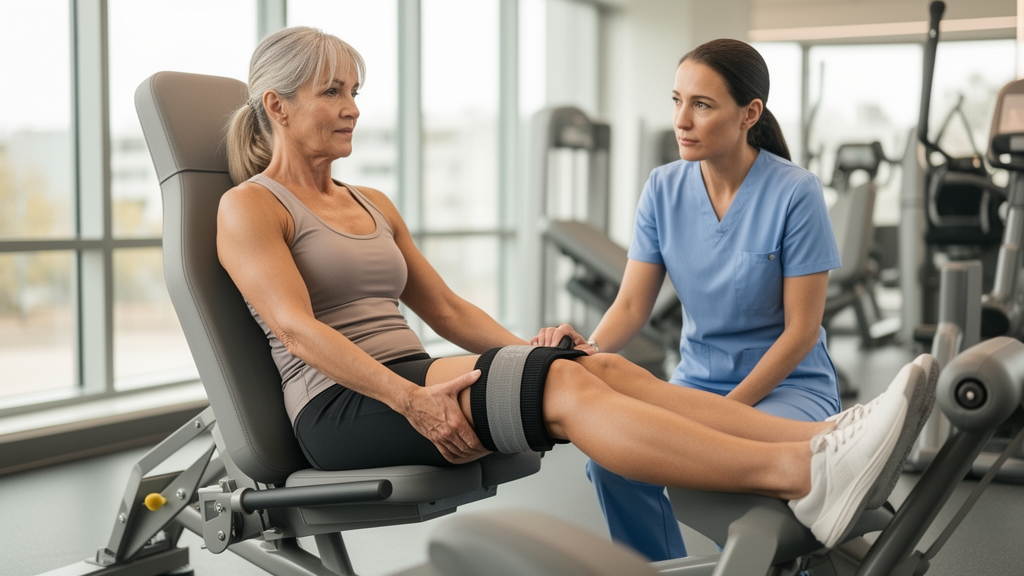
Researchers in Iran have laid out a detailed plan to test whether wrapping blood pressure-style cuffs around the limbs during light functional exercise can amplify the benefits of training in postmenopausal women. The study, published as a peer-reviewed protocol in Frontiers in Sports and Active Living, describes a single-blind, three-arm randomized controlled trial that will enroll 45 community-dwelling postmenopausal women and compare eight weeks of functional training with blood flow restriction against functional training alone and a non-exercising control group. Because the paper is a protocol, no results exist yet; what it offers instead is an unusually comprehensive blueprint for measuring how a low-load intervention might touch hormones, inflammation, blood vessel biology, cognition, strength, and daily function all at once.
The scientific rationale rests on a physiological bottleneck that many women encounter after menopause. The sustained loss of ovarian estrogen affects far more than reproduction: estrogen receptors in skeletal muscle influence satellite-cell activity, mitochondrial function, muscle repair, and inflammatory regulation, so estrogen deficiency may blunt the capacity of muscle to adapt to physical stress. The protocol’s authors argue that this places postmenopausal women at heightened risk of sarcopenia, the progressive loss of muscle strength, mass, and performance, and consequently of mobility limitations, falls, and loss of independence. With the global population of older women expanding, the team frames the search for safe, tolerable exercise strategies as a public health priority rather than a niche athletic question.
At the molecular level, the trial targets the growth hormone and insulin-like growth factor axis, which drives muscle protein synthesis and tissue repair through the PI3K/Akt/mTOR pathway. Aging and estrogen deficiency may weaken this anabolic signaling, shifting the balance toward proteolytic machinery such as the ubiquitin-proteasome system and the autophagy-lysosome pathway. The researchers will also track the testosterone-to-cortisol ratio, an indirect composite marker of anabolic versus catabolic endocrine activity; a lower ratio has previously been associated with a more catabolic environment, impaired muscle maintenance, greater adiposity, and poorer neuromuscular function. Cortisol, when chronically elevated, stimulates protein breakdown and can disrupt insulin- and IGF-1-dependent signaling, while testosterone supports repair through androgen-receptor signaling.
Inflammation forms the second thread of the study’s logic. Chronic low-grade inflammation, carried by mediators such as interleukin-6 and C-reactive protein, may interfere with growth hormone and IGF-1 signaling and contribute to anabolic resistance. Interleukin-6 can stimulate hepatic C-reactive protein production through the JAK/STAT3 pathway and suppress growth-hormone-related signaling, reducing the bioavailability of IGF-1 and its binding protein IGFBP-3. The same inflammatory environment may extend beyond muscle: elevated IL-6 and CRP are implicated in harming the hippocampus and prefrontal cortex through endothelial dysfunction, disruption of the blood-brain barrier, microglial activation, and impaired neurogenesis, potentially promoting cognitive decline and reduced cognitive-motor coordination in parallel with muscle dysfunction.
Vascular endothelial growth factor, or VEGF, serves as the trial’s proposed bridge between vascular health, neural function, and muscular adaptation. Beyond its central role in angiogenesis, VEGF contributes to cerebral blood flow regulation, neurogenesis, and trophic support of neurons. The protocol notes that aging and reduced estrogenic support may diminish VEGF-related pathway activity, limiting the ability of cerebral vessels to meet the metabolic demands of neural tissue, and that age-related VEGF reductions in the presence of chronic inflammation have been associated with impaired cerebrovascular reactivity and poorer outcomes in postmenopausal women. By measuring VEGF alongside cognitive and functional outcomes, the trial may clarify whether angiogenic adaptations accompany broader neuromuscular and cognitive changes.
The intervention itself is a circuit-based functional training program performed three times per week on non-consecutive days. Each session comprises a ten-minute warm-up, a 40-to-50-minute main circuit, and a five-to-ten-minute cool-down. The circuit includes eight exercises: dumbbell fly on a Swiss ball, medicine ball squat on a BOSU ball, standing shoulder press on a BOSU ball, medicine ball crunches, triceps extension on a Swiss ball, forward lunge on a BOSU ball, biceps curl on a BOSU ball, and medicine ball hyperextension. Intensity for dumbbell stations starts at 20 percent of the estimated one-repetition maximum and climbs by five percent weekly, reaching 55 percent by week eight, while medicine ball loads range from two to five kilograms. Perceived exertion on the Borg scale is capped between 13 and 15, described as somewhat hard, and participants are explicitly instructed to avoid breath-holding and the Valsalva maneuver.
The blood flow restriction arm adds pneumatic cuffs, five centimeters wide for upper limbs and eight centimeters for lower limbs, placed proximally on the working limbs. Arterial occlusion pressure is estimated session-by-session using validated anthropometric formulas based on limb circumference and blood pressure, and restriction pressure progresses from 50 percent of that value in week one to 85 percent by week eight. Cuffs stay inflated through two to three sets of each exercise, including 60-second inter-set rests, and are fully deflated during the one-to-two-minute transition between exercises. A study physician attends the cuff sessions, and any severe pain, numbness, dizziness, unusual shortness of breath, or exaggerated blood pressure response triggers immediate deflation and possible termination of the session. The control group maintains habitual lifestyle with general health advice and activity monitoring.
The measurement battery is unusually broad for a 45-person trial. Primary biochemical outcomes, assessed by ELISA on fasting morning blood samples drawn at baseline and 48 hours after the intervention ends, include growth hormone, IGFBP-3, interleukin-6, C-reactive protein, VEGF, and serum testosterone and cortisol, with all samples analyzed in a single batch to keep inter-assay variability below ten percent. Cognitive outcomes span the Mini-Mental State Examination, the Montreal Cognitive Assessment, a computerized Stroop test of inhibitory control, and the Corsi block-tapping test of visuospatial memory, all using validated Persian versions. Secondary outcomes cover handgrip dynamometry, leg press one-repetition maximum, the Timed Up and Go test, the five-repetition sit-to-stand test, the SF-36 quality-of-life survey, and a 100-millimeter visual analogue scale for pain.
Methodological safeguards are spelled out in detail. Participants are randomized 1:1:1 through a web-based tool with allocation concealed in sequentially numbered opaque envelopes; outcome assessors, laboratory personnel, and where possible the statistician remain blinded, though participants and trainers cannot be, given the nature of exercise. Eligibility is strict: women must have had no menstrual bleeding for at least 24 consecutive months, be sedentary or low-active, score at least 24 on the MMSE, have medical clearance, and lack conditions that contraindicate cuff use, such as thromboembolic disease, severe peripheral vascular disease, hypertension, lymphedema, or skin lesions. The sample size of 36, inflated to 45 for an anticipated 15 percent attrition, was calculated with G*Power for a repeated-measures ANCOVA design assuming a medium effect size of f = 0.25, 80 percent power, and a within-subject correlation of 0.70. Analysis will follow a complete-case framework with baseline values as covariates and Bonferroni-corrected post-hoc comparisons.
The authors are candid about the trial’s limits. It is single-center and restricted to generally healthy community-dwelling women, so findings may not generalize to frailer populations or different menopausal stages. Eight weeks is too short to assess long-term maintenance or clinical outcomes such as falls, and expectancy effects are unavoidable when participants know whether they trained. Estimating occlusion pressure from anthropometric formulas rather than Doppler ultrasound may introduce variability in the individualized stimulus, and heterogeneity in cuff characteristics across the wider BFR literature complicates comparison. Still, if the trial delivers clean answers, the payoff could be significant: a low-load, time-efficient strategy that supports muscle health, functional independence, and cognitive well-being in a population that conventional high-intensity resistance training often excludes. Recruitment is planned to begin on 15 June 2026, with the trial registered in the Iranian Registry of Clinical Trials and results to be published regardless of direction or magnitude.
Subject of Research: A randomized controlled trial protocol testing functional training with blood flow restriction in postmenopausal women
Article Title: Effects of eight weeks of functional training with blood flow restriction on biochemical, cognitive, and functional outcomes in postmenopausal women: protocol for a single-blind randomized controlled trial
Article References: Shakoor, E., Aliakbari Jam, F., Khafaei, M., Carneiro, L., & Amani-Shalamzari, S. (2026). Effects of eight weeks of functional training with blood flow restriction on biochemical, cognitive, and functional outcomes in postmenopausal women: protocol for a single-blind randomized controlled trial. Frontiers in Sports and Active Living, 8, 1953943. https://doi.org/10.3389/fspor.2026.1953943
Image Credits: AI Generated
DOI: 10.3389/fspor.2026.1953943
Keywords: blood flow restriction, postmenopausal women, functional training, sarcopenia, inflammation, cognitive function, VEGF, testosterone-to-cortisol ratio, randomized controlled trial, exercise protocol, healthy aging, IGFBP-3
Cite Scienmag News
Beatrice Stafford. (October 27, 2026). Cuffed Workouts at Low Loads: Trial to Test Blood Flow Restriction in Postmenopausal Women. Scienmag. https://scienmag.com/cuffed-workouts-at-low-loads-trial-to-test-blood-flow-restriction-in-postmenopausal-women/
Beatrice Stafford. "Cuffed Workouts at Low Loads: Trial to Test Blood Flow Restriction in Postmenopausal Women." Scienmag, 27 October 2026, https://scienmag.com/cuffed-workouts-at-low-loads-trial-to-test-blood-flow-restriction-in-postmenopausal-women/. Accessed 27 October 2026.
Beatrice Stafford. "Cuffed Workouts at Low Loads: Trial to Test Blood Flow Restriction in Postmenopausal Women." Scienmag. October 27, 2026. https://scienmag.com/cuffed-workouts-at-low-loads-trial-to-test-blood-flow-restriction-in-postmenopausal-women/


