


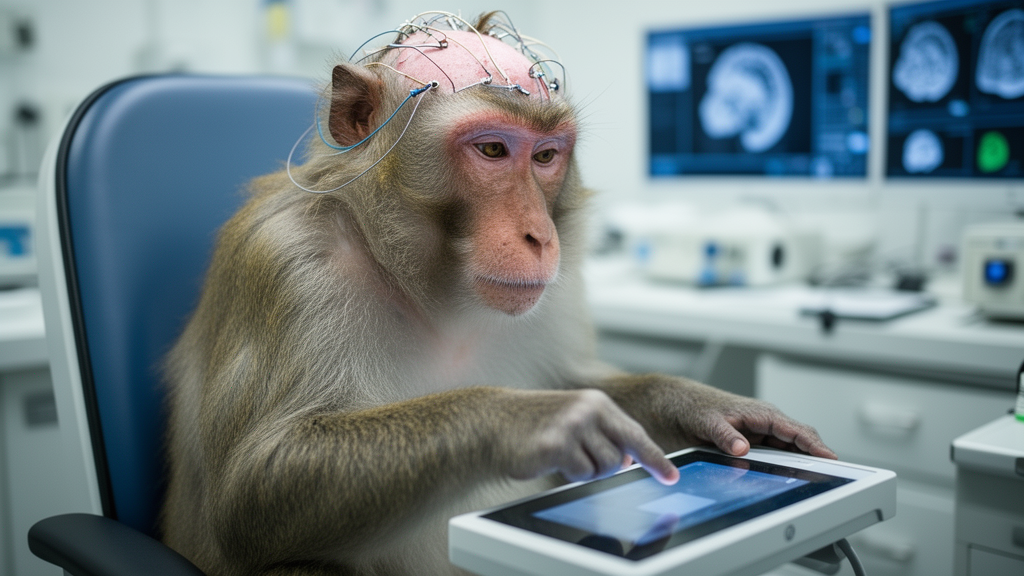
Intracortical brain-computer interfaces hold considerable promise for restoring dexterous hand function in people with severe paralysis or limb loss, yet reliable control of coordinated multi-digit movements remains difficult. A central obstacle is that the cortical representation of finger coordination is not fully understood, and it has been unclear whether this representation is shared across the cortical areas that contribute to grasping or differs from one area to another. A new case report by researchers at the German Primate Center in Göttingen addresses this question directly, reporting simultaneous intracortical recordings from three nodes of the macaque grasping network during individual and combined finger movements.
The team, led by Wei-an Sheng, Andres Agudelo-Toro, Benjamin Dann and Hans Scherberger, implanted a male rhesus macaque with six floating microelectrode arrays providing 192 recording channels. The arrays targeted three areas known to participate in grasping: the anterior intraparietal area, or AIP, in the parietal lobe; ventral premotor cortex, known as area F5; and primary motor cortex, or M1. According to the authors, this is the first study to record intracortical population activity simultaneously from these three cortical areas during coordinated multi-digit movements.
Before implantation, the animal was trained to perform individual and combined finger flexions using a microswitch-based manipulandum. This behavioral paradigm allowed the researchers to compare how each cortical area represented single-finger actions and the combined movements formed from them, providing a controlled test of whether combined-movement activity can be described as a simple mixture of the activity seen during the component single-finger movements. The recordings revealed that population activity in AIP, F5 and M1 diverged into distinct, movement-specific trajectories.
In other words, each area's neural population followed its own path through activity space depending on which finger or combination of fingers was instructed and executed. A key finding concerned dimensionality, the number of independent activity patterns needed to capture most of the movement-related differences in the data. This number was larger in F5 than in either AIP or M1.
The authors describe this condition-dependent dimensionality as significantly higher in ventral premotor cortex, suggesting that F5 represents the repertoire of finger combinations in a richer, more distributed way than the parietal and primary motor nodes of the network. Alignment and reconstruction analyses added a second layer of insight, showing descriptive area-specific patterns in how closely the activity during a combined movement resembled a simple combination of the two single-finger activity patterns it comprises. Notably, this resemblance was generally limited across a range of dimensionalities examined.
The implication is that combined-finger movements are not merely superpositions of their parts in the grasping network; the cortical code for coordination carries structure of its own, and the degree of that structure varies by area. Error-trial analyses uncovered complementary temporal dynamics within individual areas. When the animal made erroneous presses, early activity in AIP preferentially reflected the movement that had been instructed, whereas activity in M1 near the erroneous press reflected the movement that was actually produced.
For brain-computer interfaces, the authors argue that these observations raise a specific hypothesis: whether training a decoder on single-finger movements generalizes to combined presses may depend on which cortical area the decoder reads from, not only on how the decoder is built. Shared low-dimensional structure could still support a small, easy-to-calibrate signal set in some areas, while area-specific structure could limit generalization in others. The authors are careful to frame these conclusions within the limits of the study.
The findings come from a single male rhesus macaque, and the possibilities raised for decoder design require direct comparisons of decoder performance and replication beyond this one subject.
Subject of Research: Intracortical population recordings of multi-digit coordination across the macaque grasping network for brain-computer interfaces
Article Title: Case Report: Representational geometry of multi-digit coordination in the macaque grasping network for intracortical BCIs
Article References: Sheng, W.-A., Agudelo-Toro, A., Dann, B., & Scherberger, H. (2026). Case Report: Representational geometry of multi-digit coordination in the macaque grasping network for intracortical BCIs. Frontiers in Neuroscience, 20, 1933898. https://doi.org/10.3389/fnins.2026.1933898
Image Credits: AI Generated
DOI: 10.3389/fnins.2026.1933898
Keywords: brain-computer interfaces, macaque, grasping network, intracortical recording, finger movements, motor cortex, ventral premotor cortex, anterior intraparietal area, neural population dynamics, neuroprosthetics, Case, Report
Cite Scienmag News
Cassandra Pierce. (October 27, 2026). Macaque Study Maps How Three Brain Areas Encode Coordinated Finger Movements for Brain-Computer Interfaces. Scienmag. https://scienmag.com/macaque-study-maps-how-three-brain-areas-encode-coordinated-finger-movements-for-brain-computer-interfaces/
Cassandra Pierce. "Macaque Study Maps How Three Brain Areas Encode Coordinated Finger Movements for Brain-Computer Interfaces." Scienmag, 27 October 2026, https://scienmag.com/macaque-study-maps-how-three-brain-areas-encode-coordinated-finger-movements-for-brain-computer-interfaces/. Accessed 27 October 2026.
Cassandra Pierce. "Macaque Study Maps How Three Brain Areas Encode Coordinated Finger Movements for Brain-Computer Interfaces." Scienmag. October 27, 2026. https://scienmag.com/macaque-study-maps-how-three-brain-areas-encode-coordinated-finger-movements-for-brain-computer-interfaces/


