


Astronomers at the Center for Astrophysics | Harvard & Smithsonian have built one of the largest and most detailed simulations ever created of the early universe, a model designed to help scientists interpret the flood of observations now arriving from the James Webb Space Telescope and the upcoming Nancy Roman Space Telescope. The simulation, called Lumina, recreates how ordinary matter, dark matter and radiation interacted during the universe's first 2 billion years, and it is described in a paper published in Monthly Notices of the Royal Astronomical Society. By comparing what JWST, Roman and other telescopes actually see with Lumina's predictions, researchers can test whether their understanding of the physical laws governing the cosmos remains accurate or whether new discoveries may force a rethink of existing theories.
Lumina is the largest cosmological radiation-hydrodynamics simulation ever created. This class of computation models how the universe's fundamental ingredients — gas, dark matter and light — interact to form stars and galaxies. The model traces the first 2 billion years of cosmic history, following how the earliest galaxies emerged and transformed the vast regions of gas lying between them.
The simulated volume spans more than 100 times the space modeled by previous comparable simulations, and it encompasses a region equivalent to a cube roughly 1.5 billion light-years on each side, a scale comparable to what astronomers can observe with today's most powerful telescopes. Lumina is also the first simulation of its kind to capture helium reionization as it occurred while allowing its effects to immediately influence the evolving universe within the model. "For the first time, we can follow along as both hydrogen and helium changed into their modern form across such an enormous volume of the universe, while still resolving the galaxies and other luminous objects driving that transformation," said Aaron Smith, an assistant professor of physics at the University of Texas at Dallas and an author on the paper.
Building the simulation demanded extraordinary computational resources. Lumina required more than 15,000 graphics processing units running on Frontier, one of the world's fastest supercomputers, located at Oak Ridge National Laboratory in Tennessee. That computing power allowed the team to model an unprecedented volume of the early universe while maintaining the level of detail needed to study the formation of galaxies, stars and black holes.
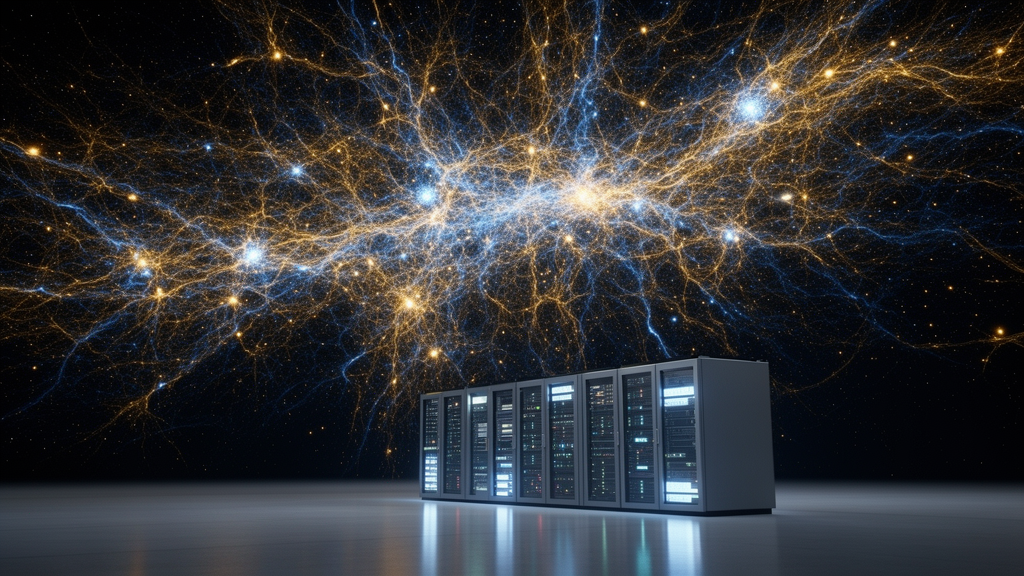
The result is a rendering of the cosmic web about 650 million light-years across, in which fine filaments trace the distribution of dark matter and warm orange and yellow tones highlight where gas is moving fastest between galaxy clusters. "With JWST, the early universe has become an exciting new frontier in astrophysics," said lead author Oliver Zier, an ITC Fellow at the Center for Astrophysics | Harvard & Smithsonian. "To understand what we are seeing with this telescope, we need to translate our theories into detailed predictions.
After several years of work, with plenty of ups and downs, it is incredibly rewarding to see the simulation results and watch our predictions come to life in video." The quote reflects the practical role simulations now play in modern astronomy: for centuries, observers built increasingly sophisticated models to explain how stars, galaxies and other cosmic structures form, and today supercomputer simulations turn those theories into concrete, testable predictions. When observations match the predictions, confidence in existing theories grows; when they do not, scientists gain opportunities to uncover new insights about how the universe works. The research team designed Lumina explicitly as a platform for testing new ideas about the formation and evolution of the universe.
Planned future studies will use the simulation to investigate how gases move between galaxies, how radiation from the Big Bang shaped cosmic evolution, and how regions of intense star formation developed over time. Because the simulated volume matches the scales probed by current observatories, the model can serve as a direct point of comparison for data from JWST and, once operational, the Nancy Roman Space Telescope, which are revealing the universe's earliest chapters in extraordinary detail. The work is a computational simulation and modeling study rather than an observational discovery, and its value lies in the predictions it generates rather than in new measurements of the sky.
The published paper, titled "Introducing the Lumina project: large-volume radiation-hydrodynamic simulations of the epochs of hydrogen and helium reionization," appears in Monthly Notices of the Royal Astronomical Society with a publication date of 26 October 2026. As with any simulation, Lumina's fidelity depends on the physical assumptions built into it, and its predictions will be judged against real telescope data as those comparisons are carried out in future research.
Subject of Research: Large-volume radiation-hydrodynamic simulation of hydrogen and helium reionization in the early universe
Article Title: Smithsonian scientists create most detailed simulation yet of the early universe
Article References: Smithsonian scientists create most detailed simulation yet of the early universe. Original publication (Bibliographic details unavailable.)
Image Credits: AI Generated
DOI: Not provided
Keywords: Lumina simulation, early universe, reionization, cosmological simulation, James Webb Space Telescope, Nancy Roman Space Telescope, dark matter, radiation hydrodynamics, Frontier supercomputer, galaxy formation, cosmic web, Center for Astrophysics
Cite Scienmag News
Grant Pearson. (October 26, 2026). Lumina simulation recreates the universe’s first 2 billion years in unprecedented detail. Scienmag. https://scienmag.com/lumina-simulation-recreates-the-universes-first-2-billion-years-in-unprecedented-detail/
Grant Pearson. "Lumina simulation recreates the universe’s first 2 billion years in unprecedented detail." Scienmag, 26 October 2026, https://scienmag.com/lumina-simulation-recreates-the-universes-first-2-billion-years-in-unprecedented-detail/. Accessed 26 October 2026.
Grant Pearson. "Lumina simulation recreates the universe’s first 2 billion years in unprecedented detail." Scienmag. October 26, 2026. https://scienmag.com/lumina-simulation-recreates-the-universes-first-2-billion-years-in-unprecedented-detail/


