


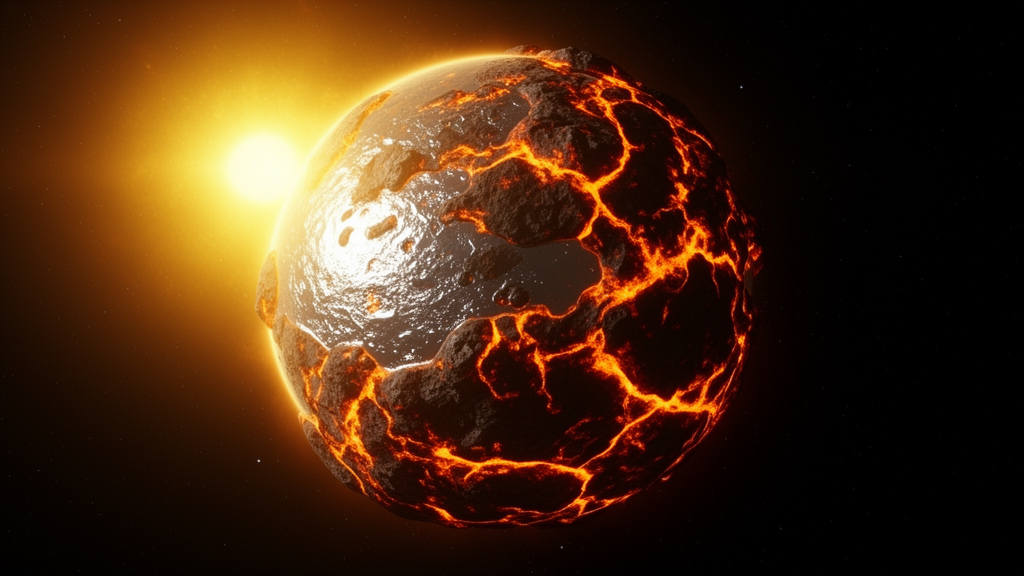
A rocky planet so close to its star that its surface is likely covered by an ocean of molten rock appears to be wrapped in a highly reflective atmosphere, according to new observations from the James Webb Space Telescope. The planet, TOI-561 b, lies some 280 light years from Earth and was long expected to have been stripped bare of any atmosphere billions of years ago under the relentless glare of its star. Instead, an international team of astronomers reports that the world reflects roughly three-quarters of the starlight that strikes it, a brightness comparable to that of Venus, and that its atmosphere appears to move heat around the planet rather than letting it pool on the sunlit side.
The findings, published in The Astronomical Journal, come from a 37-hour observing campaign with Webb’s NIRSpec instrument that captured nearly four complete orbits of the planet around its star. The study, led by Professor Lisa Dang of the University of Waterloo in Ontario, Canada, with co-authors including Dr Anjali Piette, Assistant Professor in Astronomy at the University of Birmingham, used a technique known as a phase curve. By tracking how the combined brightness of the star and planet changes as the planet circles its star, astronomers can separate the planet’s own contribution from that of the star and reconstruct both its dayside and nightside conditions.
“We measured how the planet’s brightness and heat changed throughout its orbit,” said Professor Dang. “This technique, known as a phase curve, revealed that the planet reflects a significant amount of light from its star, and that heat is being redistributed around the planet instead of only on the sunlit side. Together, these point to the presence of an atmosphere.” The phase-curve method is particularly powerful for planets like TOI-561 b because it samples the full orbit continuously, giving the first direct look at the hemisphere that always faces away from the star.
The initial puzzle was that the planet’s dayside turned out to be far cooler than the team expected for a bare, dark rock orbiting this close to its star. For a world without an atmosphere, the missing energy had to go somewhere. Two explanations were possible: the heat could be carried around to the nightside by winds or other atmospheric circulation, or it could be reflected away before the planet ever absorbed it. The new observations allowed the researchers to test both possibilities at once.
When the team examined the nightside, which never faces the star, they found it was not warm enough to account for the missing energy. That left reflection as the dominant explanation. TOI-561 b, the measurements indicate, must reflect roughly three-quarters of the incoming starlight, an albedo comparable to Venus, the most reflective planet in our own Solar System. For a rocky world bathed in intense stellar radiation, that level of brightness is remarkable, and it implies that something above the molten surface is bouncing most of the light back into space before it can be absorbed and converted into heat.
To explain the brightness, the researchers compared their observations with computer simulations of the planet’s climate. These models suggest that clouds made of silicate minerals, including silicon dioxide (SiO2) and magnesium silicate (MgSiO3), could form on the planet’s dayside and act like a planetary sunscreen. In such a scenario, the extreme heat of the magma ocean below would vaporize rock, and the resulting mineral vapour could condense into reflective cloud layers in the upper atmosphere, cooling the planet and preventing the searing temperatures expected for a bare-rock world.
“Our discovery challenges current theories,” said Dr Piette of the University of Birmingham. “We would expect a heavily irradiated rocky planet like TOI-561 b to have lost its atmosphere billions of years ago.” The puzzle is acute because stellar radiation and winds are expected to erode the atmospheres of close-in rocky planets over time, and TOI-561 b receives an enormous flux from its star. “Instead, the evidence suggests it still has a significant atmosphere today. This raises major questions such as whether the planet started with an unusually large supply of gases or if the ocean of molten rock covering its surface acts as a planet-wide volcano that is constantly feeding its atmosphere.”
The second of those possibilities has attracted particular interest. If the magma ocean continuously releases gases into the atmosphere, the planet could maintain a substantial gaseous envelope indefinitely, with the interior resupplying what the star strips away. The new results build on earlier work by Professor Dang, Dr Piette and collaborators that had already suggested TOI-561 b possesses a thick atmosphere replenished by gases released from its molten interior. The phase-curve measurements now add the crucial element of extreme reflectivity, which helps explain how the planet stays cooler than a bare rock should be.
What the atmosphere is actually made of remains an open question. One possibility is a dense blanket of carbon dioxide, making TOI-561 b something like a far hotter version of Venus, where a thick CO2 envelope drives crushing surface conditions. Another is an atmosphere rich in sulphur dioxide, a gas released by volcanic activity, analogous in composition to the plumes venting from Io, the volcanically hyperactive moon of Jupiter. Distinguishing between these scenarios requires observations at longer wavelengths, where the spectral fingerprints of different gases become visible.
“The next big question we will seek to answer is whether TOI-561 b’s atmosphere resembles Venus or an extreme version of Io,” said Professor Dang. “Observing the planet at longer wavelengths with JWST could give us insights and help explain how a planet this hot has held on to an atmosphere for billions of years.” For now, the measurements establish that the planet is not the dead, airless furnace theorists once predicted, but a reflective, cloud-shrouded world whose molten surface may be the very engine keeping its atmosphere alive. The study, “A Highly Reflective Atmosphere on the Lava World TOI-561 b Revealed by JWST/NIRSpec Phase Curve,” was published in The Astronomical Journal on 29 September 2026.
Subject of Research: JWST phase-curve observations of the lava planet TOI-561 b indicating a highly reflective atmosphere
Article Title: Shiny lava planet challenges astronomers' expectations
Article References: Shiny lava planet challenges astronomers' expectations. Original publication (Bibliographic details unavailable.)
Image Credits: AI Generated
DOI: Not provided
Keywords: TOI-561 b, James Webb Space Telescope, lava planet, exoplanet atmosphere, phase curve, silicate clouds, magma ocean, The Astronomical Journal, University of Birmingham, University of Waterloo, Venus, sulphur dioxide
Cite Scienmag News
Grant Pearson. (October 26, 2026). Lava world TOI-561 b reflects most of its starlight, Webb observations reveal. Scienmag. https://scienmag.com/lava-world-toi-561-b-reflects-most-of-its-starlight-webb-observations-reveal/
Grant Pearson. "Lava world TOI-561 b reflects most of its starlight, Webb observations reveal." Scienmag, 26 October 2026, https://scienmag.com/lava-world-toi-561-b-reflects-most-of-its-starlight-webb-observations-reveal/. Accessed 26 October 2026.
Grant Pearson. "Lava world TOI-561 b reflects most of its starlight, Webb observations reveal." Scienmag. October 26, 2026. https://scienmag.com/lava-world-toi-561-b-reflects-most-of-its-starlight-webb-observations-reveal/


