


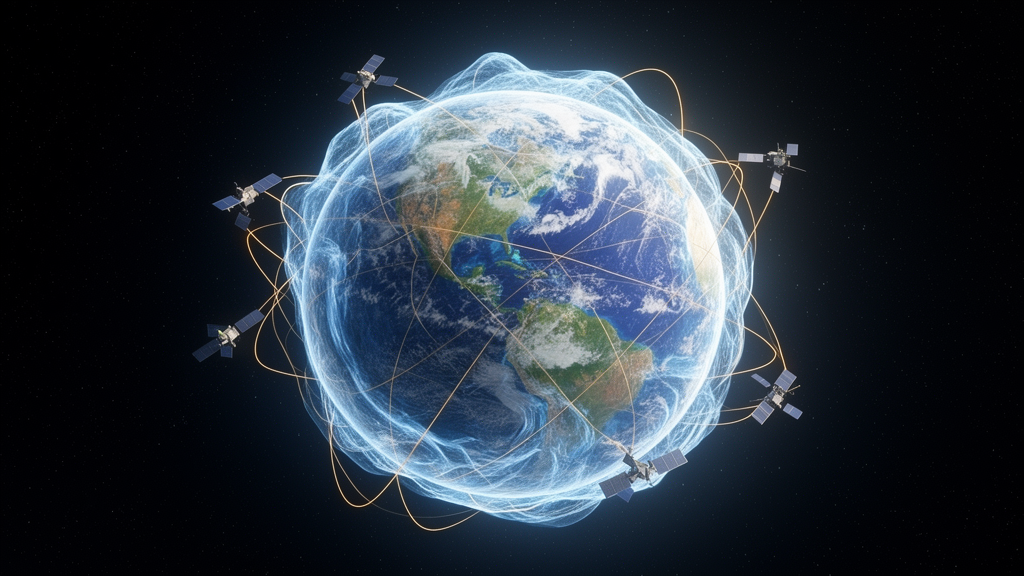
Researchers have built an open-access database that collects, standardizes and cleans water isotope measurements from eight satellite missions spanning roughly 24 years, from 2002 to the present. The database, called WISO-SAT, is described in a paper published in the journal Scientific Data, and its release is intended to make decades of satellite observations of stable hydrogen isotopes in water vapor usable as a single, coherent resource rather than as eight separate, incompatible datasets.
Water isotopes are variants of water molecules with slightly different masses. The specific fraction of heavy to light isotopes in a water molecule is unique to where the water originated and the processes it has undergone, which makes isotopic composition a natural identifier for tracking how water travels across the globe. Since 2002, the eight satellite missions covered by the database have been measuring these isotopes from orbit, producing a rich record of water’s origins and movements that, until now, was difficult to exploit in full.
The problem was not a lack of data but its fragmentation. According to Sarkar, a research scientist at Rice University and corresponding author on the paper, most satellite teams want to share their data, but each mission was designed and operated differently, so the datasets differ in format and structure even though they fundamentally measure the same thing. Combining and comparing records from even two different satellites could require extensive cleaning and reconciliation before any analysis could begin, and because the datasets were stored in different locations, researchers around the world risked unknowingly duplicating the same labor-intensive work.
To solve this, Sarkar collaborated with experts in the United States at NASA, in Europe and in Japan, each of whom had direct experience with a particular satellite and understood how its data were collected and recorded. After assembling the raw data, she worked through all of it to understand its structure and built a processing pipeline that standardizes and shares the measurements. The result is a database in which the data are gridded and standardized, so that researchers can compare datasets across missions while accounting for differences between instruments and can see exactly where on the planet each measurement was taken, regardless of which satellite produced it.
Sylvia Dee, associate professor of Earth, environmental and planetary sciences at Rice and an author on the paper, noted that satellites reach regions that field researchers cannot access and provide consistent long-term data collection, making them essential for capturing the scale of the water cycle. She emphasized that the value of the project lies not only in the data themselves but in the effort required to make them genuinely usable for the broader research community, students and even the public. Dee initially funded the work through her National Science Foundation CAREER award.
The database is designed to grow. The standardization pipeline used to process the data is publicly available as part of the dataset, which means researchers who generate new isotope measurements can apply the same procedures themselves and contribute their data to the open resource. This design choice is intended to extend the database beyond the original eight missions as new satellite observations become available.
Potential applications span a wide range of Earth science questions. Dee pointed to cloud formation, atmospheric moisture transport, the El Niño and La Niña climate patterns, and soil moisture as examples of phenomena that the unified record could help researchers investigate. Because the isotopic signature of water vapor records both where the water evaporated and the atmospheric processes it experienced on its way to a satellite’s field of view, a consistent multi-mission record offers a way to study these processes across regions and over more than two decades of continuous observation.
The paper, published in Scientific Data under the title describing the WISO-SAT global database, documents the data collection, standardization methods and quality-control steps in enough detail for other researchers to reproduce the processing and to interpret the standardized products correctly. The work was funded by the National Science Foundation and NASA, and the database itself is openly available, consistent with the open-science goals of the journals and agencies involved.
For the research community, the practical significance is straightforward: analyses that once required months of dataset reconciliation can now draw on a single, documented, publicly available record. Whether the database fulfills that promise across the full diversity of applications its creators envision will depend on how widely it is adopted and extended, but its release removes a long-standing barrier between the satellite isotope record and the scientists who want to use it.
Subject of Research: A standardized open database of satellite-measured water isotopes spanning 24 years
Article Title: Researchers create new database to track origins of water from space
Article References: Researchers create new database to track origins of water from space. Original publication (Bibliographic details unavailable.)
Image Credits: AI Generated
DOI: Not provided
Keywords: water isotopes, satellite data, WISO-SAT, water cycle, Scientific Data, open database, data standardization, Rice University, NASA, hydrology, water vapor, climate research
Cite Scienmag News
Violet Maxwell. (October 26, 2026). New open database unifies 24 years of satellite water isotope data. Scienmag. https://scienmag.com/new-open-database-unifies-24-years-of-satellite-water-isotope-data/
Violet Maxwell. "New open database unifies 24 years of satellite water isotope data." Scienmag, 26 October 2026, https://scienmag.com/new-open-database-unifies-24-years-of-satellite-water-isotope-data/. Accessed 26 October 2026.
Violet Maxwell. "New open database unifies 24 years of satellite water isotope data." Scienmag. October 26, 2026. https://scienmag.com/new-open-database-unifies-24-years-of-satellite-water-isotope-data/


