


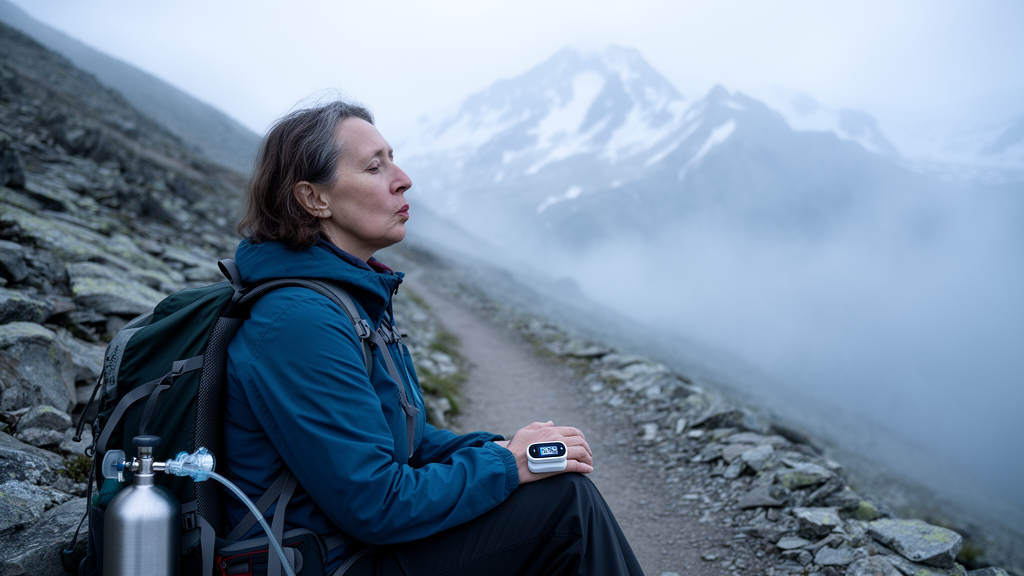
A large population-based study from Colombia has mapped how pulse oximetry readings of oxygen saturation behave as altitude rises from near sea level to 3,030 meters, and the results show that people with chronic respiratory disease lose oxygen saturation faster with altitude than healthy adults. The findings, drawn from the PREPOCOL II cross-sectional survey of adults aged 40 and older living in Colombian cities at elevations ranging from 18 to 3,030 meters, indicate that the gap between the two groups becomes clearly measurable at around 1,500 meters, where participants with respiratory disease showed a median saturation of 95.5 percent compared with 97.0 percent in controls. More than 500 million people worldwide live at altitudes of 1,500 meters or higher, but population-based data comparing oxygen saturation across altitudes in adults with and without chronic respiratory disease have been scarce.
The Colombian research team, based at Fundación Neumológica Colombiana and Universidad de La Sabana, set out to fill that gap by comparing saturation between these groups from sea level to 3,030 meters, identifying the factors most strongly associated with saturation, and describing reference values by altitude and age in adults without respiratory disease. The study used a probabilistic, two-stage, clustered sampling design to estimate the prevalence and risk factors for respiratory disease among adults aged 40 years and older. All participants completed a standardized respiratory questionnaire, underwent spirometry, and had their oxygen saturation measured by pulse oximetry.
The respiratory disease group comprised 1,146 people with conditions including chronic obstructive pulmonary disease, asthma, chronic bronchitis, obstructive sleep apnea, and interstitial lung disease. They were compared with 4,613 controls using non-parametric statistical tests, multivariable linear regression, and formal comparisons of altitude coefficients between the two groups. The raw data confirmed the researchers' hypothesis.
Oxygen saturation was lower in the respiratory disease group than in controls at every altitude measured, and it declined in both groups as altitude and age increased, with all of these relationships reaching statistical significance. Participants with respiratory disease were older on average and had lower body mass index and reduced lung function compared with the healthy controls, differences that the statistical models took into account. In the multivariable models, altitude emerged as the variable most strongly associated with oxygen saturation, with standardized coefficients of −0.69 in controls and −0.71 in the respiratory disease group.
Age and body mass index followed, and forced expiratory volume in one second, a measure of lung function, contributed in the respiratory disease group. The standardized coefficients indicate that altitude explained more of the variation in saturation than any other measured characteristic, underscoring how powerfully elevation shapes this routine clinical measurement. The most striking result was the difference in slope.
The decrease in saturation per unit of altitude was larger in the respiratory disease group, at −1.15, than in controls, at −0.80, a difference that was statistically significant. In practical terms, this means that as lifelong residents move from lowland cities to high-altitude ones, those with chronic respiratory disease experience a steeper fall in measured oxygen saturation than their healthy neighbors, and the between-group difference becomes evident at approximately 1,500 meters. The authors conclude that oxygen saturation values should be interpreted in relation to the specific altitude and age of the person being measured, rather than against a single universal threshold.
For clinicians working in high-altitude regions, the study provides population-based reference data indicating that a saturation reading that would be unremarkable at sea level may fall outside the expected range for a healthy adult at 1,500 meters and above, and that patients with lung disease at those elevations sit measurably lower still. As a cross-sectional study, the research captures a single moment in time and cannot establish causal relationships between altitude, disease, and saturation; the respiratory disease group was also older and had lower lung function than the controls, characteristics the models adjusted for but which may still influence the observed patterns.
Subject of Research: Altitude-related differences in pulse oximetry oxygen saturation between adults with and without chronic respiratory disease
Article Title: Differences in pulse oximetry saturation from sea level to high altitude among subjects with and without respiratory disease. A population-based, cross-sectional study
Article References: Gonzalez-Garcia, M., Torres-Duque, C. A., Aguirre-Franco, C., Alí-Munive, A., Proaños, N. J., Perez, C., & Casas-Herrera, A. (2026). Differences in pulse oximetry saturation from sea level to high altitude among subjects with and without respiratory disease. A population-based, cross-sectional study. Frontiers in Physiology, 17, Article 1956566. https://doi.org/10.3389/fphys.2026.1956566
Image Credits: AI Generated
DOI: 10.3389/fphys.2026.1956566
Keywords: pulse oximetry, oxygen saturation, high altitude, chronic respiratory disease, COPD, asthma, hypoxemia, cross-sectional study, spirometry, Colombia, reference values, lung function
Cite Scienmag News
Barbara Leach. (October 26, 2026). Oxygen saturation falls faster with altitude in people with respiratory disease. Scienmag. https://scienmag.com/oxygen-saturation-falls-faster-with-altitude-in-people-with-respiratory-disease/
Barbara Leach. "Oxygen saturation falls faster with altitude in people with respiratory disease." Scienmag, 26 October 2026, https://scienmag.com/oxygen-saturation-falls-faster-with-altitude-in-people-with-respiratory-disease/. Accessed 26 October 2026.
Barbara Leach. "Oxygen saturation falls faster with altitude in people with respiratory disease." Scienmag. October 26, 2026. https://scienmag.com/oxygen-saturation-falls-faster-with-altitude-in-people-with-respiratory-disease/


