


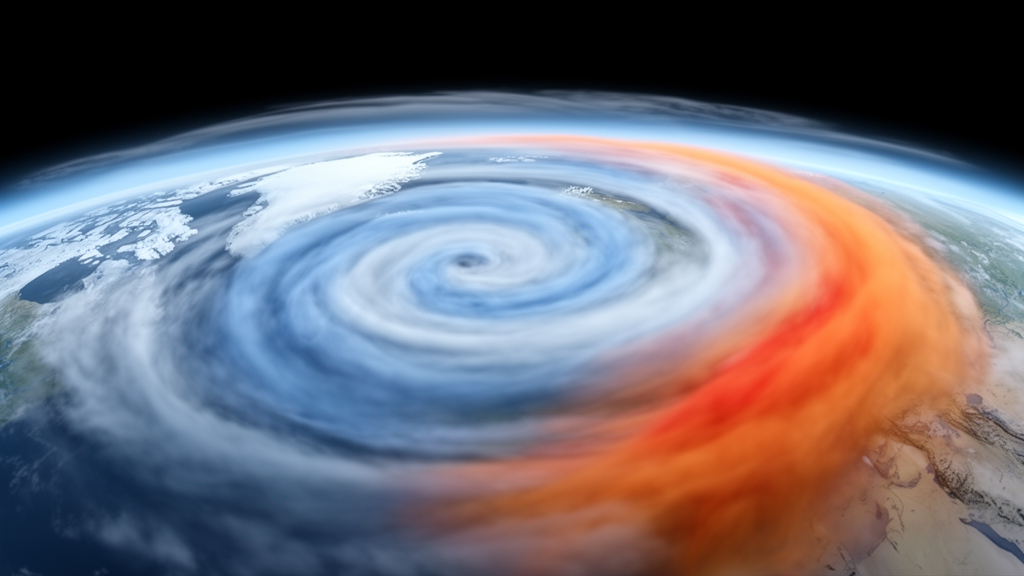
Deep in the winter stratosphere, a vast whirlpool of spinning air known as the polar vortex shapes the weather that billions of people experience far below. When the vortex suddenly weakens or collapses in an event called a sudden stratospheric warming, the jet stream tends to buckle and meander, and cold, disrupted patterns can grip mid-latitude regions for weeks. Yet despite decades of research, the seasonal forecast models run by major weather centres have struggled to predict how this vortex will behave from one winter to the next, with correlations against observations often languishing between 0.1 and 0.4. A new study published in Climate Dynamics reports that a hybrid statistical–dynamical technique can substantially sharpen those forecasts, provided the statistical ingredients are physically connected to the stratosphere in the right way.
The research, led by Federico Gargiulo and colleagues, tackles a long-standing gap in seasonal prediction. The team started from an established result: the North Atlantic Oscillation, or NAO, the dominant mode of winter climate variability over the North Atlantic and Europe, is strongly coupled to the stratospheric polar vortex. A positive NAO tends to refract planetary Rossby waves equatorward, reducing wave breaking in the stratosphere and allowing the vortex to spin up, while a negative NAO does the opposite. Because recent work had shown that statistical predictions of the autumn NAO can be used to subsample, or filter, the members of a dynamical model ensemble, boosting NAO forecast skill dramatically, the researchers asked whether the same trick could be transferred upward to the vortex itself.
The subsampling method works like a sieve applied to a large ensemble of seasonal forecasts. Five state-of-the-art prediction systems from the Copernicus Climate Change Service, operated by the Euro-Mediterranean Center on Climate Change, Météo-France, the European Centre for Medium-Range Weather Forecasts, the German Weather Service and the UK Met Office, each run dozens of slightly perturbed simulations initialized on 1 November for every winter from 1993–94 through 2016–17. Rather than averaging all 147 members together, which suppresses the very variability forecasters care about, the method builds a statistical first guess of the coming winter’s NAO from four autumn predictors: North Atlantic and North Pacific sea surface temperatures, air temperature at 100 hPa near the pole, Eurasian snow cover and Arctic sea ice concentration. Only the ensemble members whose predicted NAO sits closest to that statistical estimate, measured by Euclidean distance, are retained, typically around a dozen per predictor.
The results for the NAO itself were striking. Across the multi-model ensemble, the correlation with the observed winter NAO index rose from 0.35 to 0.71 after subsampling, and individual systems reached correlations of roughly 0.7 to 0.8. The subsampled ensemble mean also recovered much more of the real interannual variability, with the standard deviation of the NAO index increasing from 0.23 to 0.58. Notably, the hybrid approach outperformed both purely statistical and purely dynamical forecasts in every model tested, and the post-subsampling skill converged to a narrow range regardless of how good each model had been to begin with, suggesting the improvement stems mainly from the predictors rather than from any particular model’s strengths.
The crucial question was whether this tropospheric gain would propagate into the stratosphere. To measure vortex strength, the team used the zonal-mean zonal wind at 10 hPa, averaged over 55 to 70 degrees north, a standard indicator of the polar vortex. Before subsampling, forecast skill in the extratropics was modest to weak, often below 0.4, while the tropics showed near-perfect prediction thanks to the well-handled Quasi-Biennial Oscillation. After subsampling, skill improved across every individual model and both multi-model combinations, with the anomaly correlation coefficient for the vortex reaching 0.53 in the ensemble of the most skilful systems. The gains were concentrated precisely in the extratropical band where the vortex governs stratospheric variability, and an analysis of potential predictability and the ratio of predictable components indicated that the improvement reflected genuine added predictability rather than an artefact of model internal variability, helping to mitigate the well-known signal-to-noise paradox in which models predict the real atmosphere better than their own fluctuations.
The method also improved the representation of sudden stratospheric warmings in a probabilistic sense. Because deterministic prediction of individual warming events is limited to roughly 10 to 20 days, far shorter than a seasonal lead time, the researchers instead counted the number of days each winter on which the zonal-mean zonal wind reversed from westerly to easterly somewhere between 55 and 70 degrees north, a diagnostic they call SSW days. Comparing winters with and without observed warmings, classified using the community-standard SSW Compendium, the subsampled ensembles showed systematically more SSW days in warming winters and fewer in quiet winters, a separation that was weak or absent in the full ensembles. The improvement was clearest in the ECMWF and DWD systems, while the CMCC model’s tendency to overestimate vortex strength blunted its gains.
A sensitivity analysis then uncovered a subtlety with major implications. When each predictor was tested individually, all four improved NAO forecasts, with snow cover the most effective, followed by sea surface temperature and polar lower-stratospheric temperature. But for the vortex, only two predictors mattered: the 100 hPa polar temperature and Eurasian snow cover, each of which alone matched the skill of using all four together. Sea surface temperature and sea ice, despite their strong NAO correlations, failed to beat even a random selection of ensemble members and could actually degrade vortex forecasts. The explanation lies in the physics: only the temperature and snow predictors showed robust correlations with both the vortex and the upward flux of planetary wave activity into the lower stratosphere, measured by the 100 hPa eddy heat flux between 40 and 80 degrees north. The sea surface temperature and sea ice regions that correlate best with the NAO turn out to sit away from the areas most tightly linked to vortex variability, and both relationships are known to be non-stationary.
Restricting the subsampling to just these two physically connected predictors produced the study’s best results. The extratropical anomaly correlation for the vortex climbed to around 0.6 while NAO skill remained near 0.70, and the forecast became more stable across the cross-validation range. The mechanism behind the improvement emerged clearly in the wave-activity diagnostics: the December–January eddy heat flux, which correlates with the winter vortex at 0.73 in reanalysis, was predicted far better after subsampling, with the correlation for the DWD–ECMWF ensemble rising from 0.09 to 0.45. Spatially, the gains were concentrated over the North Pacific, northern Canada, central Eurasia and the region east of the Scandinavian Peninsula, exactly the centres of action previously identified as critical for troposphere–stratosphere coupling.
Finally, the team tested the approach in a real-forecast setting, training the statistical predictors only on data available before each winter and applying the method to the 2017 through 2025 period using the two systems with daily output. The probability distributions of vortex strength and SSW days separated significantly between winters with and without early-season warmings after subsampling, a distinction that was barely visible in the full ensembles, hinting at genuine operational potential. The authors caution that the nine-year forecast window is too short for robust correlation-based skill estimates, and that the method’s success depends on a caveat their analysis exposed: most seasonal models overestimate the seasonal correlation between the NAO and the vortex, which reaches only 0.34 in reanalysis. That inflated coupling means filtering on the NAO implicitly constrains the simulated vortex, so predictors weakly linked to the stratosphere can bias the selection. The broader lesson, the researchers argue, is that transferring predictability across components of the climate system requires predictors that are not merely statistically informative for the teleconnection used in the filtering, but physically and dynamically tied to the ultimate forecast target.
Subject of Research: Seasonal prediction of the stratospheric polar vortex using hybrid statistical–dynamical subsampling
Article Title: A hybrid statistical–dynamical approach for seasonal prediction of the boreal winter stratosphere
Article References: Gargiulo, F., Ruggieri, P., Famooss Paolini, L., & Sabatino, S. D. (2026). A hybrid statistical–dynamical approach for seasonal prediction of the boreal winter stratosphere. Climate Dynamics, 64(11), Article 481. https://doi.org/10.1007/s00382-026-08384-w
Image Credits: AI Generated
DOI: 10.1007/s00382-026-08384-w
Keywords: stratospheric polar vortex, sudden stratospheric warming, seasonal forecasting, North Atlantic Oscillation, climate models, Copernicus, Rossby waves, ensemble subsampling, hybrid, statistical, dynamical, approach
Cite Scienmag News
Sloane Callahan. (October 26, 2026). Statistical Trick Boosts Seasonal Forecasts of the Polar Vortex and Sudden Warmings. Scienmag. https://scienmag.com/statistical-trick-boosts-seasonal-forecasts-of-the-polar-vortex-and-sudden-warmings/
Sloane Callahan. "Statistical Trick Boosts Seasonal Forecasts of the Polar Vortex and Sudden Warmings." Scienmag, 26 October 2026, https://scienmag.com/statistical-trick-boosts-seasonal-forecasts-of-the-polar-vortex-and-sudden-warmings/. Accessed 26 October 2026.
Sloane Callahan. "Statistical Trick Boosts Seasonal Forecasts of the Polar Vortex and Sudden Warmings." Scienmag. October 26, 2026. https://scienmag.com/statistical-trick-boosts-seasonal-forecasts-of-the-polar-vortex-and-sudden-warmings/


