


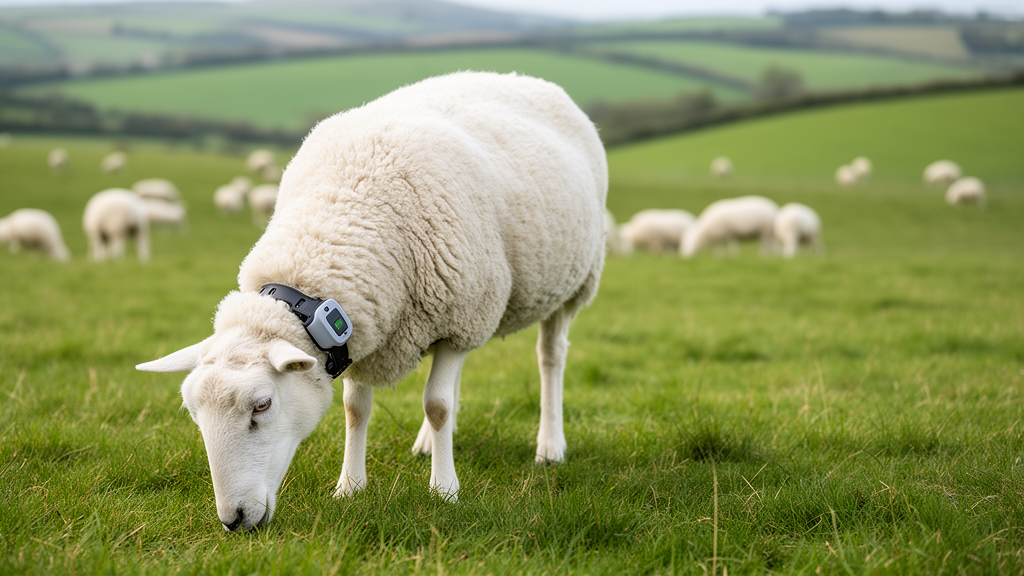
Sheep farmers battling one of the industry’s most persistent parasites may soon have an unlikely ally: the satellite tracker. Researchers at the Pontifical Catholic University of Parana in Curitiba, Brazil, report that GNSS collars can detect shifts in the movement patterns of grazing sheep infected with gastrointestinal nematodes, most notably Haemonchus contortus. The findings, published in Frontiers in Veterinary Science, position satellite-derived movement data as a candidate screening tool for targeted selective treatment, a strategy designed to slow the spread of anthelmintic resistance by treating only the animals that genuinely need it.
Gastrointestinal nematodes cause significant health and productivity losses in sheep, and H. contortus is a particularly important genus. The standard response, treating entire flocks with anthelmintic drugs, has accelerated the evolution of resistant worm populations. Targeted selective treatment offers an alternative: rather than dosing every animal, farmers treat only individuals requiring clinical intervention. The obstacle is practical. Identifying which sheep in a grazing flock require intervention traditionally demands frequent hands-on inspection, labour that scales poorly across large operations. Precision livestock farming technologies, including continuous animal-mounted sensors, are being explored as ways to close that gap.
The Brazilian team ran two experiments under natural infection conditions, one following 15 lactating ewes and the other 15 weaned lambs. Each animal wore a custom-collared GNSS tracker that logged spatial parameters while the flock grazed. Alongside the movement data, the researchers measured packed cell volume, a blood value, and faecal egg counts, an estimate of parasite burden, every week. These measurements allowed them to classify each animal’s health status over time. Every sheep began the study at a post-anthelmintic baseline considered healthy and was then monitored until it crossed into the unhealthy category, defined either as a packed cell volume below 22 percent, or a packed cell volume below 27 percent combined with a faecal egg count above 2,000.
The parasite pressure in the study was overwhelmingly dominated by a single genus. H. contortus accounted for 96 percent of nematode infections in the ewe cohort and 93.8 percent in the lamb cohort, meaning the movement changes the team observed were largely tied to one parasite rather than a mixed infection profile.
When the researchers compared GNSS-derived metrics between healthy and unhealthy animals, the clearest signal emerged in the lambs. Unhealthy lambs showed significantly higher peak speed, higher overall speed, greater peak acceleration and more total active time than their healthy counterparts, with differences reaching statistical significance at p below 0.05. In the ewes, poor health status was also associated with significantly increased active time and overall speed. However, two of the movement measures told a more complicated story in the adult animals: peak speed and peak acceleration in ewes were influenced primarily by body weight rather than by health status, suggesting that some GNSS metrics may need to be interpreted differently, or adjusted, depending on the animal.
Notably, the infected sheep in this study moved more, faster and for longer periods while grazing rather than showing reduced activity. The study’s design identifies the association between health status and these movement metrics; it does not establish the underlying behavioural mechanism.
The researchers conclude that GNSS metrics are promising non-invasive candidate indicators for targeted selective treatment in grazing sheep. The framing is deliberately cautious: the study evaluated naturally infected animals under grazing conditions and reports associations between movement metrics and health classification, not a validated diagnostic test or a demonstrated treatment outcome. Whether these movement signatures can reliably single out individual animals for treatment in commercial flocks, and how they perform against other parasite species or infection intensities, remains to be established.
Several practical considerations follow from the study’s scope. The cohorts were small, 15 animals each, and both were dominated by a single parasite genus, so the results speak most directly to H. contortus-dominated systems. The health thresholds used to define the unhealthy state were specific to this trial, combining packed cell volume cut-offs with faecal egg count criteria. And the finding that body weight confounded peak speed and acceleration in ewes indicates that raw movement metrics cannot be read identically across animal classes; any future screening system would likely need to account for such factors.
Even so, the work adds a new layer to precision livestock farming’s toolkit. For now, the study offers an early, measured proof of concept: satellite positioning data, collected passively as sheep graze, carries measurable information about the health status of animals facing one of sheep production’s significant parasite challenges.
Subject of Research: Using GNSS tracker movement data to detect gastrointestinal parasitism in grazing sheep
Article Title: GNSS-derived metrics as indicators of gastrointestinal parasitism in naturally infected grazing ewes and lambs
Article References: Santana, D. A. D., Weber, S. H., da Silva, K. G., Rieke, C. S., Consoni, J. C., Scheeren, E. M., Ollhoff, R. D., & Sotomaior, C. S. (2026). GNSS-derived metrics as indicators of gastrointestinal parasitism in naturally infected grazing ewes and lambs. Frontiers in Veterinary Science, 13, Article 1983272. https://doi.org/10.3389/fvets.2026.1983272
Image Credits: AI Generated
DOI: 10.3389/fvets.2026.1983272
Keywords: GNSS tracking, sheep, Haemonchus contortus, gastrointestinal nematodes, precision livestock farming, targeted selective treatment, anthelmintic resistance, faecal egg count, packed cell volume, grazing behaviour, animal health monitoring, GNSS-derived
Cite Scienmag News
William Thompson. (October 26, 2026). GPS Trackers Reveal Movement Changes in Parasitised Grazing Sheep. Scienmag. https://scienmag.com/gps-trackers-reveal-movement-changes-in-parasitised-grazing-sheep/
William Thompson. "GPS Trackers Reveal Movement Changes in Parasitised Grazing Sheep." Scienmag, 26 October 2026, https://scienmag.com/gps-trackers-reveal-movement-changes-in-parasitised-grazing-sheep/. Accessed 26 October 2026.
William Thompson. "GPS Trackers Reveal Movement Changes in Parasitised Grazing Sheep." Scienmag. October 26, 2026. https://scienmag.com/gps-trackers-reveal-movement-changes-in-parasitised-grazing-sheep/


