


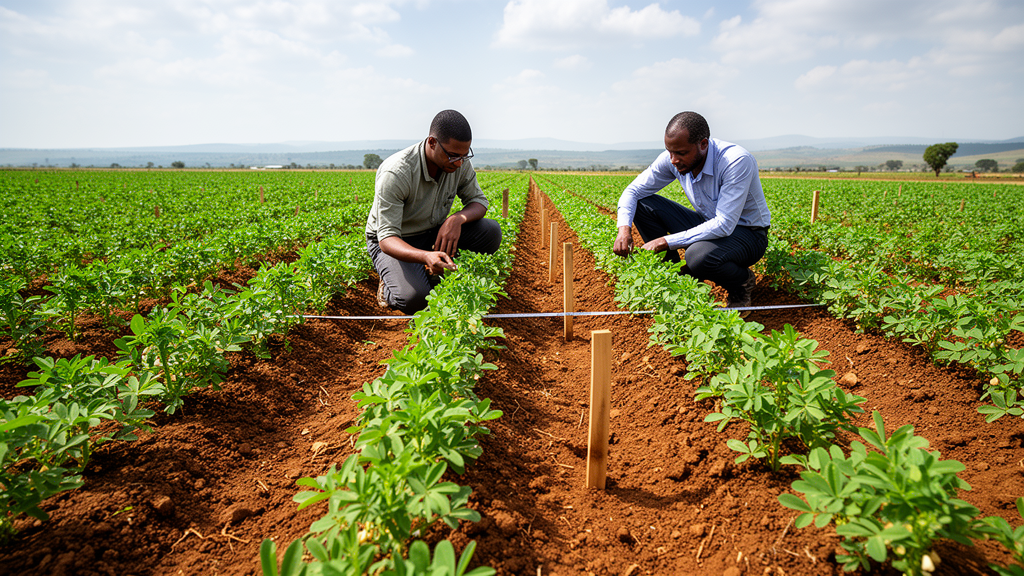
A field experiment in northwestern Ethiopia found that chickpea planted 30 centimetres apart between rows and 5 centimetres apart within rows achieved the highest grain yields under residual soil-moisture conditions. The tested arrangement produced 2,150 kg per hectare for the Desi variety and 2,050 kg per hectare for the Kabuli variety, while the widest spacing of 50 cm × 15 cm yielded the lowest grain yields.
The researchers conducted the trials on vertisols in Dembia and Takusa districts of Central Gondar Zone. They evaluated two chickpea types across 12 combinations of spacing, using a randomized complete block design with three replications. Four inter-row distances—20, 30, 40 and 50 cm—were tested with three intra-row distances of 5, 10 and 15 cm, and the recommended 40 cm × 10 cm arrangement was included for comparison.
Measurements covered phenology, growth traits, yield components and grain yield. The researchers analyzed the data using SAS version 9.0 and separated treatment means with the Least Significant Difference test at the 5% significance level. Grain yield was significantly affected by the interaction between inter- and intra-row spacing across the study locations, showing that the response to one distance depended on the other.
Within this experimental setting, the 30 cm × 5 cm treatment generated the largest measured grain yields for both chickpea types. The lowest yields occurred under 50 cm × 15 cm spacing. These results identify a specific spacing that produced the highest yields among the configurations tested; the experiment does not establish that every form of closer spacing increased productivity relative to the recommended arrangement.
The study addressed a productivity gap in Ethiopian chickpea production. According to the research summary, Ethiopia accounts for 40% of Africa’s total chickpea output, but its national average yield remains below 2 tonnes per hectare, compared with an attainable yield of about 4 tonnes per hectare. The authors identified suboptimal plant density as a major contributor to this shortfall and examined whether adjusting row and plant spacing could improve productivity in fields relying on residual moisture.
The findings are specific to chickpea grown in the Vertisol agro-ecology of Dembia and Takusa under the residual-moisture conditions represented by the experiment. Both Desi- and Kabuli-type varieties were included, allowing the researchers to compare yield responses across the two types. The treatment interaction means that spacing should be evaluated as a combined configuration rather than by considering inter-row or intra-row distance in isolation.
Several limitations constrain wider interpretation. The experiment covered two districts, one soil type, two chickpea types and a single moisture context, with three replications for the treatment design. It did not test the proposed arrangement across multiple seasons or a wider range of agro-ecological environments. The observed yields therefore demonstrate performance under the conditions studied rather than guaranteeing the same result in other soils, climates or production systems.
Based on the measured results, the authors recommend the 30 cm × 5 cm arrangement for maximizing chickpea productivity in the Vertisol and residual-moisture conditions of northwestern Ethiopia and comparable agro-ecologies. They also call for validation across additional locations, seasons and environments. The study’s central finding is that the combination of row and within-row spacing had a statistically significant effect on grain yield, with 30 cm × 5 cm producing the highest yields among the 12 configurations tested.
Subject of Research: Chickpea plant-spacing effects on grain yield under residual soil moisture in two districts of northwestern Ethiopia
Article Title: Effect of inter- and intra- row spacing on yield and yield components of chickpea [Cicer arietinum (L.)] under residual moisture in Dembia and Takusa Districts, Central Gondar Zone, Ethiopia
Article References: Biset, F., Azanaw, M., Amare, A., Jorgi, T., & Kindie, M. (2026). Effect of inter- and intra- row spacing on yield and yield components of chickpea [Cicer arietinum (L.)] under residual moisture in Dembia and Takusa Districts, Central Gondar Zone, Ethiopia. Discover Sustainability. https://doi.org/10.1007/s43621-026-03480-7
Image Credits: AI Generated
DOI: 10.1007/s43621-026-03480-7
Keywords: chickpea, plant spacing, grain yield, residual moisture, Ethiopia, Vertisol, Dembia, Takusa, Desi chickpea, Kabuli chickpea, Effect, inter-
Cite Scienmag News
Violet Maxwell. (October 26, 2026). Ethiopia field trial identifies highest chickpea yield at 30 × 5 cm spacing. Scienmag. https://scienmag.com/ethiopia-field-trial-identifies-highest-chickpea-yield-at-30-x-5-cm-spacing/
Violet Maxwell. "Ethiopia field trial identifies highest chickpea yield at 30 × 5 cm spacing." Scienmag, 26 October 2026, https://scienmag.com/ethiopia-field-trial-identifies-highest-chickpea-yield-at-30-x-5-cm-spacing/. Accessed 26 October 2026.
Violet Maxwell. "Ethiopia field trial identifies highest chickpea yield at 30 × 5 cm spacing." Scienmag. October 26, 2026. https://scienmag.com/ethiopia-field-trial-identifies-highest-chickpea-yield-at-30-x-5-cm-spacing/


