


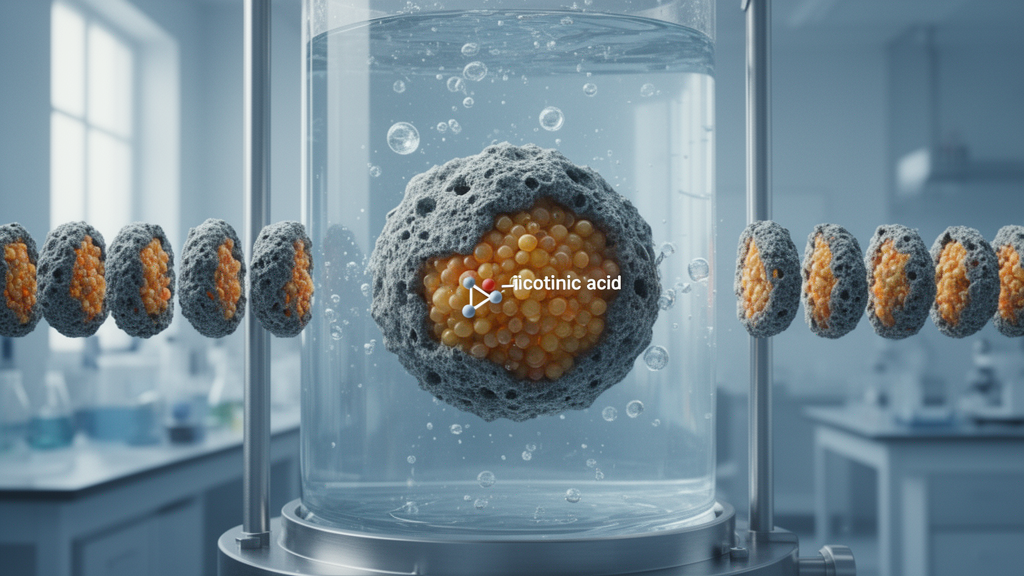
Engineered bacteria enclosed in a porous mineral shell produced 603.56 grams of nicotinic acid per liter while remaining usable for 14 reaction cycles in an experimental study. The immobilized whole-cell biocatalysts converted 3-cyanopyridine with a total molar conversion of 90.2%, compared with 86.7% for free cells, which could be reused for only 12 cycles. The researchers reported that physically protecting microbial catalysts improved their reuse performance under the tested conditions, although a life-cycle assessment comparing this route with conventional chemical production has not yet been completed.
Nicotinic acid, also called niacin or vitamin B3, is used in pharmaceuticals, foods and animal feed. Industrial synthesis commonly relies on chemical methods involving high temperatures, high pressures and strong acids or alkalis, as well as large quantities of waste salts that require neutralization. Enzymatic production with nitrilase offers a potentially cleaner alternative, but conventional free-enzyme processes can suffer from limited stability and difficult catalyst recovery. The study instead used living cells so that the nitrilase remained associated with its bacterial host, and it added a designed shell to make those cells easier to recover and reuse.
The team at Jiangnan University engineered the bacterium Corynebacterium glutamicum to express a mutant nitrilase derived from Pseudomonas putida. It then encapsulated the cells in a biomimetic core-shell structure containing a zeolite core, crosslinked polyethylene glycol with a molecular weight of 200, and an external silica shell formed from tetraethyl orthosilicate. According to the researchers, silica supplied mechanical strength, while PEG200 crosslinking supported biocompatibility and mass transfer. The authors selected C. glutamicum because it is a Generally Recognized as Safe, Gram-positive bacterium with a permeable cell wall, no endotoxin, high protein-secretion capacity, well-characterized metabolic pathways and the ability to grow at high cell densities.
Systematic optimization identified 6 grams per liter of zeolite, 50 grams per liter of cell loading, 3 grams per liter of PEG200 and 7 grams per liter of tetraethyl orthosilicate as the best tested combination. Under those conditions, immobilized cells achieved an 88.78% molar conversion from a 50-gram-per-liter feed of 3-cyanopyridine, substantially above the 62.83% conversion measured with free cells. Scanning electron microscopy confirmed that the material formed a dense but porous core-shell structure. The immobilized biocatalyst showed its highest activity at 40 degrees Celsius and pH 7.0 and retained activity across a broader tested pH range from 7.0 to 9.0. These observations concern laboratory-scale catalytic performance; they do not by themselves establish an advantage under every industrial operating condition.
The most notable result came during repeated batch reactions at a catalyst loading of 700 grams per liter. At that loading, the armored cells remained active for 14 reuse cycles and generated 603.56 grams per liter of nicotinic acid with a total molar conversion of 90.2%. Free cells achieved a lower total conversion of 86.7% and were limited to 12 cycles. The findings show that the hybrid shell improved reuse performance in this experimental system, while also recording higher conversion than free cells. The release identified unresolved issues: the researchers had not systematically examined recovery of PEG200, control of ethanol emissions or regeneration of spent carriers. A full life-cycle assessment will be needed to quantify whether the biocatalytic route actually has a lower environmental footprint than established chemical processes. The peer-reviewed study, “Efficient synthesis of nicotinic acid by biomimetic mineralization-immobilized whole-cell biocatalysts,” was published in Systems Microbiology and Biomanufacturing on September 4, 2026.
Subject of Research: Biomimetic mineral-shell immobilization of engineered bacteria for nitrilase-based nicotinic acid production
Article Title: Armored cells: A mineral shell lets whole-cell biocatalysts run 14 cycles for greener nicotinic acid
Article References: Armored cells: A mineral shell lets whole-cell biocatalysts run 14 cycles for greener nicotinic acid. Original publication (Bibliographic details unavailable.)
Image Credits: AI Generated
DOI: Not provided
Keywords: nicotinic acid, whole-cell biocatalysis, bacterial immobilization, biomimetic mineralization, nitrilase, Corynebacterium glutamicum, core-shell materials, enzyme reuse, green chemistry, Armored, cells, mineral
Cite Scienmag News
Bethany Barker. (October 26, 2026). Armored cells: A mineral shell lets whole-cell biocatalysts run 14 cycles for greener nicotinic acid. Scienmag. https://scienmag.com/armored-cells-a-mineral-shell-lets-whole-cell-biocatalysts-run-14-cycles-for-greener-nicotinic-acid/
Bethany Barker. "Armored cells: A mineral shell lets whole-cell biocatalysts run 14 cycles for greener nicotinic acid." Scienmag, 26 October 2026, https://scienmag.com/armored-cells-a-mineral-shell-lets-whole-cell-biocatalysts-run-14-cycles-for-greener-nicotinic-acid/. Accessed 26 October 2026.
Bethany Barker. "Armored cells: A mineral shell lets whole-cell biocatalysts run 14 cycles for greener nicotinic acid." Scienmag. October 26, 2026. https://scienmag.com/armored-cells-a-mineral-shell-lets-whole-cell-biocatalysts-run-14-cycles-for-greener-nicotinic-acid/


