

Monday, October 26, 2026
Science
No Result
View All Result
  • Login
  • HOME
  • SCIENCE NEWS
  • CONTACT US
  • HOME
  • SCIENCE NEWS
  • CONTACT US
No Result
View All Result
Scienmag
No Result
View All Result
Home Science News

Sentinel-2 and Random Forest Map Seasonal Shifts in Forest Canopy

October 26, 2026
in Science News
Margaret Porter
By Margaret Porter Scienmag Editorial Profile - Biodiversity Science
Reading Time: 2 mins read
0
Sentinel-2 and Random Forest Map Seasonal Shifts in Forest Canopy

Sentinel-2 and Random Forest Map Seasonal Shifts in Forest Canopy

65
SHARES
587
VIEWS
Share on FacebookShare on Twitter
ADVERTISEMENT

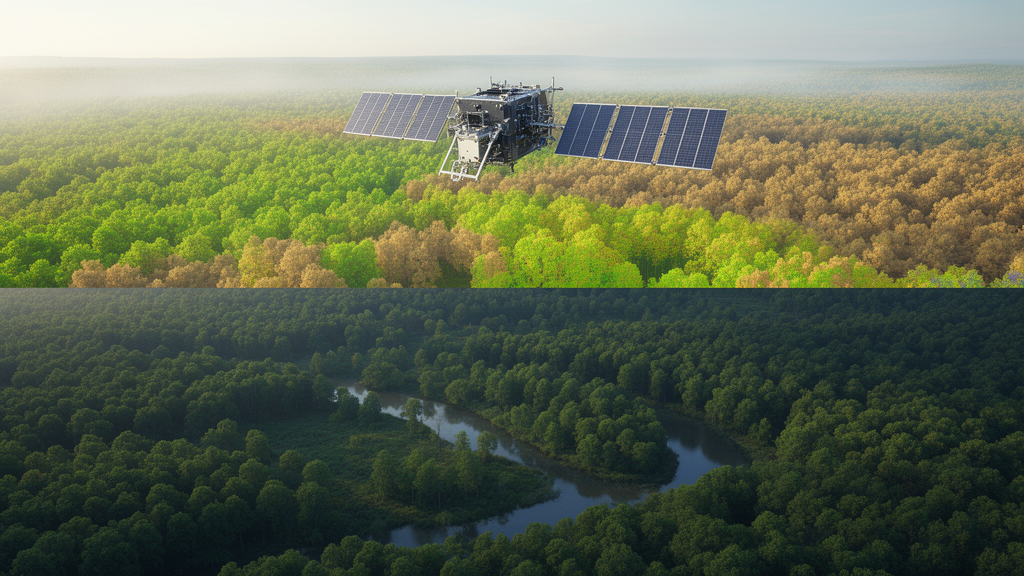
Forest canopy density within India’s Orchha Wildlife Sanctuary varied markedly between pre-monsoon and post-monsoon periods and between 2016 and 2024, according to a remote-sensing study that combined Sentinel-2 imagery, a Random Forest classifier and the Google Earth Engine platform. The researchers divided mapped canopy into four categories—non-forest, open, moderate and dense—and found that the overall classification accuracy ranged from 97.80% to 98.95%, with Kappa coefficients between 0.970 and 0.986.

The analysis assessed imagery from March–May, representing the pre-monsoon season, and October–December, representing the post-monsoon season, for two years. Its machine-learning framework used spectral indices derived from Sentinel-2 data, including the Normalized Difference Vegetation Index and Normalized Difference Moisture Index, alongside elevation, slope and gray-level co-occurrence matrix texture features. The same Random Forest procedure was applied independently to all four season-year datasets, with reference samples balanced across NDVI-informed canopy-density strata.

Pre-monsoon comparisons showed a pronounced redistribution among the mapped classes. From 2016 to 2024, the areas assigned to non-forest and open canopy decreased by 39.62% and 7.15%, respectively. At the same time, mapped moderate and dense canopy increased by 231.64% and 240.43%. The post-monsoon pattern differed: moderate canopy increased by 26.01%, while dense canopy declined by 9.46%. These results describe changes in classes produced by the classification workflow, rather than direct measurements of biological canopy growth or loss.

Transition analysis within a common comparison area of 4,533.54 hectares also revealed substantial persistence in canopy-density classes alongside movement between neighboring categories. The researchers reported particularly notable redistribution from open to moderate canopy and from dense to moderate canopy. Spatial changes occurred in riparian, interior and peripheral portions of the sanctuary, indicating that mapped canopy differences were not confined to a single landscape zone. Overall, the study demonstrates how repeated satellite observations and machine-learning classification can provide a replicable means of comparing seasonal and interannual patterns across a protected landscape.

The authors cautioned that the two years were represented by different Sentinel-2 product levels: 2016 imagery came from Level-1C top-of-atmosphere data, whereas 2024 imagery came from Level-2A surface-reflectance products. The interannual differences should therefore be interpreted as changes in mapped canopy-density classes, not as precise biophysical changes in canopy structure. Despite this limitation, the framework offers a way to examine where seasonal and longer-term canopy redistribution appears most pronounced and to support spatially targeted monitoring and conservation planning in Orchha Wildlife Sanctuary.

Subject of Research: Remote-sensing assessment of seasonal and interannual forest canopy-density changes in Orchha Wildlife Sanctuary, India

Article Title: Monitoring seasonal and long-term forest canopy dynamics using Sentinel-2 imagery and Random Forest on the Google Earth Engine platform

Article References: Kumar, P., Kumar, R., Sahu, S., Dobriyal, M., Lavania, P., Srivastav, M., Pandey, P. C., & Turyasingura, B. (2026). Monitoring seasonal and long-term forest canopy dynamics using Sentinel-2 imagery and Random Forest on the Google Earth Engine platform. PLOS One, 21(10), e0361024. https://doi.org/10.1371/journal.pone.0361024

Image Credits: AI Generated

DOI: 10.1371/journal.pone.0361024

Keywords: Sentinel-2, Google Earth Engine, Random Forest, forest canopy, NDVI, NDMI, remote sensing, seasonal monitoring, wildlife sanctuary, machine learning, Monitoring, seasonal

Cite Scienmag News

Margaret Porter. (October 26, 2026). Sentinel-2 and Random Forest Map Seasonal Shifts in Forest Canopy. Scienmag. https://scienmag.com/sentinel-2-and-random-forest-map-seasonal-shifts-in-forest-canopy/

Margaret Porter. "Sentinel-2 and Random Forest Map Seasonal Shifts in Forest Canopy." Scienmag, 26 October 2026, https://scienmag.com/sentinel-2-and-random-forest-map-seasonal-shifts-in-forest-canopy/. Accessed 26 October 2026.

Margaret Porter. "Sentinel-2 and Random Forest Map Seasonal Shifts in Forest Canopy." Scienmag. October 26, 2026. https://scienmag.com/sentinel-2-and-random-forest-map-seasonal-shifts-in-forest-canopy/


Tags: forest canopyforest classification accuracy and validationforest density categorization using remote sensingGoogle Earth EngineGoogle Earth Engine forest change detectionimpact of monsoon seasons on forest structureMachine learningmachine learning applications in forest remote sensingmonitoringNDMINDVINDVI and moisture index in forest studiespre-monsoon and post-monsoon forest dynamicsRandom ForestRandom Forest classifier in forest analysisremote sensingSeasonalseasonal forest canopy changes Indiaseasonal monitoringSentinel-2Sentinel-2 remote sensing forest canopy mappingspectral indices for vegetation monitoringtemporal analysis of forest canopy shiftswildlife sanctuary
Share26Tweet16
Previous Post

Research report: Individual versus group feedback in a peer-led mock OSCE: a randomised pilot study of medical students’ confidence, anxiety and perceived feedback quality

Next Post

Review maps how generative AI literacy is evidenced in language education

Related Posts

Review maps how generative AI literacy is evidenced in language education
Technology and Engineering

Review maps how generative AI literacy is evidenced in language education

October 26, 2026
Research report: Individual versus group feedback in a peer-led mock OSCE: a randomised pilot study of medical students’ confidence, anxiety and perceived feedback quality
Science Education

Research report: Individual versus group feedback in a peer-led mock OSCE: a randomised pilot study of medical students’ confidence, anxiety and perceived feedback quality

October 26, 2026
Phytoplasma protein structurally mimics regulators of flower development
Chemistry

Phytoplasma protein structurally mimics regulators of flower development

October 26, 2026
Aligarh mixed-methods study links civic engagement to smart-city satisfaction
Earth Science

Aligarh mixed-methods study links civic engagement to smart-city satisfaction

October 26, 2026
Monk parakeet aggression shows no major sex-based difference
Biology

Monk parakeet aggression shows no major sex-based difference

October 26, 2026
Norwegian healthcare norms reshape seven migrant professionals’ views of medical overuse
Medicine

Norwegian healthcare norms reshape seven migrant professionals’ views of medical overuse

October 26, 2026
Next Post
Review maps how generative AI literacy is evidenced in language education

Review maps how generative AI literacy is evidenced in language education

  • Mothers who receive childcare support from maternal grandparents show more optimized

    Mothers who receive childcare support from maternal grandparents show more parental warmth, finds NTU Singapore study

    27656 shares
    Share 11059 Tweet 6912
  • University of Seville Breaks 120-Year-Old Mystery, Revises a Key Einstein Concept

    1061 shares
    Share 424 Tweet 265
  • Bee body mass, pathogens and local climate influence heat tolerance

    682 shares
    Share 273 Tweet 171
  • Researchers record first-ever images and data of a shark experiencing a boat strike

    546 shares
    Share 218 Tweet 137
  • Groundbreaking Clinical Trial Reveals Lubiprostone Enhances Kidney Function

    531 shares
    Share 212 Tweet 133
Science

Embark on a thrilling journey of discovery with Scienmag.com—your ultimate source for cutting-edge breakthroughs. Immerse yourself in a world where curiosity knows no limits and tomorrow’s possibilities become today’s reality!

RECENT NEWS

  • Review maps how generative AI literacy is evidenced in language education
  • Sentinel-2 and Random Forest Map Seasonal Shifts in Forest Canopy
  • Research report: Individual versus group feedback in a peer-led mock OSCE: a randomised pilot study of medical students’ confidence, anxiety and perceived feedback quality
  • Phytoplasma protein structurally mimics regulators of flower development

Categories

  • Agriculture
  • Anthropology
  • Archaeology
  • Athmospheric
  • Biology
  • Biotechnology
  • Blog
  • Bussines
  • Cancer
  • Chemistry
  • Climate
  • Earth Science
  • Editorial Policy
  • Marine
  • Mathematics
  • Medicine
  • Pediatry
  • Policy
  • Psychology & Psychiatry
  • Science Education
  • Science News
  • Social Science
  • Space
  • Technology and Engineering

Subscribe to Blog via Email

Enter your email address to subscribe to this blog and receive notifications of new posts by email.

Join 5,151 other subscribers

© 2025 Scienmag - Science Magazine

Welcome Back!

Login to your account below

Forgotten Password?

Retrieve your password

Please enter your username or email address to reset your password.

Log In
No Result
View All Result
  • HOME
  • SCIENCE NEWS
  • CONTACT US

© 2025 Scienmag - Science Magazine

Discover more from Science

Subscribe now to keep reading and get access to the full archive.

Continue reading