


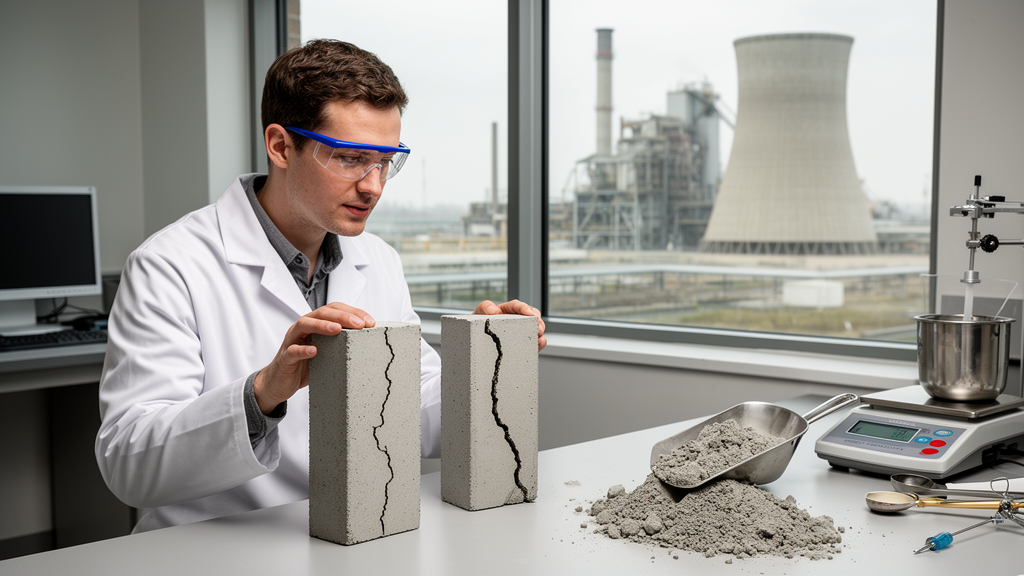
A critical review of research on untreated waste concrete powder finds that incorporating the material into cement mortar can reduce carbon dioxide emissions and production costs, but higher replacement levels are generally associated with declines in mechanical, durability and physical performance. The findings identify a central trade-off: sustainability and economic gains must be balanced against structural reliability rather than pursuing the highest possible substitution rate.
Waste concrete powder, abbreviated WCP, is obtained from construction and demolition waste. The review synthesizes existing studies of WCP-incorporated mortars through an integrated framework that brings together environmental impact, mechanical and durability behavior, physical properties and economic efficiency. Studies in the reviewed literature consistently report lower carbon dioxide emissions and lower production costs when WCP is incorporated into cement mortars.
Those advantages coexist with a recurring performance penalty. As the WCP content increases, mortar strength and other mechanical, durability and physical properties generally decline. The review does not establish one substitution level for all applications, and the reported results should therefore not be interpreted as demonstrating a universal limit. Instead, the authors propose a performance-based classification framework intended to guide the practical selection of WCP-based mortars for varying performance requirements. This approach treats the material as one component of a broader formulation problem rather than a universally beneficial replacement for conventional cement.
To place those trade-offs in a unified analytical structure, the review advances a conceptual triple-axis sustainability-performance framework. Within this qualitative, multi-objective space, environmental impact reduction, mechanical and durability performance, and economic efficiency are evaluated as interdependent design considerations. The framework highlights that the acceptability of a particular WCP substitution regime cannot be determined from emissions or cost alone; the resulting mortar must also meet the performance requirements relevant to its intended use.
The review identifies unresolved areas in the evidence base, including the need for performance-normalized life-cycle assessment, integrated life-cycle cost analysis and region-specific techno-economic evaluation of WCPs. These gaps limit the extent to which results from individual studies can be compared across different performance requirements and regional circumstances. Based on the literature synthesized, the authors describe untreated WCP as a potentially viable pathway toward circular cementitious systems when it is implemented within optimized substitution regimes that balance environmental benefits, structural performance and economic considerations. The review itself does not demonstrate a new formulation, field trial or lifecycle result; it organizes and evaluates previously reported findings while defining questions that future assessment work must address.
Subject of Research: Critical review of untreated waste concrete powder as a supplementary cementitious material for cement mortar
Article Title: A critical review of untreated waste concrete powder as a supplementary cementitious material for mortar production
Article References: Ohemeng, E. A., Ramabodu, M. S., Nana-Addy, E., & Nena, T. D. (2026). A critical review of untreated waste concrete powder as a supplementary cementitious material for mortar production. Discover Sustainability. https://doi.org/10.1007/s43621-026-05031-6
Image Credits: AI Generated
DOI: 10.1007/s43621-026-05031-6
Keywords: waste concrete powder, supplementary cementitious materials, cement mortar, construction waste, carbon emissions, mechanical performance, durability, life-cycle assessment, techno-economics, circular construction, critical, review
Cite Scienmag News
Sloane Callahan. (October 26, 2026). Review maps waste concrete powder’s emissions savings against weaker mortar performance. Scienmag. https://scienmag.com/review-maps-waste-concrete-powders-emissions-savings-against-weaker-mortar-performance/
Sloane Callahan. "Review maps waste concrete powder’s emissions savings against weaker mortar performance." Scienmag, 26 October 2026, https://scienmag.com/review-maps-waste-concrete-powders-emissions-savings-against-weaker-mortar-performance/. Accessed 26 October 2026.
Sloane Callahan. "Review maps waste concrete powder’s emissions savings against weaker mortar performance." Scienmag. October 26, 2026. https://scienmag.com/review-maps-waste-concrete-powders-emissions-savings-against-weaker-mortar-performance/


