


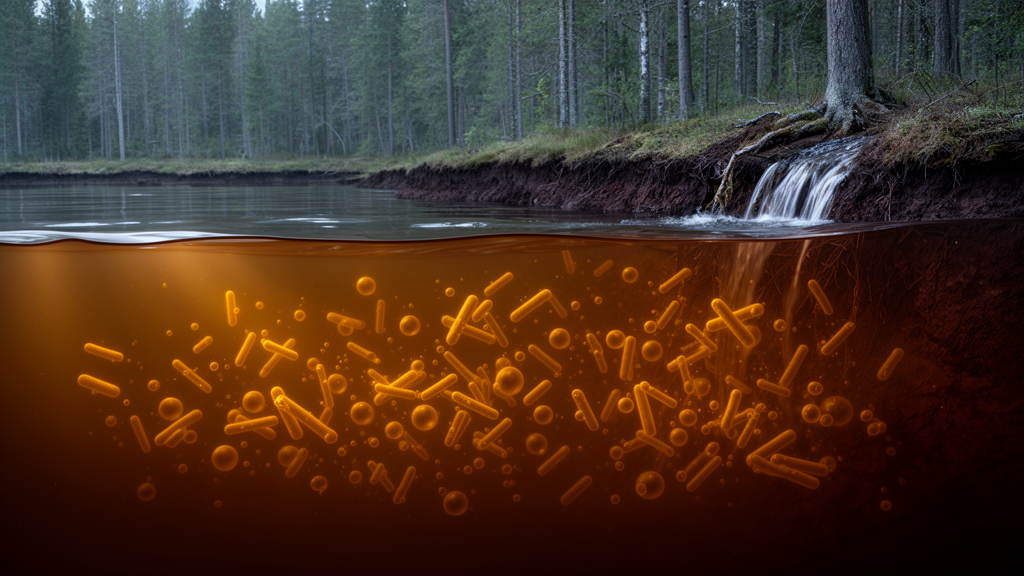
Shallow brown lakes across the Northern Hemisphere are being reshaped by two simultaneous pressures: the water is getting warmer, and it is getting darker. A new experimental study, published in Biogeosciences, disentangles these two forces and reaches a clear verdict on which one matters more. Browning, the rising input of colored dissolved organic matter from land, is the dominant driver pushing these systems toward carbon-rich conditions in which both nitrogen and phosphorus run short. Warming, at least at the moderate level of two degrees Celsius tested here, acts through a different route: it suppresses the growth of algae, particularly when combined with high levels of dissolved organic carbon. Together, the two pressures tilt the balance of microbial production away from algae and toward bacteria, revealing a dual mechanism behind the shift of brown aquatic systems toward heterotrophy.
Browning is driven by the increased mobilization of terrestrial dissolved organic matter and carbon from forest soils, wetlands, and thawing permafrost. This terrestrially derived material is typically humic, highly colored, and often arrives in company with iron and nutrients that further darken the water and modify the availability and ratios of carbon, nitrogen, and phosphorus. These stoichiometric changes shape microbial activity and alter the biogeochemical functioning of lakes. Because the trend is widespread across northern latitudes, understanding how browning restructures the nutritional landscape of freshwaters has become a central question for aquatic ecologists, especially as climate change intensifies both the runoff of organic matter and the heating of surface waters.
The two pressures also interact with each other in ways that make shallow lakes especially vulnerable. High concentrations of dissolved organic matter increase light attenuation, causing heat to be absorbed near the surface and disproportionately raising surface water temperatures. This creates a stable density gradient that suppresses wind-driven mixing despite the shallow depth of these systems. During summer, intensified and prolonged stratification can then increase the concentrations of dissolved organic carbon and nutrients in surface waters, compounding the effects of browning on the metabolic balance of the water column. Prior research has suggested that moderate levels of dissolved organic carbon can stimulate algal production through nutrient supplementation, whereas high levels suppress algal growth through light limitation, while bacterial production tends to keep rising along the entire gradient.
To test these mechanisms directly, Aleksey Paltsev and Isolde Callisto Puts of Umeå University, working with collaborators, manipulated a natural gradient of colored dissolved organic matter in boreal ponds under ambient and warmed conditions at the Experimental Ecosystem Facility in Umeå, Sweden. The experiment used sixteen treatment ponds and four buffer ponds, each roughly eleven and a half meters long, nearly seven meters wide, and about one and a half meters deep, containing soft sediments, primary producers, invertebrate consumers, and a natural shoreline. The gradient was created by continuously mixing colored-dissolved-organic-matter-rich water from the nearby Hörneån river with low-carbon municipal tap water, producing seasonal average dissolved organic carbon concentrations ranging from 1.4 to 21.3 milligrams per liter. The warming treatment achieved an average temperature difference of 1.8 degrees Celsius between warmed and ambient ponds. Monitoring ran from early May to early September 2018, which happened to be an exceptionally warm summer.
The stoichiometric results were unambiguous. Dissolved organic carbon was a strong predictor of the composition of the total nutrient pools across all sampling dates, and warming did not alter these relationships. As carbon concentrations rose, the ratios of dissolved organic carbon to total nitrogen and to total phosphorus both increased strongly, indicating progressive carbon enrichment relative to nitrogen and phosphorus with browning. Meanwhile, in the dissolved inorganic pools, the ratios of dissolved inorganic carbon to dissolved inorganic nitrogen and to phosphate declined along the gradient, showing that inorganic nutrient availability fell as organic carbon rose. Ternary diagrams normalized to the Redfield ratio confirmed that the ponds remained consistently carbon-rich, and therefore poor in nitrogen and phosphorus relative to the canonical algal requirement, in both dissolved and total nutrient pools throughout the season.
The nitrogen-to-phosphorus ratios spanned the critical range around the Redfield optimum of sixteen to one, capturing conditions from nitrogen limitation to phosphorus limitation. The stoichiometric optimum occurred at a dissolved organic carbon concentration of 7.2 milligrams per liter for the total pools and 2.5 milligrams per liter for the dissolved pools, both well below the proposed turning point of roughly eleven milligrams per liter, above which light limitation is generally expected to overtake nutrient limitation. This indicates that algal production in these ponds was constrained by suboptimal nutrient ratios rather than by light availability, which helps explain the observed decline in primary production along the gradient. Seasonal effects were also pronounced, with phosphorus appearing more limiting early in the season and nitrogen becoming relatively more limiting later, likely reflecting synchronized changes in biological uptake, microbial processing, and spring runoff inputs.
Nutrient-addition assays provided direct confirmation of the stoichiometric picture. When the researchers added nitrogen, phosphorus, or both to pond water and measured the chlorophyll a response after roughly seventy-two hours, they found consistent nitrogen-phosphorus co-limitation across all dissolved organic carbon treatments, with the strongest responses occurring when both nutrients were added together. Responses to either nutrient alone were low to moderate, with slight increases at higher carbon concentrations. Temperature had a minimal and statistically insignificant effect on these assay responses, although the highest response ratios were observed under ambient conditions and warming generally dampened the responses in the mid and high carbon treatments. The pattern aligns with large spatial surveys across Sweden showing that phytoplankton in southern, more carbon-rich lakes are co-limited by nitrogen and phosphorus, whereas phytoplankton in carbon-poor northern lakes are mainly nitrogen-limited.
Microbial production responded differently to the two pressures. Bacterial production increased strongly with dissolved organic carbon, with a one percent increase in carbon corresponding to roughly a 0.43 percent increase in bacterial production after accounting for warming, sampling date, and pond identity, and it was unaffected by warming or by any interaction between the two factors. Primary production, by contrast, showed no significant response to either driver in the mixed-effects models but displayed a trend of higher values at low carbon that declined more sharply with carbon under warming, resulting in lower primary production at high carbon in the warmed treatments. Warming amplified the carbon-related decline in the ratio of primary to bacterial production, indicating a shift toward stronger heterotrophic dominance, although full net heterotrophy was not reached. The authors attribute this partly to their measurements being taken at a single well-lit depth rather than integrated over the full water column, and to the high overall productivity of shallow systems.
The suppression of primary production under warming contrasts with observations from Swedish Arctic lakes, where primary production is typically temperature-limited, and the authors suggest a mechanism of thermal compensation: because the 2018 summer was unusually hot, the additional two degrees may have pushed primary producers beyond their thermal optimum, beyond which growth declines sharply. The decline in inorganic nutrient availability along the carbon gradient would have added further stress. The authors caution that in cooler years, when primary producers are not exceeding optimal growth temperatures, the negative temperature effect may not appear, though the browning-driven decline in primary production should persist. As with most ecosystem-scale experiments, the study simplifies natural systems: dissolved organic carbon quality was held constant, the ponds lacked the size and catchment variation of natural lakes, and pristine mountain lakes were not represented in the gradient. The authors therefore present their findings as evidence for the mechanisms underlying browning-warming interactions rather than as quantitative predictions for all boreal lakes.
The broader implication is that as browning and warming intensify across northern lakes, primary producers may become increasingly constrained while heterotrophic bacterial production is maintained or enhanced, particularly during episodic heatwaves. This identifies an additional mechanistic pathway contributing to the widespread occurrence of net ecosystem respiration in northern lakes, with consequences for carbon dioxide dynamics and the structure of microbial food webs. Because both trends are pervasive, the dual mechanism uncovered in these Swedish ponds, browning reshaping nutrient stoichiometry and fueling bacteria while warming suppresses algae, offers a general framework for anticipating how shallow brown freshwaters will respond to ongoing environmental change.
Subject of Research: Experimental effects of browning and warming on nutrient stoichiometry and microbial production in shallow boreal ponds
Article Title: Warming vs. browning: a dual mechanism behind net ecosystem production of shallow brown aquatic systems
Article References: Paltsev, A., & Puts, I. C. (2026). Warming vs. browning: a dual mechanism behind net ecosystem production of shallow brown aquatic systems. Biogeosciences, 23(20), 7493-7504. https://doi.org/10.5194/bg-23-7493-2026
Image Credits: AI Generated
Keywords: browning, boreal lakes, dissolved organic carbon, warming, nutrient stoichiometry, bacterial production, primary production, heterotrophy, NP co-limitation, net ecosystem production, pond experiment, freshwater biogeochemistry
Cite Scienmag News
Chloe Pearson. (October 26, 2026). Browning, not warming, pushes shallow boreal lakes toward bacterial dominance. Scienmag. https://scienmag.com/browning-not-warming-pushes-shallow-boreal-lakes-toward-bacterial-dominance/
Chloe Pearson. "Browning, not warming, pushes shallow boreal lakes toward bacterial dominance." Scienmag, 26 October 2026, https://scienmag.com/browning-not-warming-pushes-shallow-boreal-lakes-toward-bacterial-dominance/. Accessed 26 October 2026.
Chloe Pearson. "Browning, not warming, pushes shallow boreal lakes toward bacterial dominance." Scienmag. October 26, 2026. https://scienmag.com/browning-not-warming-pushes-shallow-boreal-lakes-toward-bacterial-dominance/


