


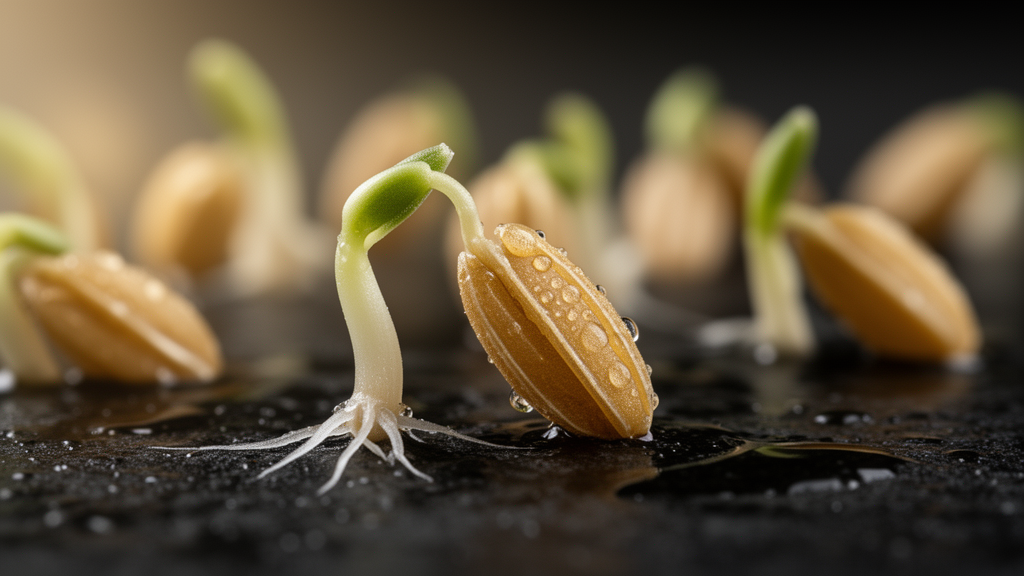
Rice seeds begin life as sealed stores of starch, and the moment they take up water, that reserve must be converted into usable fuel with remarkable precision. A multi-omics study published in BMC Genomics has traced this conversion hour by hour, combining targeted metabolomics, transcriptomics and enzyme activity assays to chart how carbon metabolism is reorganized during imbibition and germination. Working with seeds of the variety Huhanxiangruan61 (HHXR61), the researchers sampled four time points—0, 12, 24 and 48 hours after imbibition began—and linked shifts in metabolites to the enzymes and genes driving them. Because germination efficiency, seedling establishment vigor and subsequent crop productivity all depend on how efficiently stored carbon is mobilized, the staged sequence the team describes offers a molecular timetable for one of the plant life cycle’s most fundamental transitions.
The first act belongs to β-amylase. According to the study, initial starch hydrolysis mediated by this enzyme occurred during the earliest germination window, from 0 to 12 hours, providing the primary carbon source that powers the seed’s awakening. In the middle period, from 12 to 24 hours, the focus shifted to sucrose: the activities of sucrose synthase I (SS-I) and soluble acid invertase (S-AI), two key enzymes of sucrose metabolism, increased alternately, driving the breakdown of sucrose into glucose and fructose. At the same time, α-amylase and starch debranching enzyme (DBE) activities also rose, accelerating the hydrolysis of remaining starch reserves and widening the stream of sugars flowing into the seedling’s emerging metabolic machinery.
In the later stage, from 24 to 48 hours, the picture changed again. Activities of fructokinase (FRK), hexokinase (HK), phosphofructokinase (PFK) and pyruvate kinase (PK) increased synchronously, promoting the production of pyruvate and significantly enhancing metabolic flux through glycolysis/gluconeogenesis and the tricarboxylic acid (TCA) cycle. This is the point at which stored carbon is handed over to the energy-generating pathways that sustain active growth. The researchers also identified two players that appear to keep the system balanced: glucose-6-phosphatase (G6P) and trehalose-6-phosphate synthase (TPS) maintained carbon metabolic homeostasis by regulating metabolite flux, acting as stabilizers while the main pathways surged.
Pathway-level analysis reinforced this staged architecture. KEGG metabolic pathway enrichment showed that starch and sucrose metabolism, glycolysis/gluconeogenesis and the pentose phosphate pathway were the most enriched pathways during germination, mirroring the enzyme activity patterns observed at each time point. When the metabolomic and enzyme data were integrated with transcriptomic profiles, the genes encoding the enzymes above showed synchronous expression at each stage, forming what the authors describe as a defined gene–enzyme–metabolite regulatory network. In effect, the study resolves germination’s carbon economy into three successive phases—starch mobilization, sucrose cleavage and glycolytic ramp-up—each with its own enzymatic signature and matching gene expression.
The authors frame the work as an elucidation of the dynamic succession of carbon metabolic pathways during rice seed germination. The study’s scope is defined by a single rice variety, four sampled time points and the integrated multi-omics design linking metabolites, enzyme activities and transcripts at each stage. As an open-access article shared early for faster access, the peer-reviewed, accepted manuscript carries a permanent DOI, with a final Version of Record to follow after further edits.
Subject of Research: Carbon metabolism dynamics and molecular regulation during rice seed imbibition and germination
Article Title: Multi-omics analysis of carbon metabolism dynamics and its molecular mechanisms during rice seed imbibition and germination
Article References: Peng, Y., Wang, R., Wang, X., Wang, F., Li, A., & Xiong, Q. (2026). Multi-omics analysis of carbon metabolism dynamics and its molecular mechanisms during rice seed imbibition and germination. BMC Genomics. https://doi.org/10.1186/s12864-026-13496-y
Image Credits: AI Generated
DOI: 10.1186/s12864-026-13496-y
Keywords: rice, seed germination, carbon metabolism, multi-omics, starch hydrolysis, sucrose metabolism, glycolysis, TCA cycle, enzyme activity, transcriptomics, metabolomics, BMC Genomics
Cite Scienmag News
Alan Morgan. (October 26, 2026). Multi-omics maps carbon metabolism’s staged handoff as rice seeds germinate. Scienmag. https://scienmag.com/multi-omics-maps-carbon-metabolisms-staged-handoff-as-rice-seeds-germinate/
Alan Morgan. "Multi-omics maps carbon metabolism’s staged handoff as rice seeds germinate." Scienmag, 26 October 2026, https://scienmag.com/multi-omics-maps-carbon-metabolisms-staged-handoff-as-rice-seeds-germinate/. Accessed 26 October 2026.
Alan Morgan. "Multi-omics maps carbon metabolism’s staged handoff as rice seeds germinate." Scienmag. October 26, 2026. https://scienmag.com/multi-omics-maps-carbon-metabolisms-staged-handoff-as-rice-seeds-germinate/


