

Monday, October 26, 2026
Science
No Result
View All Result
  • Login
  • HOME
  • SCIENCE NEWS
  • CONTACT US
  • HOME
  • SCIENCE NEWS
  • CONTACT US
No Result
View All Result
Scienmag
No Result
View All Result
Home Science News Biology

Culturing Mediterranean Coral Bacteria Reveals Potential New Species

October 26, 2026
in Biology
Morgan Morrow
By Morgan Morrow Scienmag Editorial Profile - Bacteriology
Reading Time: 3 mins read
0
Culturing Mediterranean Coral Bacteria Reveals Potential New Species

Culturing Mediterranean Coral Bacteria Reveals Potential New Species

65
SHARES
587
VIEWS
Share on FacebookShare on Twitter
ADVERTISEMENT

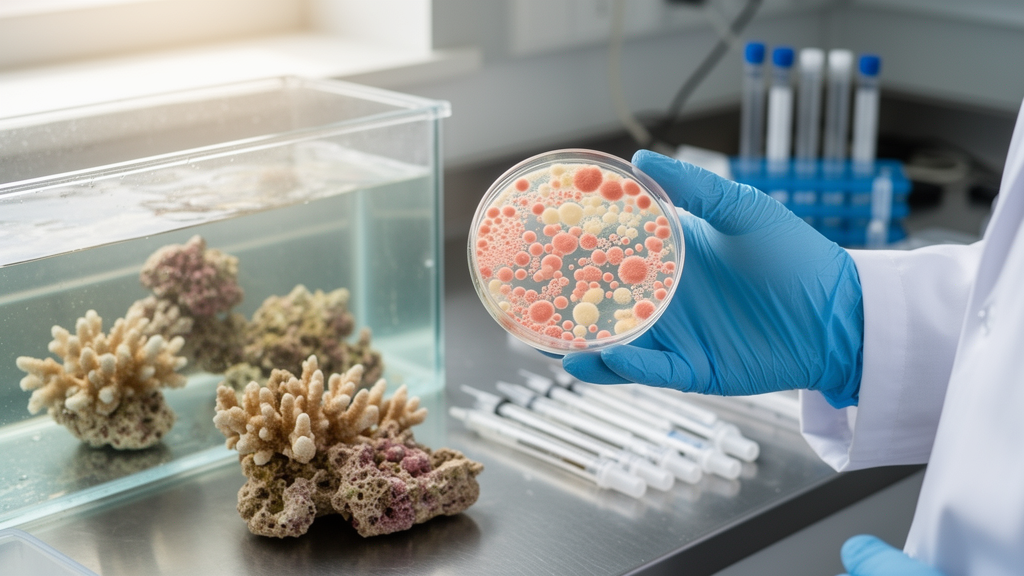
Researchers have grown and catalogued bacteria living in association with four coral species from the Mediterranean Sea, recovering 84 pure bacterial isolates whose initial genetic screening suggests that at least six may belong to previously undescribed taxa. The study, published open access in the journal Microbial Ecology by Rocío Mozo, Andrea Illa-Oviedo and Javier del Campo, targeted the corals Eunicella singularis, Cladocora caespitosa, Leptogorgia sarmentosa and Paramuricea clavata, and marks a deliberate return to classic microbiological methods in a field that has been dominated for the past decade by culture-independent molecular techniques.

Corals host diverse bacterial communities that are thought to facilitate their adaptation and sustain their health, a collective assemblage known as the coral holobiont. Molecular approaches such as metabarcoding have transformed understanding of these partnerships by revealing a high diversity of previously unrecognized bacterial symbionts, and microbiota characterization has relied heavily on such techniques. The authors argue, however, that relying solely on culture-independent methods does not provide a detailed understanding of the dynamics of the holobiont complex, because DNA-based surveys alone cannot reveal the physiology, metabolism or interactions of the organisms being detected.

To address that gap, the team set out to isolate and culture bacteria from the four Mediterranean coral species. Classifying the isolates based on the 16S rRNA gene, the standard marker for bacterial identification, revealed a diverse community of culturable coral-associated bacteria spanning four classes and 20 genera. Among the 84 isolates, six showed less than 97 percent 16S rRNA identity to their closest described species, the conventional threshold used to flag candidate novel taxa. These candidates fall within the genera Vibrio, Pseudoalteromonas, Alteromonas, Shewanella and Tritonibacter, a result the authors say underscores the value of culture-based studies even in well-surveyed environments.

Beyond taxonomy, the cultured diversity included taxa exhibiting traits potentially involved in host association, biofilm formation, surface colonization and the degradation of complex polysaccharides. Such functions suggest possible roles for these bacteria in coral colonization and in the maintenance of the holobiont, although the study reports these as traits of the isolates rather than as demonstrated effects on living coral hosts. Establishing what these bacteria actually do inside the symbiosis will require the kind of controlled experimentation that only cultured strains make possible.

That experimental path is precisely what the new collection is intended to enable. By banking 84 pure isolates with known identities, the researchers have created a foundation for detailed morphological and physiological characterization and for experimental ecology studies aimed at testing how individual bacterial strains interact with their coral hosts. The work, published on 26 October 2026 as a peer-reviewed accepted manuscript that is citable and carries a permanent DOI, positions culture-based microbiology as a complement rather than a rival to molecular surveys of the coral microbiome. The authors present the collection as a starting point for those investigations, with the six candidate novel taxa offering particularly promising subjects for future taxonomic description and functional study.

Subject of Research: Culturing and taxonomic identification of bacteria associated with Mediterranean coral species

Article Title: Culture and Isolation of Bacteria Associated with Mediterranean Corals

Article References: Mozo, R., Illa-Oviedo, A., & del Campo, J. (2026). Culture and Isolation of Bacteria Associated with Mediterranean Corals. Microbial Ecology. https://doi.org/10.1007/s00248-026-02919-8

Image Credits: AI Generated

DOI: 10.1007/s00248-026-02919-8

Keywords: coral microbiome, holobiont, Mediterranean corals, bacterial culture, 16S rRNA, novel taxa, Vibrio, Pseudoalteromonas, microbial ecology, symbiosis, Culture, Isolation

Cite Scienmag News

Morgan Morrow. (October 26, 2026). Culturing Mediterranean Coral Bacteria Reveals Potential New Species. Scienmag. https://scienmag.com/culturing-mediterranean-coral-bacteria-reveals-potential-new-species/

Morgan Morrow. "Culturing Mediterranean Coral Bacteria Reveals Potential New Species." Scienmag, 26 October 2026, https://scienmag.com/culturing-mediterranean-coral-bacteria-reveals-potential-new-species/. Accessed 26 October 2026.

Morgan Morrow. "Culturing Mediterranean Coral Bacteria Reveals Potential New Species." Scienmag. October 26, 2026. https://scienmag.com/culturing-mediterranean-coral-bacteria-reveals-potential-new-species/


Tags: 16S rRNAbacterial culturebacterial isolates from Mediterranean coralscoral bacterial diversitycoral health and microbial communitiescoral holobiont microbiotacoral microbiomecoral microbiome functional analysiscoral-bacteria symbiosis in Mediterranean SeaCultureculture-dependent methods in coral microbiologydiscovery of new coral bacteria speciesholobiontimplications of new bacterial taxa for coral ecosystemsisolationMediterranean coral-associated bacteriaMediterranean coralsmicrobial ecologymicrobiological culture of coral bacterianovel taxaPseudoalteromonassymbiosistraditional microbiology in coral researchVibrio
Share26Tweet16
Previous Post

Pericyte Snai1 Drives Pathological Retinal Angiogenesis Through Extracellular Matrix Remodelling

Next Post

Cellulose-based azo conjugates release 5-ASA selectively in rat colonic contents

Related Posts

Plants Wage Chemical Warfare Against Pathogens, and Scientists Are Learning to Weaponize It
Biology

Plants Wage Chemical Warfare Against Pathogens, and Scientists Are Learning to Weaponize It

October 26, 2026
Older Donors’ Immune Cells Show Distinct Galectin Response to Dengue Virus in Lab Study
Biology

Older Donors’ Immune Cells Show Distinct Galectin Response to Dengue Virus in Lab Study

October 26, 2026
Two Muscle Stem Cell Fates Track Hyperplasia and Hypertrophy in Growing Trout
Biology

Two Muscle Stem Cell Fates Track Hyperplasia and Hypertrophy in Growing Trout

October 26, 2026
Handheld Hyperspectral Camera Distinguishes Listeria Species and Serotypes on Agar
Biology

Handheld Hyperspectral Camera Distinguishes Listeria Species and Serotypes on Agar

October 26, 2026
Dragonfly chromosomes reveal dramatic fusion-driven karyotype evolution and a hidden neo-XY system
Biology

Dragonfly chromosomes reveal dramatic fusion-driven karyotype evolution and a hidden neo-XY system

October 26, 2026
Ten Iranian patients expand the genetic spectrum of classical homocystinuria
Biology

Ten Iranian patients expand the genetic spectrum of classical homocystinuria

October 26, 2026
Next Post
Cellulose-based azo conjugates release 5-ASA selectively in rat colonic contents

Cellulose-based azo conjugates release 5-ASA selectively in rat colonic contents

  • Mothers who receive childcare support from maternal grandparents show more optimized

    Mothers who receive childcare support from maternal grandparents show more parental warmth, finds NTU Singapore study

    27656 shares
    Share 11059 Tweet 6912
  • University of Seville Breaks 120-Year-Old Mystery, Revises a Key Einstein Concept

    1061 shares
    Share 424 Tweet 265
  • Bee body mass, pathogens and local climate influence heat tolerance

    682 shares
    Share 273 Tweet 171
  • Researchers record first-ever images and data of a shark experiencing a boat strike

    546 shares
    Share 218 Tweet 137
  • Groundbreaking Clinical Trial Reveals Lubiprostone Enhances Kidney Function

    531 shares
    Share 212 Tweet 133
Science

Embark on a thrilling journey of discovery with Scienmag.com—your ultimate source for cutting-edge breakthroughs. Immerse yourself in a world where curiosity knows no limits and tomorrow’s possibilities become today’s reality!

RECENT NEWS

  • Cervical spinal cord stimulation linked to stronger arm muscle activation after chronic stroke
  • Optimal Geometry Unlocks Peak Dopamine Sensing in Organic Transistors
  • Plants Wage Chemical Warfare Against Pathogens, and Scientists Are Learning to Weaponize It
  • New framework seeks to end the rangeland war between cattle and wildlife

Categories

  • Agriculture
  • Anthropology
  • Archaeology
  • Athmospheric
  • Biology
  • Biotechnology
  • Blog
  • Bussines
  • Cancer
  • Chemistry
  • Climate
  • Earth Science
  • Editorial Policy
  • Marine
  • Mathematics
  • Medicine
  • Pediatry
  • Policy
  • Psychology & Psychiatry
  • Science Education
  • Science News
  • Social Science
  • Space
  • Technology and Engineering

Subscribe to Blog via Email

Enter your email address to subscribe to this blog and receive notifications of new posts by email.

Join 5,151 other subscribers

© 2025 Scienmag - Science Magazine

Welcome Back!

Login to your account below

Forgotten Password?

Retrieve your password

Please enter your username or email address to reset your password.

Log In
No Result
View All Result
  • HOME
  • SCIENCE NEWS
  • CONTACT US

© 2025 Scienmag - Science Magazine

Discover more from Science

Subscribe now to keep reading and get access to the full archive.

Continue reading