


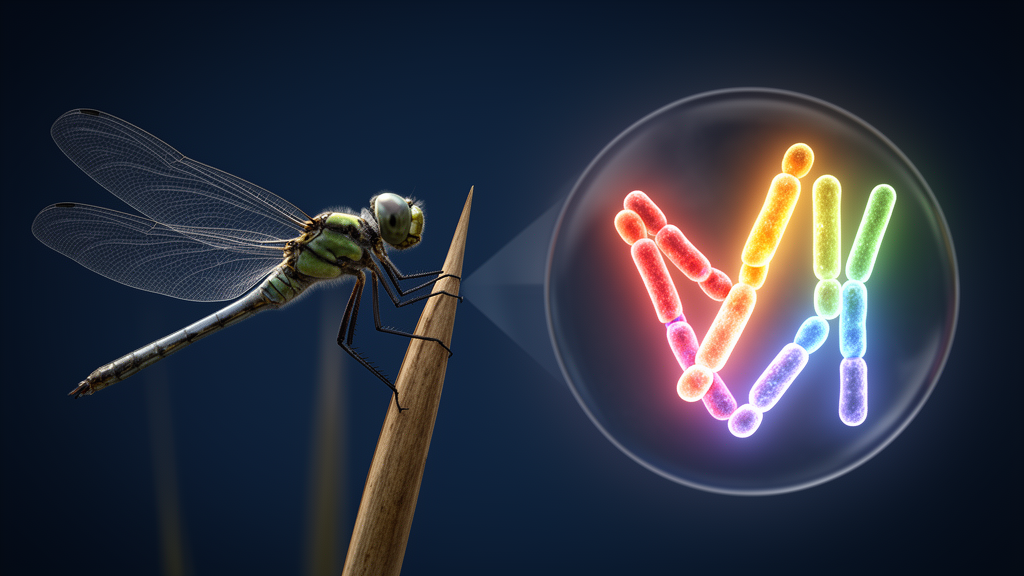
A cytogenetic survey of three Argentine dragonfly species in the genus Orthemis has documented some of the most extreme chromosome-number variation known within a single genus of the family Libellulidae, and has pinpointed, for the first time in this genus, the previously cryptic neo-XY sex-determining system of Orthemis ambinigra. The study, based on males collected in Misiones and Buenos Aires provinces, combined classical meiotic analysis with C-banding, base-specific fluorescent staining and Feulgen staining to reconstruct how the karyotypes of these insects could have arisen from a common ancestral complement.
The family Libellulidae has a modal chromosome number of 2n=25 in males, with an X0 sex-determination system in which the X is one of the smaller chromosomes and the complement decreases gradually in chromosome size. Orthemis, a common genus of American dragonflies concentrated in the Neotropical region, breaks this pattern entirely. None of the species studied to date carries the family’s modal number. Counts across the genus range from 2n=7 in Orthemis levis, where meiosis shows two bivalents and a trivalent, up to 2n=41 in O. nodiplaga, and roughly half of the species analyzed possess neo-XY sex systems rather than the simple X0 arrangement.
The new work examined nine adult males of O. discolor from three Misiones localities, three males of O. nodiplaga from Parque Pereyra Iraola in Buenos Aires Province, and nineteen males of O. ambinigra from Delta del Paraná and Parque Nacional Iguazú. Specimens were fixed in the field, gonads were dissected and squashed for meiotic analysis, and unstained slides were processed with C-banding to reveal constitutive heterochromatin, with the fluorochromes DAPI and CMA3, which preferentially stain AT-rich and GC-rich DNA respectively, and with Feulgen staining to confirm the presence of DNA in specific structures.
Orthemis discolor showed 2n=23, n=11+X, with no chromosomal differences among the three sampled locations. At spermatogonial prometaphase the X chromosome, a pair of very small m chromosomes and one larger pair could be distinguished, and thin associations between some telomeric regions were consistently observed. During the first meiotic prophase the X was isopycnotic or only slightly heteropycnotic, sitting near the nuclear periphery at pachytene, and bivalents carried a single subterminal chiasma at diakinesis. The X divided equationally at anaphase I, and all second-division cells contained twelve chromosomes.
Orthemis nodiplaga, re-examined in new specimens, confirmed the earlier count of 2n=41, n=20+X, and allowed the first description of its meiotic stages. Here the X is the largest chromosome of the complement, a striking reversal of the usual odonate pattern in which the X is small. Bivalents showed one subterminal chiasma, less often a medial one, decreased only slightly in size, and every metaphase II carried twenty-one chromosomes. Notably, the bivalents of this species are smaller than those of O. discolor, consistent with the interpretation that its high chromosome number arose through multiple fragmentations of an ancestral karyotype while the X remained intact.
Orthemis ambinigra presented the opposite extreme: 2n=12, n=5+neo-XY, again with no differences between individuals from the two geographically distinct sampling sites. Its six bivalents are homomorphic and of similar size, comparable to the largest bivalent of O. discolor. During early anaphase I, the long duration of this stage allowed a detailed analysis: chromatids migrating to the same pole lay roughly parallel to the equatorial plane, their medial telomeric regions held together and moving slightly ahead, while the outer telomeric regions were connected by thin chromatin threads to chromatids moving to the opposite pole. Feulgen staining confirmed that these threads contain DNA, and they persisted until late telophase, with no true interkinesis because the chromosomes never fully decondensed.
The heterochromatin patterns differed sharply among the three species. O. discolor displayed C-positive bands in the telomeric region of all bivalents, either symmetric or asymmetric. O. nodiplaga carried small DAPI-bright, AT-rich telomeric bands on all chromosomes except one pair, whose telomeric region showed a DAPI-dull/CMA3-bright, GC-rich band that may correspond to a nucleolus organizer region, an association frequently reported in insects with holokinetic chromosomes. In O. ambinigra, from pachytene onward all bivalents showed telomeric regions that were simultaneously DAPI-bright and CMA3-bright, indicating large telomeric heterochromatin blocks with interspersed AT- and GC-rich sequences, and supporting the idea that odonate telomeric heterochromatin is heterogeneous in base-pair composition.
The C-banding analysis of O. ambinigra also delivered the study’s central discovery. From mid-diplotene onward, one of the larger bivalents was visibly heteromorphic: one homologue bore C-positive bands only in its telomeric region, while the other was almost entirely C-positive and carried three large, closely spaced interstitial bands in addition to its telomeric bands. From diakinesis onward, condensation merged these three bands into one. At metaphase II, one chromatid was entirely C-positive. The authors identify the largely C-positive chromosome with three interstitial blocks as the neo-Y, and propose that the bivalent showing a small interstitial loop at pachytene is the neo-XY pair, the loop corresponding to the original X chromosome segment that has no homologue on the neo-Y.
To explain how this system arose, the researchers propose that the O. ambinigra complement derived from the ancestral genus karyotype of 2n=22+X through five fusions of non-homologous autosomes in pairs, which became fixed in the population, followed by the interstitial insertion of the X chromosome into one of the fused autosomes, creating the neo-XY system. The fusions occurred between chromosomes of different sizes, producing the uniformly sized complement seen today, and much of the telomeric heterochromatin was apparently lost in the process, reflected in the scarcity of interstitial heterochromatin in the modern karyotype. The three interstitial C-bands on the neo-Y are interpreted as remnants of the multiple fusions, and the submedial bands on the neo-X may delimit the site where the original X was inserted, indicating that its telomeric heterochromatin was not completely lost. The authors consider this scenario more parsimonious than an alternative in which the X fused with an autosome first and both members of another autosomal pair then fused to the neo-X and neo-Y.
Comparisons with other insects add evolutionary context. In three Aeschna species whose neo-XY systems were previously characterized, the formation of the neo-sex chromosomes was accompanied by heterochromatinization of the autosomal regions of both the neo-X and the neo-Y. In O. ambinigra, by contrast, the study found no evidence of such heterochromatinization of the neo-X’s autosomal region. Because the bivalents of this species carry a single subterminal chiasma, the authors suggest that differentiation of the neo-Y from the homologous autosomal region of the neo-X would be facilitated by the accumulation of repetitive DNA sequences, which can modify chromatin structure and lead to heterochromatinization. On this basis, the three interstitial heterochromatin blocks in the neo-Y may indicate a relatively advanced evolutionary stage of the neo-XX/neo-XY system in this dragonfly, making Orthemis ambinigra a useful reference point for understanding how sex chromosomes emerge and degenerate in lineages with holokinetic chromosomes, where fusions and fragmentations are not constrained by a localized centromere.
Subject of Research: Cytogenetics and karyotype evolution, including neo-XY sex chromosome origin, in three Orthemis dragonfly species from Argentina
Article Title: High karyotypic variation in Orthemis Hagen, 1861 species, with insights about the neo-XY in Orthemis ambinigra Calvert, 1909 ( Libellulidae , Odonata )
Article References: Mola, L. M., Fourastié, M. F., & Agopian, S. S. (2021). High karyotypic variation in Orthemis Hagen, 1861 species, with insights about the neo-XY in Orthemis ambinigra Calvert, 1909 (Libellulidae, Odonata). Comparative Cytogenetics, 15(4), 355-374. https://doi.org/10.3897/compcytogen.v15.i4.68761
Image Credits: AI Generated
DOI: 10.3897/CompCytogen.v15.i4.68761
Keywords: Orthemis, Libellulidae, Odonata, cytogenetics, karyotype evolution, neo-XY sex chromosomes, holokinetic chromosomes, C-banding, heterochromatin, DAPI/CMA3 staining, chromosomal fusions, Argentina
Cite Scienmag News
Gavin Prescott. (October 26, 2026). Dragonfly chromosomes reveal dramatic fusion-driven karyotype evolution and a hidden neo-XY system. Scienmag. https://scienmag.com/dragonfly-chromosomes-reveal-dramatic-fusion-driven-karyotype-evolution-and-a-hidden-neo-xy-system/
Gavin Prescott. "Dragonfly chromosomes reveal dramatic fusion-driven karyotype evolution and a hidden neo-XY system." Scienmag, 26 October 2026, https://scienmag.com/dragonfly-chromosomes-reveal-dramatic-fusion-driven-karyotype-evolution-and-a-hidden-neo-xy-system/. Accessed 26 October 2026.
Gavin Prescott. "Dragonfly chromosomes reveal dramatic fusion-driven karyotype evolution and a hidden neo-XY system." Scienmag. October 26, 2026. https://scienmag.com/dragonfly-chromosomes-reveal-dramatic-fusion-driven-karyotype-evolution-and-a-hidden-neo-xy-system/


