


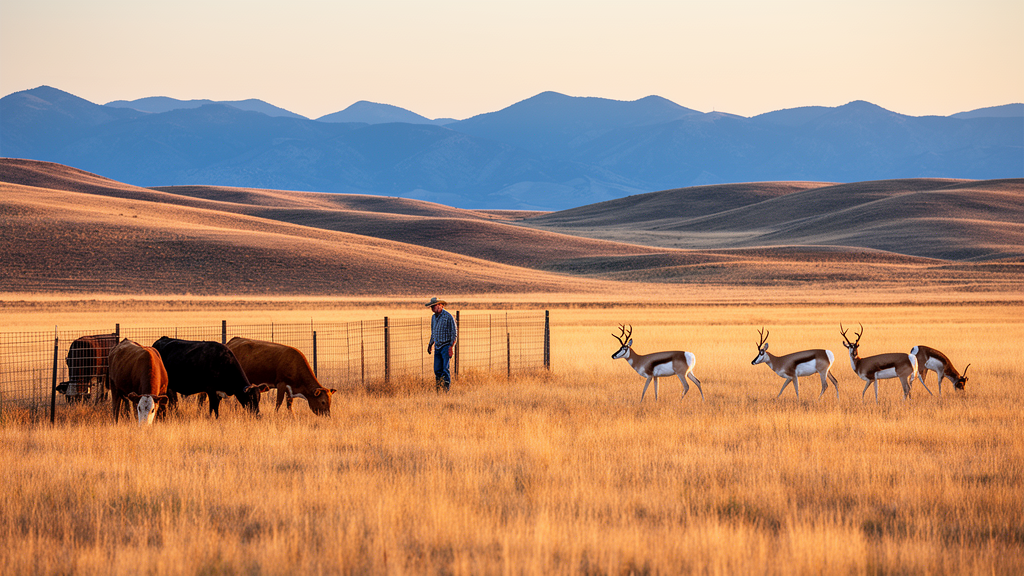
For decades, rangeland managers have treated livestock production and wild herbivore conservation as fundamentally opposed: more cattle meant less wildlife, and protecting wildlife meant restricting herders. A new narrative review, published in Discover Conservation, argues that this opposition is largely an artifact of how rangelands are managed, not an ecological inevitability, and it proposes a framework designed to dissolve the conflict at its institutional roots.
The review, led by Rosemary Peter Mramba together with Agnes Carol Kisanga and Kabuni Thomas Kabuni, synthesised 154 publications identified through Scopus, Web of Science, Google Scholar and ScienceDirect, covering literature from 2000 to 2026 with no geographic restrictions. The authors examined how institutional and governance arrangements, landscape management and ecosystem functioning shape the prospects for livestock and wild herbivores sharing the same terrain. Their central diagnosis is a recurring management disconnect: livestock production and wild herbivore conservation are administered by different agencies, judged by different performance indicators and funded through different mechanisms, even though both depend on the same forage, water and ecological processes.
The consequences of this sectoral siloing are visible across the globe. In southern Africa, veterinary cordon fences were erected to control disease and support livestock trade, but they severed wildlife migration routes and reduced landscape connectivity. In India’s Khangchendzonga National Park, grazing bans intended to strengthen conservation displaced pastoralists from traditional grazing areas, even though pastoral production and conservation both relied on the same landscape. In the Greater Yellowstone Area of the United States, brucellosis management has focused on spatially separating bison from cattle, yet elk share the same terrain and are an important source of transmission to livestock, so the intervention addresses only part of the ecological problem.
The review argues that these interventions exemplify a deeper flaw: sector-specific optimisation assumes that improving each component of a system will improve the system as a whole. Studies from rangelands indicate this assumption does not consistently hold. Livestock programmes are judged by productivity, stocking rates and disease control, while conservation initiatives are assessed by species abundance, habitat protection and population recovery. Neither set of indicators captures the condition and functioning of the rangeland as an integrated social-ecological system. When interdependencies are ignored, gains in one sector are perceived as occurring at the expense of the other, reinforcing what the authors call the production-conservation trade-off.
Crucially, the evidence increasingly challenges the assumption that co-occurrence alone determines outcomes. The effects of livestock-wild herbivore interactions on resource use and ecosystem functioning are shaped by environmental conditions, species composition and management practices. Under appropriate ecological and management conditions, resource partitioning and grazing complementarity can emerge, allowing domestic and wild herbivores to use the same landscape while supporting both production and conservation objectives. The review defines coexistence as the sustained viability of both groups within one landscape through management that maintains ecological integrity while supporting human well-being, and it stresses that effective coexistence depends on managing the processes that sustain these outcomes rather than eliminating interactions.
To move beyond the trade-off paradigm, the authors propose Functional Systems Integration, or FSI, a conceptual framework that organises rangeland management around three interdependent dimensions: coordinated institutions, integrated spatial planning and ecosystem functioning. FSI does not replace established approaches such as land-sharing, land-sparing, integrated landscape approaches or social-ecological systems thinking; rather, it builds on them by linking their complementary elements specifically to livestock-wild herbivore coexistence. The framework’s ambition is to sustain the processes that underpin multifunctional landscapes, pursuing production, conservation and livelihood goals simultaneously in what the authors term nature-positive rangelands, where biodiversity, ecosystem functions and ecological integrity are maintained and enhanced while livestock production and human well-being are sustained.
The institutional dimension of FSI demands that policies governing land use, livestock production, wildlife conservation and rural development be evaluated against shared landscape outcomes. Several existing systems illustrate what coordinated management can look like. In Laikipia County, Kenya, collaboration among private ranches, community conservancies, conservation organisations and local communities has supported livestock production, wildlife conservation and tourism through negotiated land-use planning. In the Greater Yellowstone Ecosystem, collaborative adaptive management and Argentina’s National Guanaco Management Plan seek to coordinate livestock and wild herbivore objectives across multiple stakeholders and institutional levels. In Canada, targeted livestock grazing in the Meewasin Valley supports native prairie and wildlife habitat, while grazing leases on Crown lands sustain both production and ecosystems. By contrast, Tanzania’s Ngorongoro Conservation Area, historically a multiple land-use model, has come under severe strain from population growth and policy shifts, including contested pastoralist relocations since 2022, showing that integration cannot survive without sustained governance capacity.
The spatial dimension of FSI treats protected areas, wildlife corridors, buffer zones and grazing lands as interconnected components of a multifunctional landscape. Infrastructure developed for livestock production, including disease-control fencing, should maintain ecological connectivity wherever possible through strategic placement, risk-based management or wildlife-friendly designs such as virtual fencing, which GPS-enabled trials in Canada have evaluated for rotational cattle grazing as an alternative to permanent barriers. Seasonal livestock mobility in Mongolia demonstrates the principle in practice: pastoral communities move herds in response to changing forage and water availability, distributing grazing pressure across the landscape while maintaining access to spatially dispersed resources. Similar principles underpin transhumant systems in the Mediterranean, the Southern Apennines of Italy and the Pyrenees, where seasonal movement between lowland and highland pastures sustains heterogeneous, biodiverse pastoral landscapes across national borders. A non-nomadic example from South Africa adds nuance: cattle and oribi shared grazing areas during the wet season, and dry-season separation of cattle reduced direct overlap, yet the effects of cattle stocking density on the availability and quality of forage for oribi persisted across seasons.
The ecological dimension of FSI is perhaps the most surprising for readers raised on the competition narrative. Complementary grazing, in which herbivore species differ in forage preferences, grazing intensity and movement patterns, creates vegetation mosaics that increase plant diversity and habitat heterogeneity. In the Greater Serengeti-Mara ecosystem, livestock grazing increased plant diversity and generated vegetation communities that complemented those within neighbouring protected areas. Comparable patterns appear in the Spanish dehesa, in semi-arid eastern Australia where livestock and kangaroos co-graze, and in United States sagebrush-grasslands where combined grazing by livestock and native ungulates increases forage production, plant diversity and shrub dynamics. Foraging facilitation goes further: in Kenya, wild herbivores improved forage quality for cattle during the wet season by reducing dead grass stems and stimulating access to higher-quality forage, while in the Brazilian Pantanal extensive cattle production has maintained habitat conditions supporting diverse wildlife communities. Mixed herbivore assemblages also contribute to nutrient redistribution, sustain primary productivity and strengthen ecosystem resilience under variable environmental conditions.
The authors are careful to state that FSI remains a conceptual framework rather than a validated management model, and that its applicability requires empirical testing across contrasting rangeland contexts. They identify two priorities for advancing it from concept to practice: testing mechanisms for FSI governance, assessment and monitoring in integrated livestock-wild herbivore systems, and developing measurable indicators across its institutional, spatial and ecological dimensions. Ecosystem service assessment offers one route, as demonstrated by work showing how grazing intensity can be evaluated against forage utilisation, carbon sequestration, erosion prevention and biodiversity, though the authors caution that many non-bundled ecosystem services are public goods lacking established markets, so less readily quantified benefits must not be systematically undervalued. The framework’s utility also depends on positive stakeholder relationships, including mutual trust and a shared vision, without which formal coordination mechanisms are unlikely to function. Future research, the review concludes, should test FSI across contrasting systems and use longitudinal assessment of ecological, production and social outcomes to determine whether and under what conditions it improves results for livestock production, wild herbivore conservation and human well-being.
Subject of Research: A conceptual framework for integrating livestock production and wild herbivore conservation in shared rangelands
Article Title: Functional systems integration: a framework for reconciling livestock production and wild herbivore conservation in nature-positive rangelands
Article References: Mramba, R. P., Kisanga, A. C., & Kabuni, K. T. (2026). Functional systems integration: a framework for reconciling livestock production and wild herbivore conservation in nature-positive rangelands. Discover Conservation, 3(1), Article 43. https://doi.org/10.1007/s44353-026-00112-z
Image Credits: AI Generated
DOI: 10.1007/s44353-026-00112-z
Keywords: rangelands, livestock, wild herbivores, conservation, Functional Systems Integration, governance, landscape connectivity, grazing complementarity, nature-positive, pastoralism, social-ecological systems, ecosystem functioning
Cite Scienmag News
Margaret Porter. (October 26, 2026). New framework seeks to end the rangeland war between cattle and wildlife. Scienmag. https://scienmag.com/new-framework-seeks-to-end-the-rangeland-war-between-cattle-and-wildlife/
Margaret Porter. "New framework seeks to end the rangeland war between cattle and wildlife." Scienmag, 26 October 2026, https://scienmag.com/new-framework-seeks-to-end-the-rangeland-war-between-cattle-and-wildlife/. Accessed 26 October 2026.
Margaret Porter. "New framework seeks to end the rangeland war between cattle and wildlife." Scienmag. October 26, 2026. https://scienmag.com/new-framework-seeks-to-end-the-rangeland-war-between-cattle-and-wildlife/


