


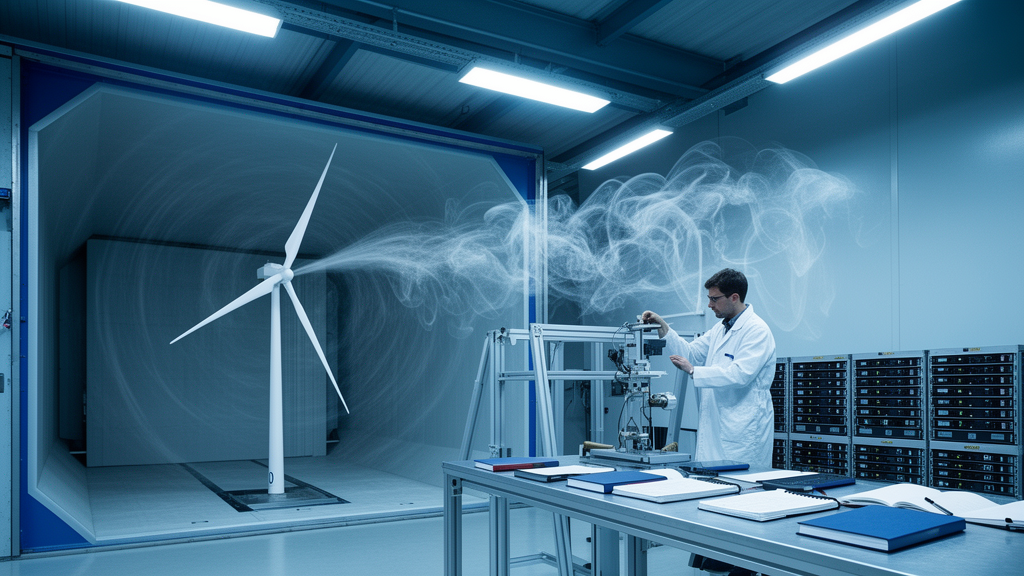
A team at the Technical University of Munich, working with the Politecnico di Milano, has published a complete, harmonized archive of nearly a decade of wind tunnel experiments with instrumented, computer-controlled scale model wind turbines. The dataset, described in the journal Wind Energy Science, gathers measurements collected between 2016 and 2025 from wind tunnel campaigns that had already supported numerous published studies. What makes the release unusual is that the underlying data themselves — not just the conclusions drawn from them — are now public for the first time, in a fully documented form with test matrices, metadata and uncertainty estimates attached to every experimental run.
The archive spans more than two thousand individual experiments, ranging from single-wake surveys to three-turbine clusters operating under shifting wind directions. The machines at the heart of the work are the G1 scale model turbines, small three-bladed machines with a rotor diameter of 1.1 meters and a hub height of 0.825 meters, designed specifically for wind farm control research. Despite their size, the G1s are serious pieces of engineering: each carries its own blade pitch actuators housed inside the hollow blade roots, a yaw drive, a generator with torque control rated at 46 watts, and an array of strain gauges arranged in full Wheatstone bridges that measure bending moments at the tower base and on the rotating shaft.
The models run at a time compression ratio of 80, meaning that one second in the wind tunnel corresponds to 80 seconds on a full-scale machine — a scaling that makes the actuation of the small turbines as fast as, or faster than, their full-scale counterparts. Every experiment captured a rich set of simultaneous signals: time-resolved structural loads, rotor speed, generated torque and power, individual blade pitch angles, nacelle yaw position, and — critically — the commands sent to the actuators themselves. This combination is what distinguishes the release from most existing datasets, which the authors note tend to focus either on wake or flow-field characterization or on aggregate power output, with detailed on-board turbine measurements under active wake-control operation rarely available outside small closed consortia.
With commands, responses and loads recorded together at sampling rates up to 2.5 kilohertz, researchers can dissect exactly how a control action propagates through a turbine and into the wake behind it. The experiments cover essentially the full menu of modern wind farm control strategies. There is yaw-based wake steering, in which turbines are deliberately yawed to push their wakes away from downstream neighbors; curtailment and derating, in which machines give up some power to change how much they block the wind; and a family of wake-mixing techniques — Helix control, dynamic yaw actuation and Pulse operation — that use small, rapid oscillations of pitch or yaw to stir the wake.
Individual pitch control for load reduction and various combinations of these strategies round out the collection. In the largest single block of tests, 1650 experiments with typical durations between 60 and 300 seconds covered static yaw misalignments up to 40 degrees, derating levels between 50 and 90 percent of available power, Helix excitation frequencies between 0.025 and 0.3 times the rotor frequency, and dynamic yaw amplitudes between 2 and 20 degrees. The wind tunnel itself, a boundary-layer facility in Milan with a test section 35.6 meters long, 13.84 meters wide and 3.84 meters high, was configured to reproduce four different atmospheric boundary layers, from a nearly laminar flow with about 1 to 2 percent turbulence to a deliberately extreme condition with roughly 22 percent turbulence intensity at rotor apex and a power-law shear exponent of about 0.36.
Trapezoidal and triangular spires at the inlet and rows of rectangular bricks on the floor generated these profiles, which were mapped in detail and included in the release. The published collections are extensive. The single-wake dataset comprises 201 experiments surveyed with hot-wire probes at distances from 2 to 10 rotor diameters downstream, under all four boundary layers, with wind speeds between roughly 5 and 6 meters per second.
The double-wake dataset adds 68 experiments with two turbines in tandem at spacings of 3.2, 4.1 and 5 rotor diameters. Four 10-minute lidar runs documented the wakes of a three-turbine column with and without wake steering, and 264 experiments recorded cluster operation under a dynamically rotating turntable that emulated 90 minutes of shifting wind direction, testing lookup-table-based wake-steering controllers and active power control algorithms that tracked prescribed power references of 0.8, 0.85 and 0.9 of available power. Considerable care went into measurement quality.
Load cells were calibrated in the laboratory with weights known to within 0.1 grams, blade pitch was calibrated against an inclinometer mounted on a CNC-machined saddle, and sensors were zeroed before and after each test run. The authors quantified uncertainties from linearity, resolution, thermal drift, zeroing and gearbox backlash, conservatively combining them into an overall estimate at a 95 percent confidence level. Where strain-gauge conditioning boards malfunctioned and torque signals drifted by up to 15 percent of rated torque, a lookup-table-based correction was applied during post-processing, and the affected experiments are explicitly flagged in the test matrices so users always know whether they are working with corrected data.
Alongside the experimental measurements, the team released a suite of numerical models: a simplified two-degree-of-freedom Simulink model, a full aeroservoelastic OpenFAST model, a high-fidelity AMR-Wind large-eddy simulation configured as a digital twin of the facility with a mesh resolution of roughly one rotor diameter divided by 112 at the rotor disk, three-dimensional CAD geometries, and synthetic turbulent inflow time histories generated with the SOWFA solver. Validation against a subset of the data shows the models reproducing mean values and variability of turbine loads and wake profiles with good fidelity, though the authors note that high-frequency tower vibrations above the first tower mode are underestimated and that the variability of the side-side bending moment at the tower base is not fully captured by the aeroelastic model. The team is candid about what the data can and cannot support.
The chord-based Reynolds numbers of the model rotors fall between roughly 50,000 and 80,000, orders of magnitude below full scale, so blade boundary-layer physics, stall characteristics and aeroacoustic emissions do not transfer. The blades were built for strength rather than aeroelastic similarity, so their natural frequencies are not representative of full-scale machines, and the measured loads should be treated as those of a stiff aeroservoelastic system — useful for validating control-oriented load models, but not for extrapolating absolute fatigue levels to real turbines. The facility also cannot reproduce atmospheric effects such as Coriolis-driven wind veer, stratification or the largest turbulent structures, wind-direction changes are emulated by rotating the turntable rather than by the flow itself, and the experiments cover compact clusters of at most three turbines rather than deep arrays.
Within those limits, the release fills a gap that researchers have repeatedly flagged. Large field campaigns such as the recent American Wake Experiment collected extensive measurements, of which only a small fraction has been released to the scientific community, and the authors note that existing experimental investigations of wake steering often focus on aggregated power performance metrics, with time-resolved field measurements seldom publicly released. By providing time-resolved actuator commands, loads and flow measurements under controlled, repeatable conditions, the new archive gives the community a common benchmark for engineering wake models, large-eddy simulation codes and wind farm control algorithms — much as shared wind tunnel datasets have historically supported community benchmarking in aeronautics and rotorcraft research.
The data are hosted on Zenodo and the WindLab repository, each release carrying a versioned digital object identifier, and the documentation will be maintained and updated in response to user feedback, with future extensions potentially adding new inflow conditions, additional control strategies and expanded numerical reference cases.
Subject of Research: An open-access wind tunnel dataset of scaled turbine loads, actuator commands and wake measurements for wind farm control research
Article Title: Experimental wind tunnel dataset of wake and turbine measurements for wind farm control
Article References: Campagnolo, F., Aktan, H. D., Bortolin, D., Tamaro, S., Mühle, F. V., & Bottasso, C. L. (2026). Experimental wind tunnel dataset of wake and turbine measurements for wind farm control. Wind Energy Science, 11(10), 4005-4040. https://doi.org/10.5194/wes-11-4005-2026
Image Credits: AI Generated
Keywords: wind energy, wind farm control, wake steering, wind tunnel, open data, turbine loads, Helix control, lidar, LES validation, scaled model turbines, data sharing, aeroservoelasticity
Cite Scienmag News
Faith Mcneil. (October 26, 2026). Nine years of wind tunnel data on turbine wakes released to the public for the first time. Scienmag. https://scienmag.com/nine-years-of-wind-tunnel-data-on-turbine-wakes-released-to-the-public-for-the-first-time/
Faith Mcneil. "Nine years of wind tunnel data on turbine wakes released to the public for the first time." Scienmag, 26 October 2026, https://scienmag.com/nine-years-of-wind-tunnel-data-on-turbine-wakes-released-to-the-public-for-the-first-time/. Accessed 26 October 2026.
Faith Mcneil. "Nine years of wind tunnel data on turbine wakes released to the public for the first time." Scienmag. October 26, 2026. https://scienmag.com/nine-years-of-wind-tunnel-data-on-turbine-wakes-released-to-the-public-for-the-first-time/


