

Monday, October 26, 2026
Science
No Result
View All Result
  • Login
  • HOME
  • SCIENCE NEWS
  • CONTACT US
  • HOME
  • SCIENCE NEWS
  • CONTACT US
No Result
View All Result
Scienmag
No Result
View All Result
Home Science News Technology and Engineering

Double-modified zeolite removes over 90% of ammonia nitrogen in laboratory tests

October 26, 2026
in Technology and Engineering
Denise Maddox
By Denise Maddox Scienmag Editorial Profile - Mechanical Engineering
Reading Time: 2 mins read
0
Double-modified zeolite removes over 90% of ammonia nitrogen in laboratory tests

Double-modified zeolite removes over 90% of ammonia nitrogen in laboratory tests

65
SHARES
587
VIEWS
Share on FacebookShare on Twitter
ADVERTISEMENT

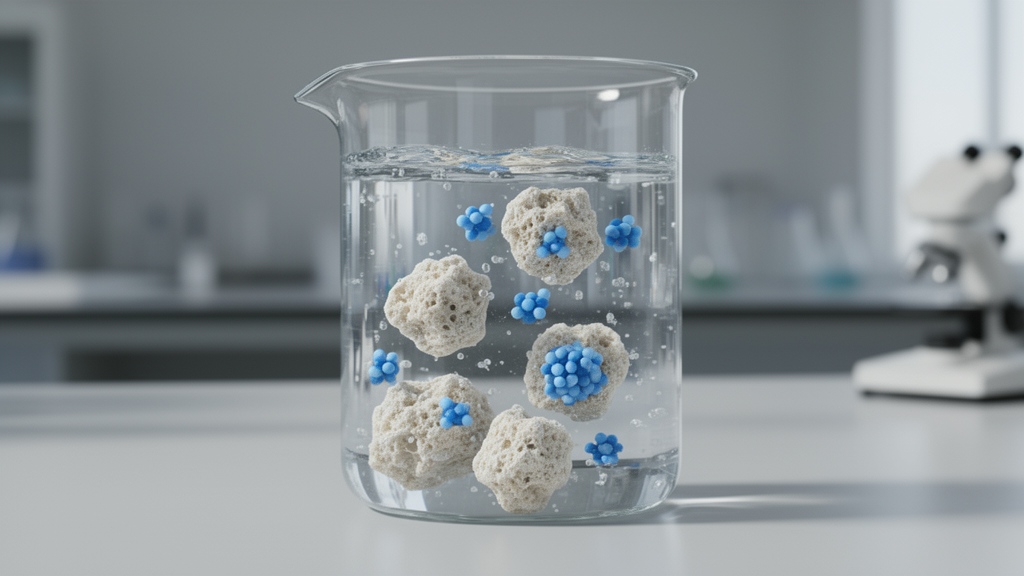
A particle-level natural zeolite modified with sodium acetate and sodium 2-ethylhexyl sulfate removed more than 90% of ammonia nitrogen from wastewater under optimal experimental conditions in a laboratory study. Designated SS@PNZ, the double-modified material also reached a maximum adsorption capacity of 9.40 mg/g, according to the reported results. The findings indicate that chemical modification can improve the material’s ability to capture ammonia nitrogen, with ion exchange identified as the dominant adsorption mechanism.

The researchers prepared SS@PNZ and evaluated its adsorption and recovery performance for ammonia nitrogen, or NH₃-N, in wastewater. An orthogonal experiment found that pH was the primary factor influencing removal efficiency. They linked this effect to pH-dependent changes in ammonia nitrogen speciation, material surface charge and ion-exchange equilibrium.

SS@PNZ’s adsorption data were consistent with the Langmuir adsorption model, and the study reported a maximum adsorption capacity of 9.40 mg/g. This fitted capacity describes the material’s performance in the tested adsorption system; it does not by itself demonstrate treatment performance in a full-scale installation. Particle-level characterization also showed that modification increased the zeolite’s specific surface area by 73% compared with unmodified particle-level natural zeolite.

Surface impurities were significantly reduced, and the pore structure became more even. The researchers associated these changes with the material’s enhanced adsorption capacity. Fourier-transform infrared spectroscopy and X-ray photoelectron spectroscopy supported a mechanism dominated by exchange between Na⁺ ions in the modified material and NH₄⁺ ions in solution.

Electrostatic adsorption involving sulfonate groups provided a supplementary contribution. The material also showed selective adsorption capacity for ammonia nitrogen when coexisting cations were present, showing that its performance was assessed beyond solutions containing ammonia nitrogen alone. After ten adsorption–regeneration cycles, the adsorption capacity remained above 60%, although the supplied findings do not clearly define that percentage against a specific reference value.

The cycle result nevertheless supports retained adsorption performance during repeated reuse. The results present SS@PNZ as a potentially useful material for ammonia-nitrogen pollution treatment because it combined high removal efficiency under the reported conditions, a maximum capacity of 9.40 mg/g, selectivity in the presence of competing cations and performance above 60% after ten regeneration cycles. The authors also characterized the material as having stability, recyclability and low economic cost.

However, the evidence is limited to a prepared material tested under defined laboratory conditions. The central measured result is that double modification altered the zeolite’s surface properties and strengthened adsorption, principally through Na⁺/NH₄⁺ ion exchange with an additional electrostatic contribution from sulfonate groups.

Subject of Research: Adsorption of ammonia nitrogen by chemically modified natural zeolite

Article Title: Adsorption mechanism of ammonia nitrogen by green-modified zeolite: a particle-Level investigation

Article References: Liu, Z., Zhang, X., Xu, N., Li, L., Shen, C., Zheng, C., & Qian, Y. (2026). Adsorption mechanism of ammonia nitrogen by green-modified zeolite: a particle-Level investigation. Journal of Materials Science, 61(40), 30631-30650. https://doi.org/10.1007/s10853-026-13630-x

Image Credits: AI Generated

DOI: 10.1007/s10853-026-13630-x

Keywords: ammonia nitrogen, natural zeolite, water treatment, adsorption, ion exchange, sodium acetate, sodium 2-ethylhexyl sulfate, surface modification, wastewater, regeneration, mechanism, ammonia

Cite Scienmag News

Denise Maddox. (October 26, 2026). Double-modified zeolite removes over 90% of ammonia nitrogen in laboratory tests. Scienmag. https://scienmag.com/double-modified-zeolite-removes-over-90-of-ammonia-nitrogen-in-laboratory-tests/


Denise Maddox. "Double-modified zeolite removes over 90% of ammonia nitrogen in laboratory tests." Scienmag, 26 October 2026, https://scienmag.com/double-modified-zeolite-removes-over-90-of-ammonia-nitrogen-in-laboratory-tests/. Accessed 26 October 2026.

Denise Maddox. "Double-modified zeolite removes over 90% of ammonia nitrogen in laboratory tests." Scienmag. October 26, 2026. https://scienmag.com/double-modified-zeolite-removes-over-90-of-ammonia-nitrogen-in-laboratory-tests/

Tags: adsorptionammoniaammonia nitrogenion exchangemechanismnatural zeoliteregenerationsodium 2-ethylhexyl sulfatesodium acetatesurface modificationwastewaterWater treatment
Share26Tweet16
Previous Post

RandomFuzzyRules: Random Search Delivers Fast, Interpretable Two-Rule Fuzzy Classifiers

Next Post

Cross-sectional blood analysis finds exploratory immune-marker differences in long COVID

Related Posts

RandomFuzzyRules: Random Search Delivers Fast, Interpretable Two-Rule Fuzzy Classifiers
Technology and Engineering

RandomFuzzyRules: Random Search Delivers Fast, Interpretable Two-Rule Fuzzy Classifiers

October 26, 2026
Mapping the MnTe–SnTe–Bi2Te3 liquidus reveals routes to tailored telluride phases
Technology and Engineering

Mapping the MnTe–SnTe–Bi2Te3 liquidus reveals routes to tailored telluride phases

October 26, 2026
Research report: Review: advances in conductive network engineering, multidimensional performance optimization, and functional design of conductive hydrogels
Technology and Engineering

Research report: Review: advances in conductive network engineering, multidimensional performance optimization, and functional design of conductive hydrogels

October 26, 2026
High-sensitivity formaldehyde gas sensor based on cobalt and indium co-doped ZnO hierarchical microspheres
Technology and Engineering

High-sensitivity formaldehyde gas sensor based on cobalt and indium co-doped ZnO hierarchical microspheres

October 26, 2026
Research report: Hot deformation behavior and microstructure evolution of 3003 aluminum alloy at low strain rate
Technology and Engineering

Research report: Hot deformation behavior and microstructure evolution of 3003 aluminum alloy at low strain rate

October 26, 2026
SnSb-silicon oxide anode sustains storage at temperatures down to −40 °C
Technology and Engineering

SnSb-silicon oxide anode sustains storage at temperatures down to −40 °C

October 26, 2026
Next Post
Cross-sectional blood analysis finds exploratory immune-marker differences in long COVID

Cross-sectional blood analysis finds exploratory immune-marker differences in long COVID

  • Mothers who receive childcare support from maternal grandparents show more optimized

    Mothers who receive childcare support from maternal grandparents show more parental warmth, finds NTU Singapore study

    27656 shares
    Share 11059 Tweet 6912
  • University of Seville Breaks 120-Year-Old Mystery, Revises a Key Einstein Concept

    1061 shares
    Share 424 Tweet 265
  • Bee body mass, pathogens and local climate influence heat tolerance

    682 shares
    Share 273 Tweet 171
  • Researchers record first-ever images and data of a shark experiencing a boat strike

    546 shares
    Share 218 Tweet 137
  • Groundbreaking Clinical Trial Reveals Lubiprostone Enhances Kidney Function

    531 shares
    Share 212 Tweet 133
Science

Embark on a thrilling journey of discovery with Scienmag.com—your ultimate source for cutting-edge breakthroughs. Immerse yourself in a world where curiosity knows no limits and tomorrow’s possibilities become today’s reality!

RECENT NEWS

  • Cross-sectional blood analysis finds exploratory immune-marker differences in long COVID
  • Double-modified zeolite removes over 90% of ammonia nitrogen in laboratory tests
  • RandomFuzzyRules: Random Search Delivers Fast, Interpretable Two-Rule Fuzzy Classifiers
  • Childhood hepatitis C burden falls worldwide but progress stalls in high-burden regions

Categories

  • Agriculture
  • Anthropology
  • Archaeology
  • Athmospheric
  • Biology
  • Biotechnology
  • Blog
  • Bussines
  • Cancer
  • Chemistry
  • Climate
  • Earth Science
  • Editorial Policy
  • Marine
  • Mathematics
  • Medicine
  • Pediatry
  • Policy
  • Psychology & Psychiatry
  • Science Education
  • Science News
  • Social Science
  • Space
  • Technology and Engineering

Subscribe to Blog via Email

Enter your email address to subscribe to this blog and receive notifications of new posts by email.

Join 5,151 other subscribers

© 2025 Scienmag - Science Magazine

Welcome Back!

Login to your account below

Forgotten Password?

Retrieve your password

Please enter your username or email address to reset your password.

Log In
No Result
View All Result
  • HOME
  • SCIENCE NEWS
  • CONTACT US

© 2025 Scienmag - Science Magazine

Discover more from Science

Subscribe now to keep reading and get access to the full archive.

Continue reading