


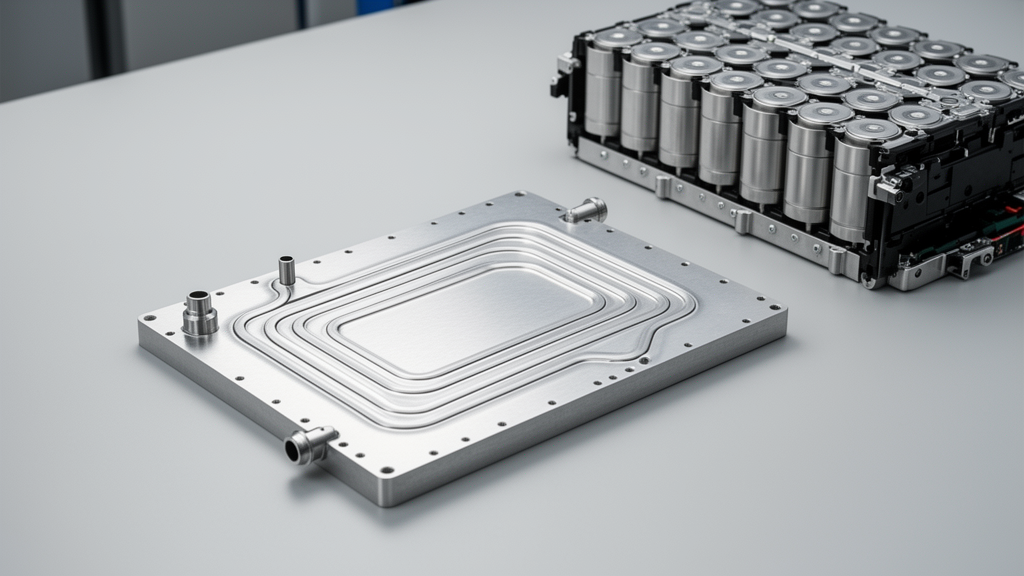
Electric vehicles live or die by the temperature of their battery cells, and one unassuming component sits at the center of that battle: the cold plate. A new mini review published in Frontiers in Mechanical Engineering argues that these liquid-cooling plates should no longer be judged by thermal performance alone. Instead, the authors, Jifa Lu and Xingxia Hao of Shandong Huayu University of Technology, propose a three-gate qualification framework that ties a plate’s channel design to its manufacturability and its fate at the end of the vehicle’s life. The review, which synthesizes recent literature with a focus on 2026 publications, makes the case that a channel improvement only becomes a supplier-ready component when thermal-hydraulic results, production evidence and recovery evidence all describe the same physical plate.
The numbers in the review illustrate why flow layout matters so much. In one modeled case involving a square plate six millimeters thick under a 2C battery load, a bidirectional flow arrangement reduced the temperature spread at the thermal interface surface from 2.0 degrees Celsius with unidirectional flow to just 0.62 degrees Celsius. A separate finned-channel study reported improvements in temperature uniformity of 33.8 percent to 41.7 percent near quasi-steady operation, depending on the operating point. These are within-study comparisons, each tied to its own cell arrangement, coolant conditions and plate dimensions, but the shared engineering lesson is clear: temperature distribution and pumping demand must be evaluated together under the same declared load and flow conditions before a design is transferred to a supplier.
The physics behind these comparisons rests on standard coupled models. Published cold-plate studies typically solve incompressible, laminar, Newtonian coolant flow alongside heat conduction in the cell and plate, using the continuity, momentum and energy equations with a volumetric heat source representing the battery. The review stresses that model interpretation requires the associated inputs. As a concrete example, one published model assessed a 22.25 ampere-hour cell at a 5C discharge rate, with water entering at 298.15 kelvin, or 25 degrees Celsius, at a velocity of 0.03 meters per second, an external convection coefficient of 5 watts per square meter kelvin, and a material table that included directional cell conductivity. Without such declared conditions, the review argues, thermal results from different studies cannot be meaningfully compared.
Channel geometry, the review emphasizes, is simultaneously a thermal decision and a production decision. Narrow turns and dense internal features affect tool access, wall thickness, cleaning and inspection. Manufacturing constraints can be built directly into topology optimization, and friction-stir channeling links channel shape and surface roughness to process settings. Additively manufactured cold plates have already been tested in battery modules, though the review cautions that prototype performance must be separated from production yield. Two design routes emerge from the literature: one starts from a flexible channel topology and adds manufacturing constraints, while the other starts from a repeatable process and optimizes within its limits. Both, the authors write, require evidence that internal channels can be measured, cleaned and sealed consistently across production lots, with rejected parts and rework data making the comparison meaningful for suppliers.
Joining introduces another layer of constraint. The review cites work on friction-stir-welded AA6061/AlSi10MgMn battery-housing joints, which connects local microstructure and post-weld heat treatment to hardness uniformity. Although that evidence concerns housings rather than plates, it informs joint qualification whenever a cold plate shares an aluminum structural boundary with the pack. Plate specifications, the authors argue, should identify the alloy, the joint process, distortion and the post-processing state. Leak testing and access for repair then determine whether the joint can meet the component duty over the vehicle’s service life.
Thermal contact is where mechanics and heat transfer collide. The pressure between the cell or module, the thermal interface material and the cold plate directly changes heat flow. A 2026 study of a battery system assembly modeled the time-dependent viscoelastic response of a pad-type thermal interface material and validated its effect on thermal contact resistance. The implication is that plate flatness and assembly preload cannot be treated as independent details; they belong in the same acceptance test as channel performance. If a supplier changes the plate process or alloy, the pack contact test may need to be repeated. Uneven preload alters the heat path between cell and plate, so the qualification record should include mounting pressure, interface thickness and the measured contact condition.
Liquid containment forms an independent gate of its own. A plate can meet every temperature target and still fail as a pack component if a channel or joint leaks. Coolant compatibility and corrosion become especially relevant when new fluids or additives are considered, and the literature on electric-vehicle battery structures shows that structural integration changes repair and separation routes. The review proposes a practical qualification sequence linking dimensional inspection, hydraulic proof and leak tests, thermal cycling, corrosion exposure, vibration and a pack-level contact test to the same part revision. This has a supply-chain consequence: a second supplier may copy nominal channel dimensions but use a different joining route, alloy temper or surface finish, and those changes can affect sealing, flatness and contact pressure. Dual sourcing, the authors contend, should compare qualified process families rather than drawings alone.
End-of-life considerations complete the framework. In one life-cycle assessment of a switchable heat-pipe cooling concept, the aluminum cooling plate contributed 86 percent of the production-phase climate impact within that system’s boundary, a figure that belongs to that specific system’s production inventory. A separate 2026 parametric pack assessment considered integration, compression and disassembly together. The message, according to the review, is that changing plate mass or integration demands a defined production and recovery boundary alongside use-phase cooling power. Integration can lower part count, but it can also make separation harder: a detachable plate can be removed as a service part, while an integrated cooling floor that shares load paths with the pack depends for its separation on the joining and bonding scheme. Useful comparisons, the authors write, should record the fasteners, adhesives or welds that must be released, the fluids that must be drained and the material streams produced, identifying which operations can be completed without damaging cells or structural members.
The three gates themselves are straightforward to state. Gate one covers thermal-hydraulic performance: maximum temperature, temperature spread, pressure drop and mass under a declared battery and coolant duty cycle. Gate two covers production integrity: channel geometry, wall and joint features, allowable defects, leakage and contact performance for production-representative parts. Gate three covers circularity: access, drainage, separation steps and material identity at pack end of life. A design passes the chain only when evidence for all three gates refers to the same configuration, a discipline the review says prevents model, prototype and vehicle results from being compared as if they were interchangeable. The gates can be captured in a single component evidence sheet identifying the plate drawing revision, alloy and stock form, forming and joining route, coolant, thermal interface material, cell format and test duty cycle, linked to measured temperatures and pressures, leak-test results, dimensional inspection and end-of-life separation steps.
The review closes with a research agenda that reads like a checklist for the next generation of cold plates. The authors call for matched thermal benchmarks that publish geometry, coolant properties, heat input and boundary conditions together; durability tests that follow the same plate-joint-interface assembly through thermal and pressure cycles while recording leakage, contact resistance and failure location; and final disassembly tests that measure access time, drainage, separation and recovered alloy streams. Experimental evidence, they add, is strongest when measurement uncertainty and model disagreement are reported separately, with sensor calibration, flow and pressure measurement, mesh studies and parameter studies documented alongside predicted and measured temperatures. If the industry adopts such a common qualification record, the review concludes, moving production to another site or switching suppliers becomes a controlled engineering comparison rather than a leap of faith that nominally similar plates are truly equivalent.
Subject of Research: Battery cold plate design, manufacturing and recovery for electric vehicle thermal management
Article Title: A review of battery cold plates for electric vehicles: design, manufacturing, and recovery
Article References: Lu, J., & Hao, X. (2026). A review of battery cold plates for electric vehicles: design, manufacturing, and recovery. Frontiers in Mechanical Engineering, 12, Article 2012434. https://doi.org/10.3389/fmech.2026.2012434
Image Credits: AI Generated
DOI: 10.3389/fmech.2026.2012434
Keywords: battery cold plates, electric vehicles, thermal management, liquid cooling, topology optimization, friction stir welding, thermal interface materials, life-cycle assessment, supplier qualification, battery recycling, design for manufacturing, circular design
Cite Scienmag News
Faith Mcneil. (October 26, 2026). Battery Cold Plates Get a Three-Gate Makeover for Electric Vehicle Packs. Scienmag. https://scienmag.com/battery-cold-plates-get-a-three-gate-makeover-for-electric-vehicle-packs/
Faith Mcneil. "Battery Cold Plates Get a Three-Gate Makeover for Electric Vehicle Packs." Scienmag, 26 October 2026, https://scienmag.com/battery-cold-plates-get-a-three-gate-makeover-for-electric-vehicle-packs/. Accessed 26 October 2026.
Faith Mcneil. "Battery Cold Plates Get a Three-Gate Makeover for Electric Vehicle Packs." Scienmag. October 26, 2026. https://scienmag.com/battery-cold-plates-get-a-three-gate-makeover-for-electric-vehicle-packs/


