


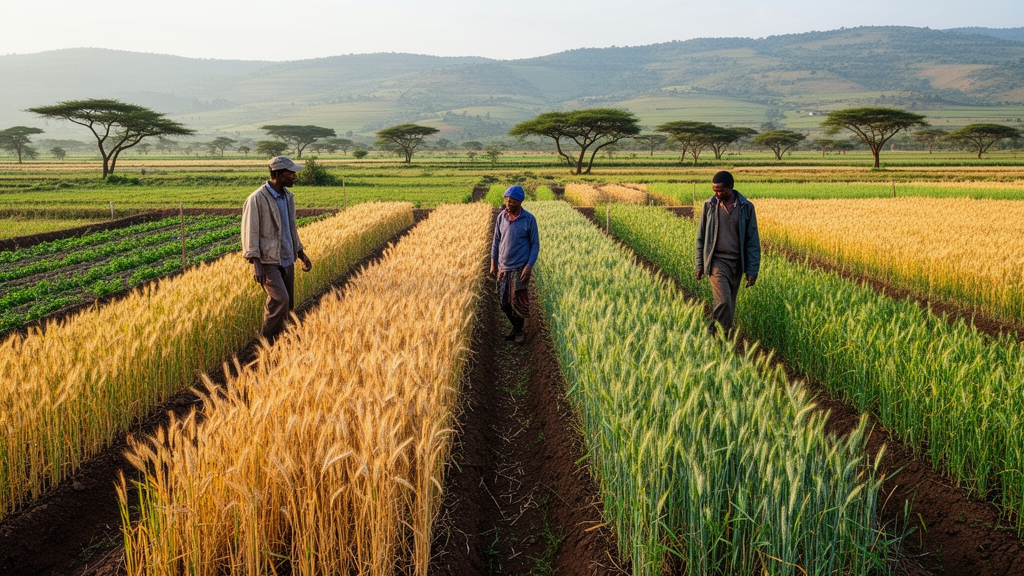
Four released food barley genotypes—G8, G9, G14 and G15—showed favorable combinations of grain yield and yield stability across 17 diverse Ethiopian environments in a two-year multi-environment field trial. The researchers analyzed 20 released varieties during the 2023 and 2024 main cropping years, using a randomized complete block design with three replications at each location. Their combined analysis of variance, Additive Main Effects and Multiplicative Interaction model, AMMI Stability Value, Yield Stability Index and Genotype plus Genotype × Environment biplot analysis identified G8, G9, G14 and G15 as the strongest candidates for further validation across similar Ethiopian highland barley-growing agro-ecologies.
The results distinguish stable performance from a single genotype with the highest trial-wide average. G2 recorded the greatest mean grain yield at 3.28 tonnes per hectare, but its comparatively lower stability indicated that its performance was less consistent across the tested environments. G11 had the lowest mean yield, at 1.91 tonnes per hectare. Average grain yield among the 17 test environments ranged from 1.44 tonnes per hectare at Ambo to 3.17 tonnes per hectare at Debre Markos. Thus, the trial captured substantial differences among environments as well as differences among barley genotypes, with G2 emerging as the leading genotype when maximizing average yield was the primary criterion.
Combined analysis of variance found highly significant effects for every source of variation examined, with all reported P values below 0.0001. Environment accounted for 33.06% of the total variation in the ANOVA, year for 10.62%, genotype for 8.00%, environment × year for 13.44%, genotype × environment interaction for 10.72%, genotype × year for 2.84%, and genotype × environment × year for 6.40%. In the pooled AMMI analysis, environment represented 61.47% of total variation, genotype represented 7.09%, and genotype × environment interaction represented 16.58%. The interaction component indicates that the relative performance of the barley genotypes was not constant across the locations and years included in the trial.
Two complementary measures of performance gave similar results. The AMMI Stability Value identified G8, G9, G14 and G15 as genotypes with favorable yield and stability across the evaluated environments. The Yield Stability Index placed G8 and G14 first for their combination of grain yield and stability, followed by G9 and G15. The GGE biplot analysis divided the 17 environments into three mega-environments, corresponding to distinct groups of test locations with related genotype responses. It also identified Holeta, designated E11, as both highly discriminative and representative of the overall set of environments. On that basis, the study identified Holeta as a suitable core testing environment for future Ethiopian barley evaluation programs.
These findings are limited to the released genotypes, growing environments and two cropping years included in the trial; they do not establish that the four leading candidates will perform identically at untested locations or under different management conditions. The researchers therefore described G8, G9, G14 and G15 as promising candidates requiring further validation and wider evaluation, particularly in the cool sub-humid and humid Ethiopian highland agro-ecologies represented by the test sites. G2 may be better suited to favorable production environments where maximum yield is the main objective, while its yield potential could also make it a potential parent when crossed with stable, broadly adapted material. More broadly, the results distinguish four genotypes suited to evaluating broad adaptation from one with stronger specialization in favorable environments, while identifying a single site that could improve the efficiency of subsequent national barley breeding trials.
Subject of Research: Multi-environment evaluation of food barley yield and genotype-by-environment interaction in Ethiopia
Article Title: Genotype × environment interaction and yield stability of food barley (Hordeum vulgare L.) varieties using AMMI and GGE biplot models
Article References: Alamerew, S., Hailu, W., Fekadu, W., Sebssibe, H., Hassen, M., Taye, K., Robsa, A., Mekasa, W., Wale, S., Amare, A., Workie, A., Tadesse, T., Gurumu, F., & Semahegn, Y. (2026). Genotype × environment interaction and yield stability of food barley (Hordeum vulgare L.) varieties using AMMI and GGE biplot models. BMC Plant Biology. https://doi.org/10.1186/s12870-026-09830-x
Image Credits: AI Generated
DOI: 10.1186/s12870-026-09830-x
Keywords: food barley, yield stability, multi-environment trial, Ethiopian highlands, AMMI analysis, GGE biplot, genotype-by-environment interaction, grain yield, crop breeding, agroecological adaptation, Genotype, environment
Cite Scienmag News
Alan Morgan. (October 26, 2026). Four barley genotypes combine yield and stability across 17 Ethiopian environments. Scienmag. https://scienmag.com/four-barley-genotypes-combine-yield-and-stability-across-17-ethiopian-environments/
Alan Morgan. "Four barley genotypes combine yield and stability across 17 Ethiopian environments." Scienmag, 26 October 2026, https://scienmag.com/four-barley-genotypes-combine-yield-and-stability-across-17-ethiopian-environments/. Accessed 26 October 2026.
Alan Morgan. "Four barley genotypes combine yield and stability across 17 Ethiopian environments." Scienmag. October 26, 2026. https://scienmag.com/four-barley-genotypes-combine-yield-and-stability-across-17-ethiopian-environments/


